Colorado Fence Laws: Property Lines & Neighbor Rights
Overview: Colorado fence laws are primarily governed by state livestock statutes and long-standing fence-out principles, with additional authority given to counties and municipalities. In many rural areas, landowners are expected to protect their property from roaming livestock unless local rules say otherwise—while residential and suburban areas often follow very different standards.
Key Points:
- Fence-Out Rule: In much of rural Colorado, landowners must fence livestock out to claim damages.
- Livestock Liability: Livestock owners may still be liable if animals escape through negligence or violate local ordinances.
- Boundary Fences: A fence does not automatically establish a legal property line.
- Local Control: Counties and cities can impose stricter fence, height, and material rules.
When The Headaches Start Adding Up: If fence disputes, upkeep responsibilities, or boundary questions keep dragging on, it may be time to explore a direct cash offer for your Colorado land and move forward without the legal back-and-forth.
How Fence Laws Work in Colorado
Colorado does not apply a single fence rule statewide. Instead, state law sets the baseline, especially for agricultural land and livestock, while counties and municipalities are free to add stricter regulations. This layered system explains why two neighbors can live a few miles apart and be subject to completely different fence obligations. Understanding which rules apply to your property is the first step in resolving any dispute.
Major Colorado Fence Laws
Fence-Out vs. Fence-In Rules in Colorado
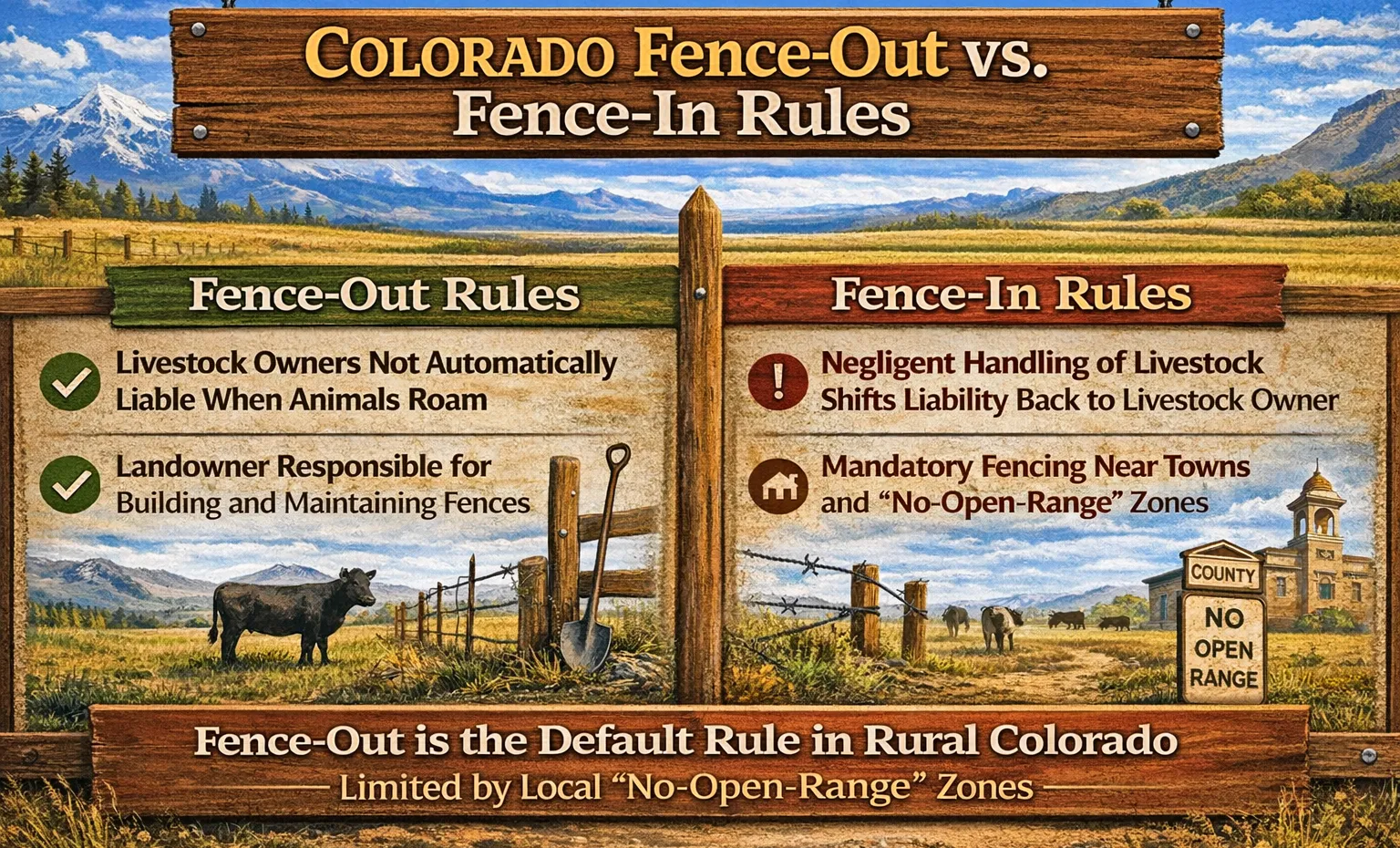
Colorado is traditionally considered a fence-out state for livestock. That means, in many rural areas, livestock owners are not automatically responsible when animals wander onto unfenced land. If a landowner wants to prevent livestock intrusion, the burden is often on that landowner to build and maintain a lawful fence.
However, this does not grant unlimited freedom to livestock owners. Negligent handling, broken enclosures, or violations of county stock laws can shift liability back to the livestock owner. Local “no-open-range” zones near towns and subdivisions frequently override the default rule.
Who Is Responsible for Building and Maintaining a Fence?
Responsibility depends on the type of fence and its purpose, not simply who built it.
Private Fences
A private fence built solely for one owner’s benefit—such as enclosing a yard or garden—is typically that owner’s responsibility. Neighbors are not required to contribute to construction or upkeep unless a specific agreement exists.
Boundary (Partition) Fences
Boundary fences located along a shared property line do not automatically create shared responsibility in Colorado. Cost-sharing usually arises only through written agreements, local ordinances, or long-standing mutual use. Assuming your neighbor must pay half without confirming legal authority is a common—and costly—mistake.
What If My Neighbor’s Fence Is on My Property?
Removing or altering a fence without proper documentation can create legal exposure. Before taking action, it is critical to confirm the boundary with a survey, document the fence’s location, and review local rules. Even if a fence appears misplaced, self-help remedies can escalate disputes and increase liability.
Local Rules, Counties, and HOA Exceptions
Colorado grants significant authority to counties, cities, and HOAs. Many municipalities regulate fence height, materials, setbacks, and permits, especially in residential zones. HOAs can impose even stricter standards through covenants. Always verify local ordinances before assuming state law controls your situation.
How Colorado Courts View Fence Disputes
Courts focus less on who feels wronged and more on documented facts: land use, location, local rules, and evidence of negligence. Fence disputes frequently turn on surveys, written agreements, and whether either party violated a statute or ordinance. Assumptions based on tradition rarely hold up without proof.
Fence Law Checklist for Colorado Landowners
- Confirm Local Rules: Check county or city ordinances before relying on state law alone.
- Identify Fence Type: Determine whether the fence is private or along a boundary.
- Livestock Context: Know whether fence-out or fence-in rules apply to your area.
- Survey First: Verify property lines before moving or removing any fence.
- Document Everything: Photos, maps, and written communication matter.
🛠️ Free Resource: The Professional Fence & Boundary Audit 🛠️
Don’t risk legal liability or neighbor disputes by guessing. We’ve developed this comprehensive 4-phase field guide to help you audit boundaries, verify compliance, and document communication like a pro.
📥 Download the Printable PDF Audit
Print this out to use as a worksheet while you walk your property line.
Colorado Fence Law Case Studies: Real Court Decisions
These Colorado cases show how fence disputes are actually resolved in practice. Colorado courts don’t treat a fence as automatically “the boundary” just because it’s been there a long time. Instead, judges focus on deeds and surveys, plus whether both neighbors clearly treated a fence as the boundary for the required period under Colorado’s boundary-by-acquiescence statute (often discussed in connection with C.R.S. § 38-44-109).
Hartley v. Ruybal (1966)
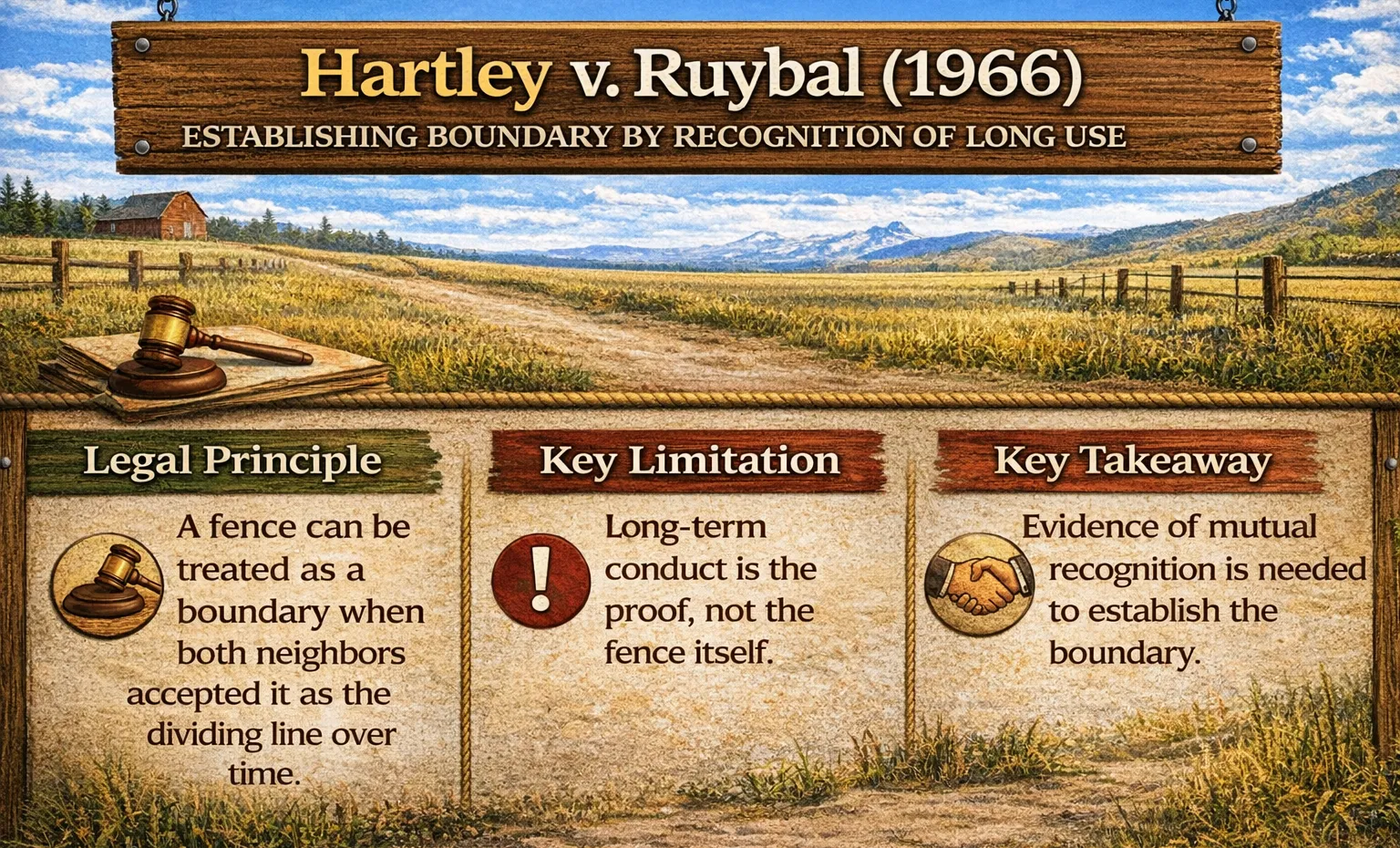
In Hartley v. Ruybal, neighbors fought over where the true boundary line belonged when a fence line had been treated as the dividing line over time. The Colorado Supreme Court emphasized that whether a fence has been treated as the boundary is a fact-driven question based on the parties’ conduct—not just the fence’s existence.
Salazar v. Terry (1996)
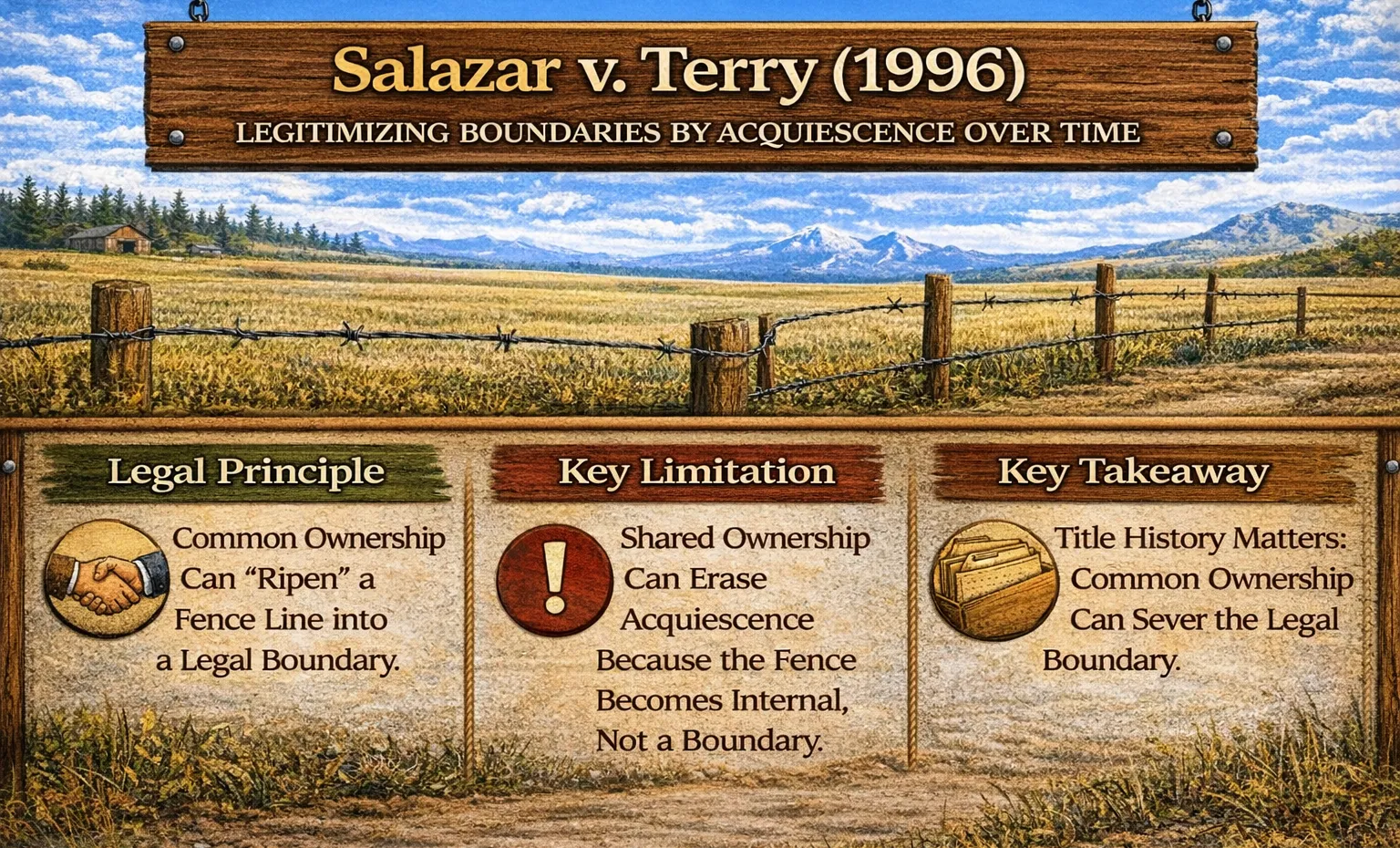
In Salazar v. Terry, the dispute centered on whether a fence that prior owners had treated as the boundary for decades should override the deeded/surveyed line. The Colorado Supreme Court explained that even if prior owners had acquiesced to a fence as a boundary, a later period of common ownership of both parcels can eliminate the fence’s legal significance as an “external boundary” between two separately owned properties (unless later documents clearly adopt the fence line again).
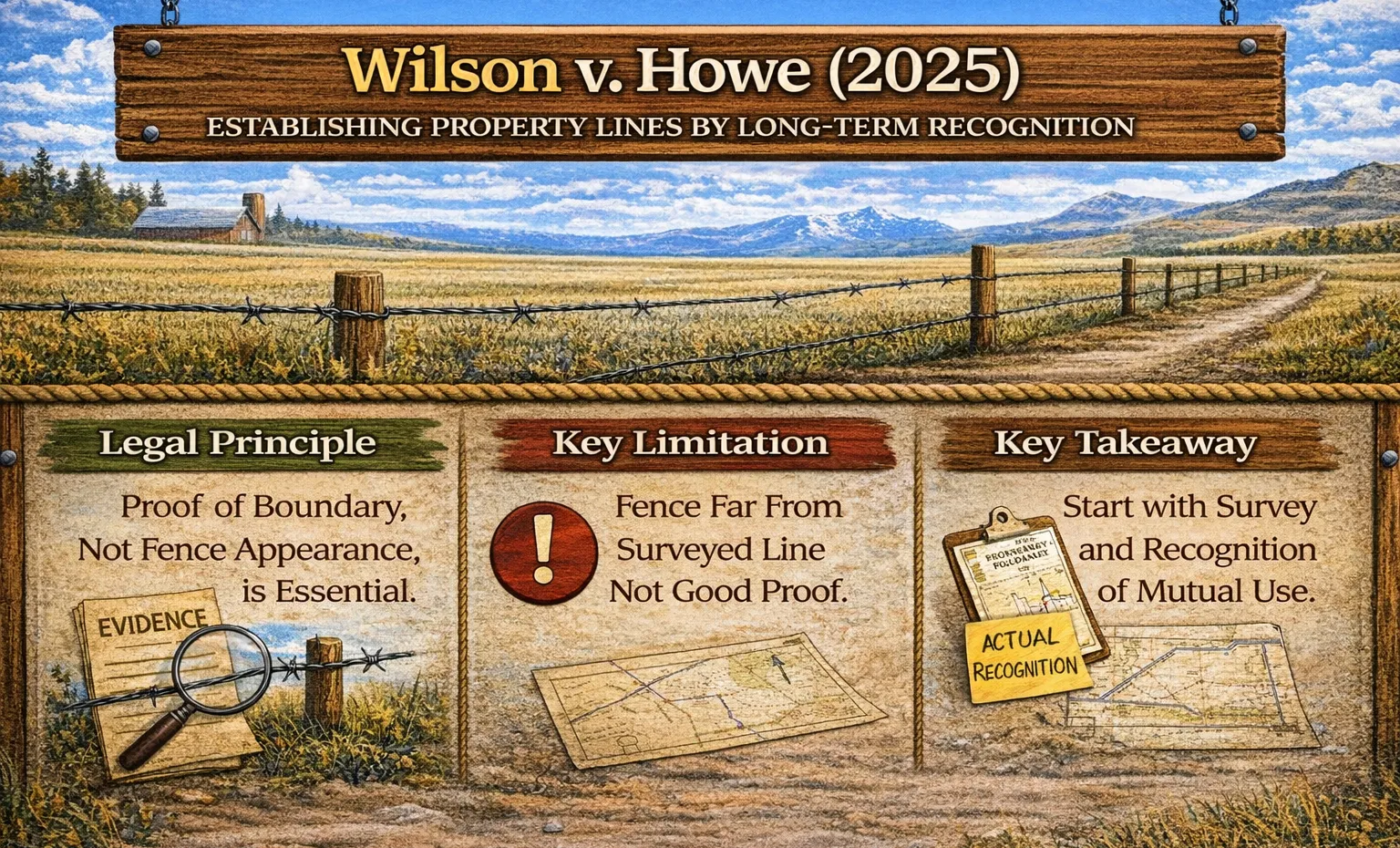
Wilson v. Howe (2025)
In Wilson v. Howe, the court dealt with an argument that a fence “looked like” a boundary fence and should be treated as the property line. The Colorado Court of Appeals rejected that approach, stressing that the mere existence of a fence is not enough. The party claiming boundary-by-acquiescence must show that owners actually treated the fence as the dividing line for the statutory period and that the fence functioned as a boundary between the parcels—not just a barrier located somewhere on one property.
FAQs
Do I have to pay for half of my neighbor’s fence in Colorado?
Usually no. Colorado does not have a blanket law requiring neighbors to split fence costs. Cost-sharing typically applies only when there is a written agreement, a court order, or a local ordinance that specifically requires shared responsibility. If a fence was built solely for your neighbor’s use, you are generally not obligated to pay for it.
Is Colorado considered an open-range or fence-out state?
Yes, in many rural areas. Colorado follows a traditional fence-out approach for livestock, meaning landowners may be responsible for fencing animals out if they want to prevent entry. However, this rule is frequently overridden by county stock laws and municipal ordinances, especially near towns, subdivisions, and developed areas where livestock owners may be required to fence animals in.
Can I remove or move a fence that I believe is on my property?
Not without confirming the boundary first. Removing a fence based on assumption can expose you to civil liability if the fence is later shown to be on the true boundary or on your neighbor’s land. A professional survey, documentation, and review of local regulations should come before any physical action.
Does an existing fence establish legal ownership of the land?
No. In Colorado, property ownership is determined by recorded deeds and surveys—not by fence placement. While a long-standing fence can become evidence in certain disputes, it does not automatically change legal boundaries or transfer ownership.
Do HOA or city fence rules override Colorado state fence laws?
Yes. Municipal ordinances and HOA covenants can impose stricter requirements on fence height, materials, placement, and permits than state law. When applicable, these local rules control—even if state statutes would allow something different in rural or agricultural settings.
Conclusion
Colorado fence laws are highly situational, shaped by land use, livestock rules, boundary documentation, and local authority. Acting on assumptions—rather than confirmed rules—can quickly turn a simple fence issue into a costly dispute. Taking the time to identify which laws actually apply to your property is the safest way to protect your rights and avoid escalation.
For landowners who decide that ongoing fence disputes, unclear boundaries, or neighbor conflicts are no longer worth managing, options like selling Colorado land can offer a clean break without continued legal uncertainty.
Beyond the Colorado: Regional Boundary Laws
Managing rural acreage outside of Colorado requires a thorough understanding of different agricultural statutes and boundary dispute regulations. Whether you are dealing with open range traditions in Wyoming or shared partition fences across the plains of Nebraska, local codes strictly dictate your responsibilities as a landowner. Explore our comprehensive guides below to confidently manage property lines and livestock containment rules across the Rocky Mountains and Great Plains.
- Nebraska Boundary Regulations: Review the Cornhusker State’s specific requirements for agricultural enclosures and neighbor dispute resolution.
- Oklahoma Partition Fence Guide: Master the Sooner State’s “Closed Range” system and what it means for containing livestock on your rural acreage.
- South Dakota Property Line Laws: Navigate the Mount Rushmore State’s rules regarding partition fences and shared maintenance responsibilities between rural neighbors.
- Utah Livestock Fencing Rules: Understand the Beehive State’s agricultural codes governing shared property lines and neighbor liability.
- Wyoming Fence Statutes: Learn how the Equality State balances open range traditions with legal fencing requirements to protect rural landowners.