How to Subdivide Land in Alaska: A Practical Guide for Large Acreage
Overview: Subdividing land in Alaska is uniquely governed depending on whether your property is located within an organized borough or the vast Unorganized Borough managed by the state.
Key Points:
- Jurisdictional Control: Organized boroughs handle their own platting regulations and zoning codes. The State of Alaska Department of Natural Resources (DNR) oversees platting for the Unorganized Borough.
- Split Estates: Landowners must carefully verify surface and subsurface rights, as these are frequently separated across Alaskan properties.
- Environmental Compliance: The Department of Environmental Conservation (DEC) enforces strict regulations for water and septic systems on all newly created lots.
- Substantial Investment: Splitting land requires significant upfront capital for professional land surveyors, soil engineering, and bureaucratic fees before final approval is granted.
Side Note: If the high surveying costs, environmental testing, and lengthy platting board delays feel overwhelming, many landowners prefer to sell their Alaska land directly for cash to bypass the bureaucratic headache entirely.
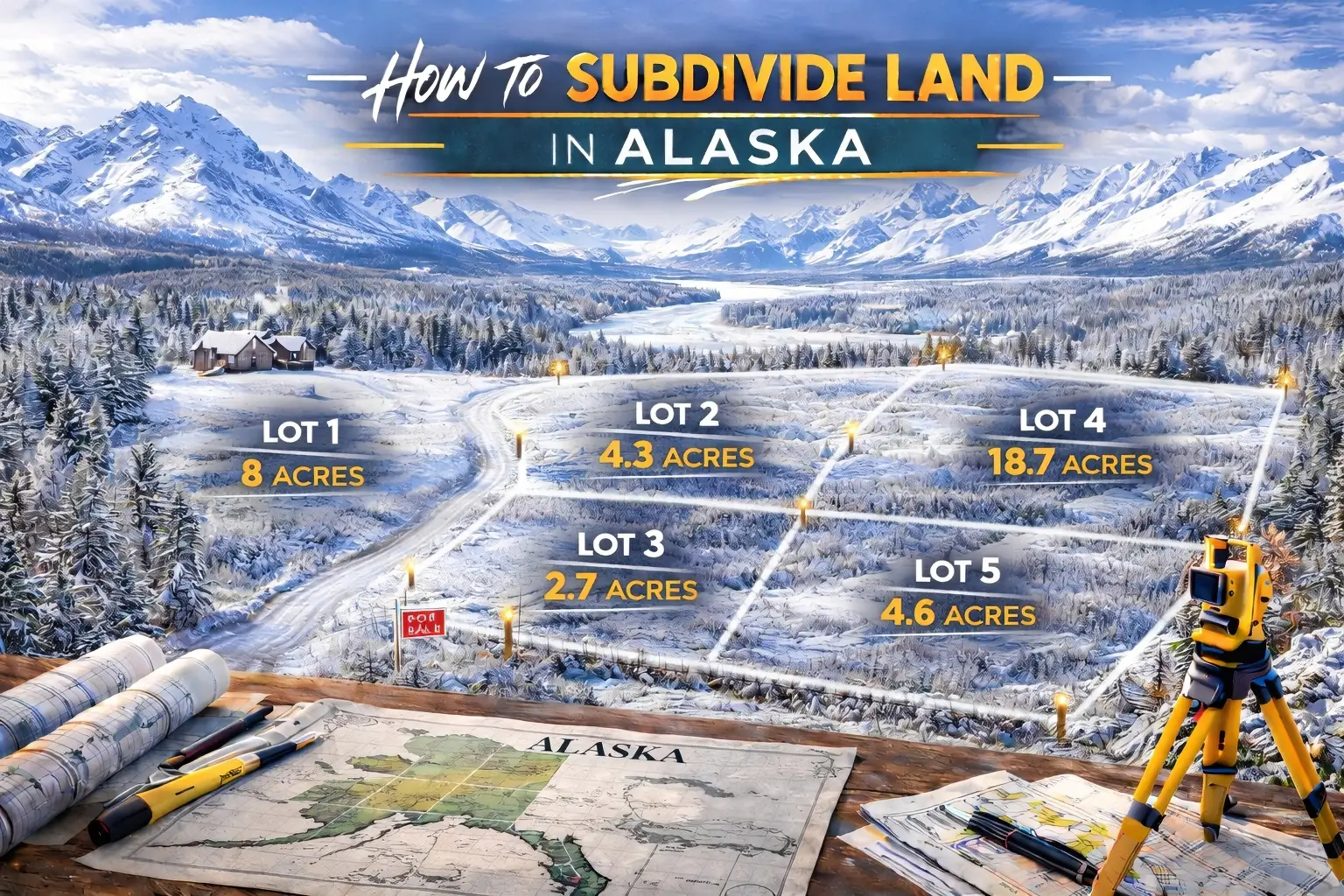
As a landowner in the Last Frontier, splitting your property into smaller parcels can unlock significant value. Alaska presents a highly specific set of rules for platting and subdividing rural acreage. The state manages vast tracts of unorganized land, requires rigorous environmental testing for septic systems, and frequently deals with split estate rights.
This guide outlines exactly what you need to know to successfully navigate the subdivision process in Alaska. We will cover jurisdictional rules, environmental requirements, surveying steps, and the precise costs involved.
Understanding Alaska’s Unique Land Subdivision Process
Alaska operates under a specific framework of organized boroughs and a massive Unorganized Borough. This distinction dictates exactly who controls the platting process for your property.
Boroughs vs. the Unorganized Borough
- Organized Boroughs: If your land is located within an organized municipality like the Matanuska-Susitna Borough or the Kenai Peninsula Borough, you must submit your subdivision application directly to their local platting board. Each borough enforces its own zoning codes and minimum lot sizes.
- The Unorganized Borough: If your property falls outside of a structured local government, the State of Alaska Department of Natural Resources (DNR) acts as the platting authority. You will submit your paperwork to the DNR Division of Mining, Land and Water.
The Reality of Split Estate Land Rights
Surface rights and subsurface rights are frequently split in Alaska. You must verify that you hold the correct property rights before attempting to parcel out hunting land or timberland. A title search will confirm your exact ownership structure and reveal any existing easements or Native Corporation land boundaries that could impact your project.
Step 1: Determine Your Platting Jurisdiction and Feasibility
The first phase of subdividing requires thorough research to ensure your project is legally and financially viable.
Title Search and the Certificate to Plat
Platting authorities require a Certificate to Plat before approving a subdivision. A title company generates this document to prove you are the legal owner and to identify any liens, restrictive covenants, or easements. The certificate is typically only valid for 90 days after issuance, so you must time this step carefully with your application submittal.
Zoning and Minimum Lot Sizes
Local zoning laws dictate the minimum allowable acreage for new parcels. You must check with your local planning department or the DNR to confirm road access rules and minimum lot dimensions for your specific zoning district.
Step 2: Navigate the Department of Environmental Conservation Rules
The Alaska Department of Environmental Conservation (DEC) tightly controls water supply and wastewater regulations. You must ensure each new parcel can legally support a well and a septic system.
- Soil and Percolation Tests: You must hire a registered engineer to evaluate the soils and perform a percolation test. This proves the land can absorb wastewater safely.
- Separation Distances: DEC regulations strictly enforce minimum separation distances between wells, septic tanks, and surface water.
- Documentation of Construction: You can learn more about wastewater engineering and compliance on the Alaska DEC Wastewater Engineering site to ensure your new parcels meet all state environmental codes.
Step 3: Hire a Professional Land Surveyor
State law requires you to hire a licensed professional land surveyor to legally divide your property. Boundary adjustments and new parcel creation require exacting precision.
Field Surveying and Monumentation
The surveyor will conduct physical fieldwork to locate existing property corners. They must set permanent monuments, typically capped rebar, at the corners of every new lot to comply with state platting standards.
Drafting the Preliminary Plat
The surveyor will draft a preliminary plat map. This technical drawing includes:
- Exact boundary lines and topographic features.
- Acreage calculations for each new lot.
- Proposed easements for utilities and road access.
Step 4: Submit the Subdivision Application
Once your surveyor completes the preliminary plat, you will submit the formal subdivision application to your local borough or the DNR.
Required Documents for Submittal
A complete application package typically requires:
- The preliminary plat map.
- Completed application forms and paid filing fees.
- The Certificate to Plat.
- Proof of legal access to all new parcels.
- Topographic and soils information for DEC review.
Agency Review and Public Comment
The platting authority will circulate your application to government agencies like the Department of Transportation and the DEC. The authority will also mail notices to neighboring property owners within a specific radius. Neighbors have the right to voice concerns or objections at a scheduled public hearing.
Step 5: Final Plat Approval and Recording
The final phase transforms your preliminary map into legally recognized parcels.
The Platting Authority Decision
The platting board will vote to approve the plat, deny it, or require specific modifications. If approved, the surveyor will draft the final plat incorporating any required changes.
Recording with the State of Alaska
The final plat requires signatures from the surveyor, the property owner, and a notary public. The document is then officially filed with the Alaska Department of Natural Resources Recorder’s Office. This recording officially creates the new legal descriptions and property tax ID numbers.
How Much Does It Cost to Subdivide Land in Alaska?
Subdividing land requires significant upfront capital. Costs vary widely based on the location, size, and terrain of your rural acreage. Here is an itemized breakdown of the estimated expenses you will encounter:
- Professional Land Surveyor: $3,000 to $10,000+ (Varies heavily by parcel size and remote access requirements)
- Title Search and Certificate to Plat: $300 to $600
- Application and Platting Fees: $500 to $1,500 (Base fee plus a per-lot charge)
- DEC Review and Soil Engineering: $1,000 to $3,000 (Required for septic and well approval)
- State Recording Fees: $50 to $150
- Total Estimated Cost: $4,850 to $15,250+
Common Reasons to Subdivide Rural Land in Alaska
Landowners choose to navigate this complex process for several strategic reasons.
Divesting Inherited Property
Heirs frequently inherit massive tracts of land. Subdividing allows a family to split the asset equally or sell off portions while retaining a core homestead.
Maximizing Hunting Land and Timberland
Large acreage often sells at a lower price per acre than smaller lots. Carving a massive timber tract into smaller 5 to 10 acre recreational parcels can significantly increase the total gross return on the property.
A Faster Alternative: Sell Your Alaska Land As Is for Cash
Subdividing land in Alaska is a time-consuming and expensive bureaucratic process. Between hiring surveyors, waiting on DEC approvals, and paying thousands in upfront fees, splitting a parcel can take several months to well over a year. If your goal is simply to divest an unwanted rural property, there is a much simpler solution that completely bypasses the local platting board and traditional real estate listings.
Bubba Land Company provides a hassle-free, direct cash sale for landowners who want to avoid the steep costs and long timelines of subdividing. We buy vacant rural acreage, timberland, and hunting land nationwide in its current condition. Request a fast, fair cash offer today and sell your land in Alaska directly to us.