How to Subdivide Land in Arizona: Fast Moves, Hidden Rules
Overview: Subdividing land in Arizona is primarily regulated by state statutes that distinguish between municipal and unincorporated county jurisdictions, making the “Rule of 5” the most critical factor for landowners.
Key Points:
- The Rule of 5: Local counties manage splits of five or fewer lots. Creating six or more parcels requires formal state approval.
- Local Zoning Dictates Size: Current county zoning laws determine your exact minimum lot sizes and legal access requirements.
- Required Upfront Investment: Landowners pay directly for licensed surveyors, application fees, and required soil tests before gaining approval.
Alternative Option: If the upfront surveyor fees, county red tape, and lengthy approval timelines seem overwhelming, many property owners simply sell their Arizona land for cash to avoid the subdivision process entirely.
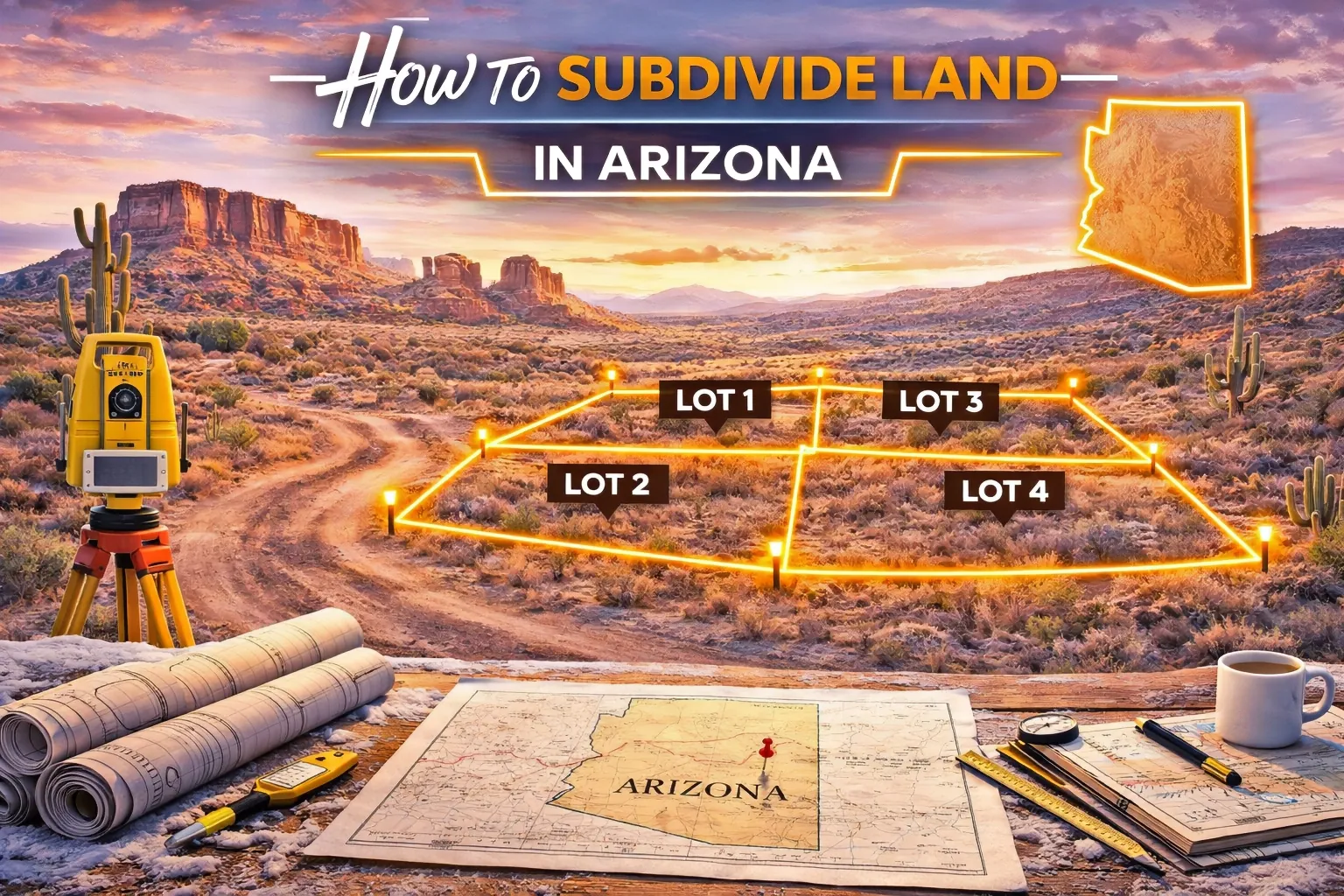
Dividing a large parcel of land in Arizona can unlock significant hidden value for property owners. The process involves navigating a strict set of state laws, county ordinances, and hidden fees. Whether you want to carve out a single lot for a family member or split a larger rural acreage for investment purposes, understanding the legal framework is mandatory.
This guide provides a comprehensive breakdown of Arizona land division laws, the local approval processes, and a dedicated cost analysis to help you execute a successful property split.
Understanding Arizona Land Division Laws: The Rule of 5
The most critical concept to understand when subdividing land in Arizona is the legal difference between a “Minor Land Division” and a “Major Subdivision.” State law draws a hard line based on the number of parcels you intend to create.
Minor Land Divisions (5 or Fewer Lots)
If you are splitting a property in an unincorporated county area into five or fewer parcels, it qualifies as a Minor Land Division. Counties operate under Arizona Revised Statutes Section 11-809, which grants local Boards of Supervisors the authority to regulate these smaller splits. The process requires less bureaucratic red tape than a major development. Municipalities, such as incorporated cities or towns, may have even stricter rules. Some city ordinances limit minor splits to just three lots before triggering heavy subdivision rules.
Major Subdivisions (6 or More Lots)
The moment you divide a single parcel into six or more lots, you enter the territory of a Major Subdivision. This triggers strict oversight from the state. You will be required to submit extensive engineering plans, conduct traffic and drainage studies, and secure a Subdivision Public Report from the Arizona Department of Real Estate. You cannot legally market or sell any of these lots until this public report is issued.
The “Acting in Concert” Warning
Arizona law strictly prohibits “wildcat subdivisions.” This occurs when a landowner or a group of people act in concert to secretly bypass the five-lot limit. You cannot split your land into four lots, sell one to a friend, and then have that friend immediately split their new lot into three more. If the county or state determines that multiple parties are conspiring to create six or more lots through a series of rapid transactions, severe legal and financial penalties will follow.
Local Approval Requirements for a Minor Land Division
Even if you keep your land split under the six-lot threshold, you cannot simply draw lines on a map and start selling acreage. County Development Services and Planning Departments require you to meet specific baseline standards.
- Zoning and Minimum Lot Sizes: Every newly created parcel must meet the minimum acreage requirements of your current zoning district. If your property is zoned for a minimum of ten acres, you cannot legally split a 15-acre parcel into two lots.
- Legal and Physical Access: Counties require proof that every new lot has guaranteed legal access, usually through a recorded easement. The access must also be physical and traversable by a standard two-wheel-drive passenger vehicle. You cannot create a landlocked parcel in Arizona.
- Utility Easements: You must designate and record appropriate utility easements so future owners can access power, water, and internet infrastructure.
- Water Adequacy: Depending on your location and whether you are inside an Active Management Area (AMA), you may need to prove an adequate or assured water supply through the Arizona Department of Water Resources before the county approves your split.
The Step-by-Step Subdivision Process
Completing a Minor Land Division in Arizona requires coordination between professionals and local government offices. Follow these standard steps to ensure compliance.
Step 1: Conduct Preliminary Research
Start by pulling your current property deed and checking your county zoning maps. Verify your current zoning designation and calculate exactly how many conforming lots you can legally create based on the total acreage.
Step 2: Hire a Registered Land Surveyor
You must hire an Arizona Registered Land Surveyor (R.L.S.) to draft the new boundaries. The surveyor will physically mark the property lines, locate existing easements, and produce a formal Minor Land Division map that meets county formatting standards.
Step 3: Submit the Minor Land Division Application
File your application with your county’s Planning and Development Services department. You will need to provide the application fee, the surveyor’s map, proof of legal access, and a title report proving ownership. The county will conduct an administrative review to ensure all zoning and access requirements are met.
Step 4: Record the New Deeds
Once the county approves the Minor Land Division permit, the split is still not complete. You must record the approved map and the newly drafted deeds with the County Recorder’s Office. Afterward, the County Assessor will assign new, distinct Assessor’s Parcel Numbers (APNs) to each new lot.
Dedicated Cost Breakdown to Subdivide Land
The financial commitment to subdivide land varies wildly based on your property size, the complexity of the terrain, and your specific county. Below is an itemized breakdown of the typical costs associated with a standard Minor Land Division in Arizona.
These estimates reflect the administrative and professional fees required just to establish the legal lot lines. They do not include physical infrastructure improvements like paving roads, extending utility lines, or drilling wells, which add tens of thousands of dollars to your project.
| Expense Category | Estimated Cost Range | Description |
|---|---|---|
| Registered Land Surveyor | $1,500 to $5,500+ | The largest upfront expense. Costs scale with total acreage, difficult terrain, and the availability of historical survey monuments. |
| County Application Fees | $150 to $600 | Processing fees charged by the county planning department. Some counties charge a base fee plus an additional amount per new lot created. |
| Title and Deed Preparation | $300 to $800 | Fees paid to a title company or real estate attorney to draft the new legal descriptions and deeds for recording. |
| County Recording Fees | $30 to $100 | Standard administrative fees paid to the County Recorder to officially register the new maps and deeds. |
| Percolation (Perc) Tests | $500 to $1,500 | Often required if the new lots will rely on septic systems to prove the soil can absorb effluent. |
| Total Estimated Base Cost | $2,480 to $8,500+ | The baseline capital required to execute a Minor Land Division legally. |
Is Subdividing Your Arizona Land Worth It?
Taking a large parcel through the Minor Land Division process can be highly profitable. Smaller lots often sell for a higher price per acre than massive, undivided tracts. Subdividing makes your property accessible to a larger pool of retail buyers who may be looking for a two-acre homestead rather than a forty-acre ranch.
The primary drawbacks are the upfront capital requirements and the timeline. Finding an available surveyor, passing county reviews, and finalizing the deed work can take several months. If your land lacks clear physical access or requires extensive brush clearing just to run a survey line, the costs climb rapidly.
A Faster Alternative for Landowners
Subdividing Arizona land requires significant time, upfront capital, and strict regulatory compliance. For property owners looking to liquidate their asset without the bureaucratic delays of county planning departments, selling the parcel whole provides immediate liquidity and peace of mind.
Bubba Land Company provides a direct, “as-is” cash buyout for your vacant rural acreage. We cover all closing costs and manage the entire transaction from start to finish. To bypass the surveyor fees and permit applications entirely, reach out to get a fast, no-obligation cash offer on your Arizona land today.