How to Subdivide Land in Connecticut: The Free Split Guide
Overview: Subdividing land in Connecticut is strictly controlled at the local municipal level through Planning and Zoning Commissions. State law defines a subdivision as dividing a parcel into three or more lots, but towns enforce the specific rules. Landowners must navigate wetlands approvals, health department soil tests, and strict surveying standards to legally split their acreage. Understanding these rules is critical before spending money on engineering and applications.
Key Points:
- The Free Split: The first time a parcel is divided, it might be exempt from the formal subdivision process.
- The Three Lot Rule: Connecticut legally defines a subdivision as creating three or more parcels from one tract.
- Hyper-Local Control: With no county government, every local town sets its own specific zoning and acreage rules.
- Wetlands Protections: Inland Wetlands and Watercourses Commission (IWWC) approval is mandatory for most rural land divisions.
Side Note: If engineering costs, town hearings, and surveying delays are becoming too much of a burden, you can sell your Connecticut land directly to Bubba Land Company and avoid the municipal red tape entirely.
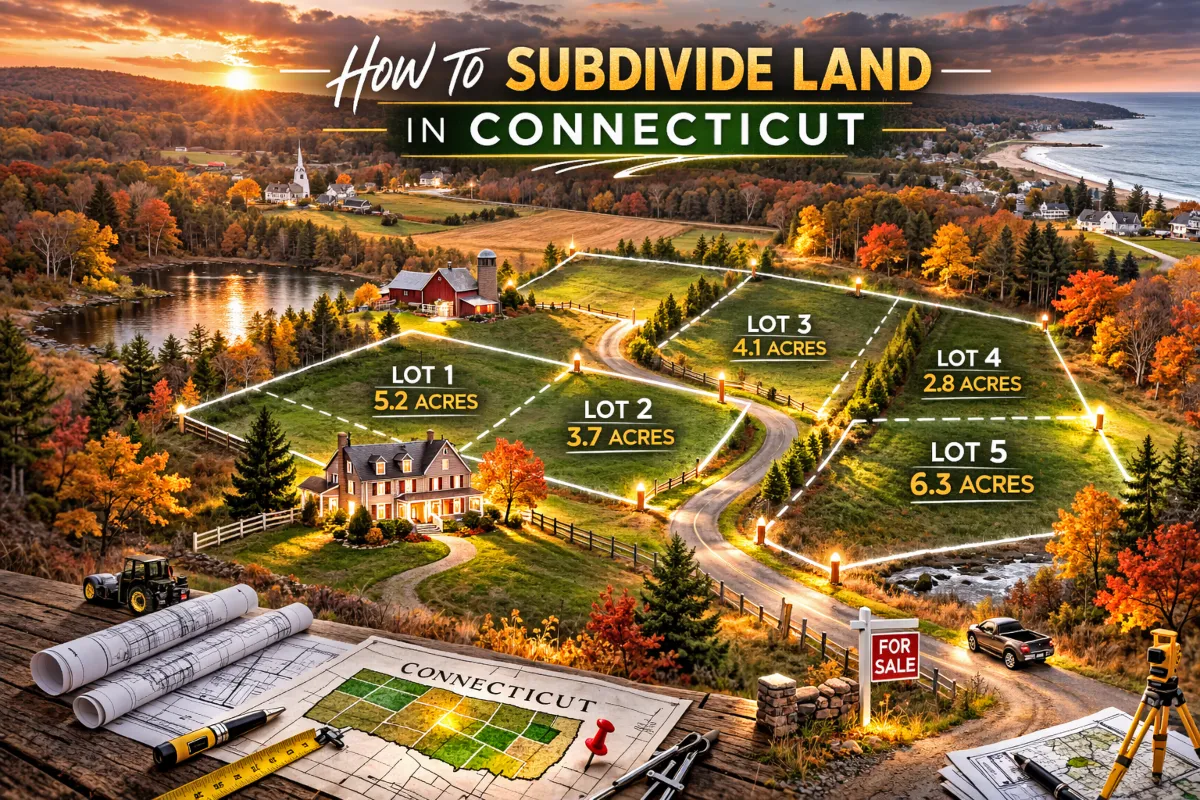
Subdividing land in Connecticut is a complex process controlled entirely at the municipal level. Understanding local zoning laws, health department requirements, and strict surveying standards is required before you spend money on engineering and applications. As a Certified Commercial Investment Member (CCIM) and land acquisition specialist, I have navigated these intricacies to help landowners make informed decisions about their property.
Understanding Connecticut Land Division Laws
The Connecticut Free Split Exemption
Connecticut law offers a unique process known as the first cut or free split. Dividing a parcel for the very first time since the local town adopted its subdivision regulations often bypasses the formal, lengthy subdivision process. This exemption allows landowners to avoid massive engineering fees and public hearings. You still need a basic survey to record the new boundary lines and health department approval to prove the new lot supports a well and septic system. This exemption applies most often to rural acreage and inherited family land being split between relatives.
The Three Lot Rule
State law legally defines a subdivision as dividing a single tract of land into three or more parts. Once you create that third lot, you trigger the formal municipal review process. This requires full compliance with all local subdivision regulations, engineering mandates, and environmental reviews.
Why Local Town Zoning Rules Everything
Connecticut has no county government. Every land use decision is handled at the municipal level by the local Planning and Zoning Commission (PZC). Regulations for minimum acreage, road frontage, and setbacks vary significantly from one town to the next. You must understand your specific town’s rules before planning any land division.
The Step by Step Process to Subdivide Land in CT
Step 1: Consult Your Local Planning and Zoning Commission
Review the local minimum acreage and road frontage rules with your town planner. Confirm your property’s zoning district and verify that your proposed division meets all baseline requirements before hiring professionals.
Step 2: Hire a Licensed Surveyor for an A-2 Boundary Survey
Connecticut requires exact boundary and topographic mapping. You must hire a state-licensed surveyor to complete a Class A-2 Transit Survey. This highly accurate map is mandatory for all land divisions and legally records the new property lines.
Step 3: Complete Soil and Percolation Tests
For vacant rural land without city sewer access, the local health department requires deep hole and percolation tests. These tests prove the land can safely support a septic system and well water. Passing these tests is mandatory for creating a buildable lot.
Step 4: Secure Inland Wetlands and Watercourses Approval
Connecticut fiercely protects its wetlands. An Inland Wetlands and Watercourses Commission (IWWC) review or permit is mandatory for almost any land division, especially for rural acreage, timberland, and hunting land. You must secure this approval to ensure your project protects local watercourses.
Step 5: Submit the Formal Subdivision Application
File the formal plans with the local Planning and Zoning Commission. This submission includes all paperwork, engineering plans, soil test results, and municipal fees. A complete and accurate application prevents delays.
Step 6: Present at the Public Hearing
Most formal subdivisions require a public hearing. This process allows neighbors and community members to weigh in on your project. Prepare to answer questions about traffic, environmental impact, and neighborhood compatibility.
Step 7: File the Final Mylar Map with the Town Clerk
The subdivision is not legally complete until the final, signed mylar map is filed with the Town Clerk. This official recording legally creates the new lots and allows you to sell or develop the divided parcels.
Major Costs and Timeline Expectations
Professional Fees and Municipal Application Costs
Subdividing land requires significant upfront capital. You must pay for licensed surveyors, soil scientists, civil engineers, and often land use attorneys. Municipal application fees add to the total expense. The formal process takes anywhere from six months to over a year depending on the town backlog and required environmental approvals.
Open Space Dedications and Fees in Lieu
Many Connecticut towns require developers to dedicate 10 to 15 percent of the subdivided land as public open space. Towns may accept a cash fee in lieu of open space instead. This adds a substantial cost to the project and requires careful financial planning.
The Easier Alternative: Sell Your Rural Land As Is
Get a Cash Offer from Bubba Land Company Today
The upfront costs, engineering requirements, and municipal red tape make subdividing land a stressful burden for many landowners. If you want to bypass the fees and town hearings, you have a better option. Bubba Land Company buys vacant rural land, hunting land, and inherited properties nationwide for cash. We specialize in fast, hassle-free closings for properties of 5 acres or more. We buy land as is, allowing you to liquidate your asset quickly and easily. Reach out today to get a cash offer from Bubba Land Company and turn your land into cash without the headache.