How to Subdivide Land in Delaware: Step by Step
Overview: Delaware land subdivision is managed primarily at the county level (Sussex, Kent, New Castle) with strict state oversight from DelDOT for road access and DNREC for environmental and septic regulations. Many landowners are surprised to learn that even minor splits require significant upfront costs and a Letter of No Objection from the state before recording.
Key Points:
- Minor vs. Major: Minor subdivisions of 5 lots or fewer avoid lengthy public hearings and are the most cost-effective route for rural land.
- The DelDOT Hurdle: You must secure a Letter of No Objection to Recordation (LONOR) regarding road access before a county will finalize a plat.
- High Water Tables: DNREC requires perc tests early on. Failing a test means the lot cannot support a septic system and is virtually unbuildable.
- Upfront Costs: Expect to pay $5,000 to $15,000 in surveying and engineering fees, plus varying county application costs.
Side Note: If managing surveyors, soil scientists, and local zoning boards sounds exhausting, you always have the option to sell your Delaware land directly and bypass the lengthy approval process.
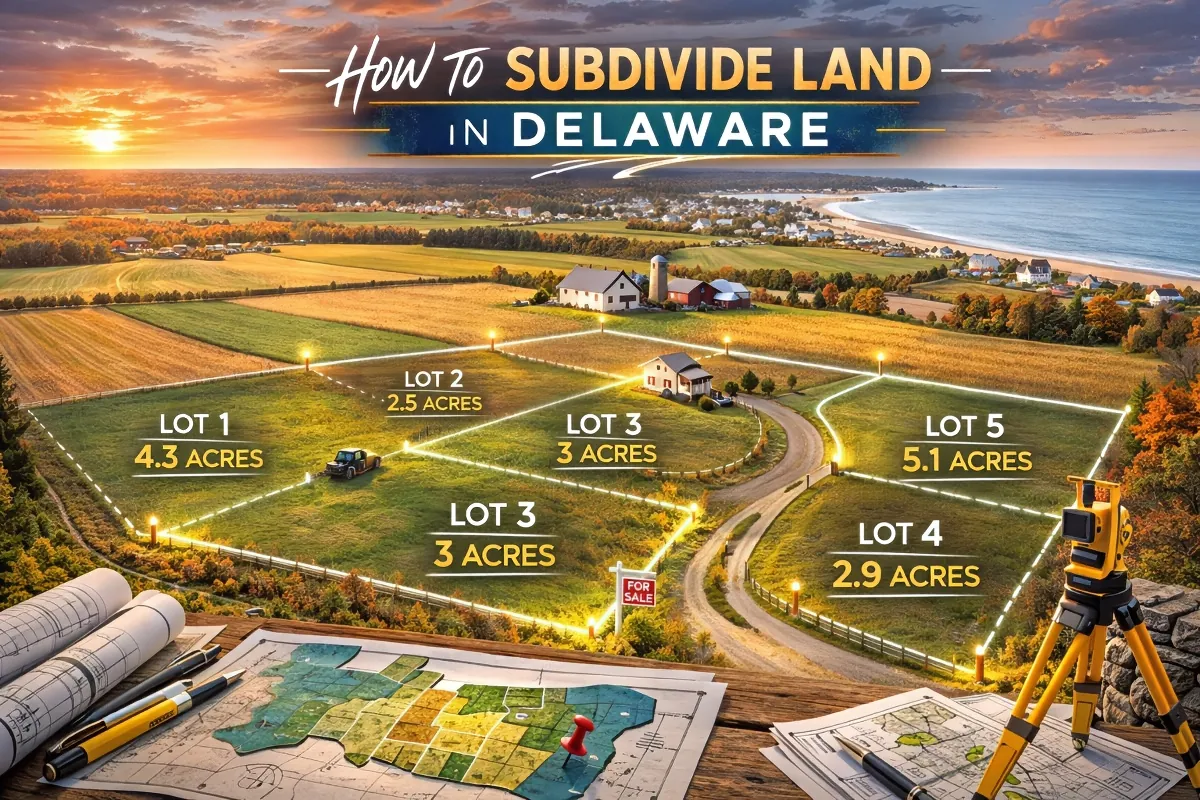
Subdividing land in Delaware requires navigating specific county zoning laws and state department regulations. Whether you own a large hunting tract in Sussex County or agricultural land in Kent County, turning one parcel into multiple lots is a complex process. You must secure approvals from both local planners and state agencies.
Understanding the Delaware Subdivision Process
Minor vs. Major Subdivisions: Which Path Are You On?
A Minor Subdivision in Delaware typically involves creating 5 lots or fewer without building new public roads. This path is faster and more cost-effective. Sussex County favors rural land development with a minor application fee of around $200. New Castle County is much more expensive, with Minor Record Plan submissions starting at $3,500. Sticking to a Minor Subdivision is the smartest financial play for most rural landowners.
The Role of County Zoning
Delaware land use is managed directly by its three counties: Sussex, Kent, and New Castle. Each county enforces its own Unified Development Code. Sussex County requires a forest assessment when splitting timber tracts or hunting land. If your property contains mature forests, the county will mandate conservation limits on how you draw your new property lines.
Step-by-Step: Moving from One Parcel to Many
Step 1: The Feasibility Study and Soil Testing
Delaware has notoriously high water tables. You must secure a perc test approved by the Department of Natural Resources and Environmental Control (DNREC) as your very first step. A newly subdivided lot that fails a perc test cannot support a septic system, making it unbuildable and unsellable for residential use.
Step 2: Hiring a Delaware Licensed Surveyor
You need a Delaware-licensed surveyor and civil engineer to draw your subdivision plat. This professional service typically costs between $5,000 and $15,000 even for a simple 3-lot split. This fee covers topographic surveys, boundary marking, and drainage planning.
Step 3: Navigating the DelDOT No Objection Letter
The Delaware Department of Transportation (DelDOT) controls all state road access. You absolutely must secure a Letter of No Objection to Recordation (LONOR) before any county will approve your subdivision. DelDOT enforces strict driveway spacing and often requires landowners to dedicate additional Right-of-Way back to the state. You can review the exact road access rules in the DelDOT Development Coordination Manual.
Step 4: County Review and Public Notice
Once your plat is engineered and DelDOT gives initial approval, you submit your application to the county. The county administrative staff reviews the plans for compliance with local zoning. You can find application forms and fee schedules directly at the Sussex County Planning and Zoning portal.
Common Pitfalls for Delaware Landowners
Drainage, Wetlands, and DNREC Regulations
State environmental rules heavily dictate usable land. DNREC strictly regulates wetlands and drainage corridors. If your parcel contains significant wetlands, your buildable acreage shrinks drastically, reducing the number of lots you can legally create.
Agricultural Preservation Easements
Many Delaware farms and timber tracts are enrolled in Agricultural Preservation Districts. These legal easements lock the land into agricultural use and prohibit residential subdivision. You must verify your land’s legal status before spending money on surveys.
Why Subdividing Might Not Be Your Best Option
Subdividing Delaware land requires a massive upfront investment of time and capital. You will spend $15,000 on engineering, wait months for DNREC and DelDOT approvals, and navigate complex county bureaucracies just to get a recorded plat. The market could shift while you wait for your final approvals.
Sell Your Delaware Land Fast Without the Subdivision Headache
You can skip the surveying fees, the DelDOT red tape, and the long waiting periods. Bubba Land Company buys vacant rural acreage, timberland, and hunting land for cash. We handle the paperwork and provide a simplified exit strategy for landowners. Contact us today to receive a competitive cash offer on your property by visiting our Sell My Delaware Land page.