How to Subdivide Land in Maine: The Complete Guide for Landowners
Overview: Subdividing land in Maine requires strict adherence to state statutory laws. You must understand the unique regulatory split between local municipal control and the Land Use Planning Commission (LUPC) for unorganized territories.
Key Points:
- The 3 in 5 Rule: Maine legally defines a subdivision as creating three or more lots from a single parcel within any five year period.
- Jurisdiction Matters: Organized towns rely on local Planning Boards. Unorganized territories fall under strict LUPC regulations.
- Strategic Exemptions: Specific transfers like gifts to immediate family members can bypass the subdivision threshold if statutory conditions are met.
- High Upfront Investment: Landowners face substantial out of pocket costs for professional land surveyors, soil site evaluators, and municipal review fees before approval.
An Alternative Path: If the strict state rules and surveying costs feel overwhelming, many property owners opt to sell their Maine land directly for a fast cash closing to avoid the burdensome development process.
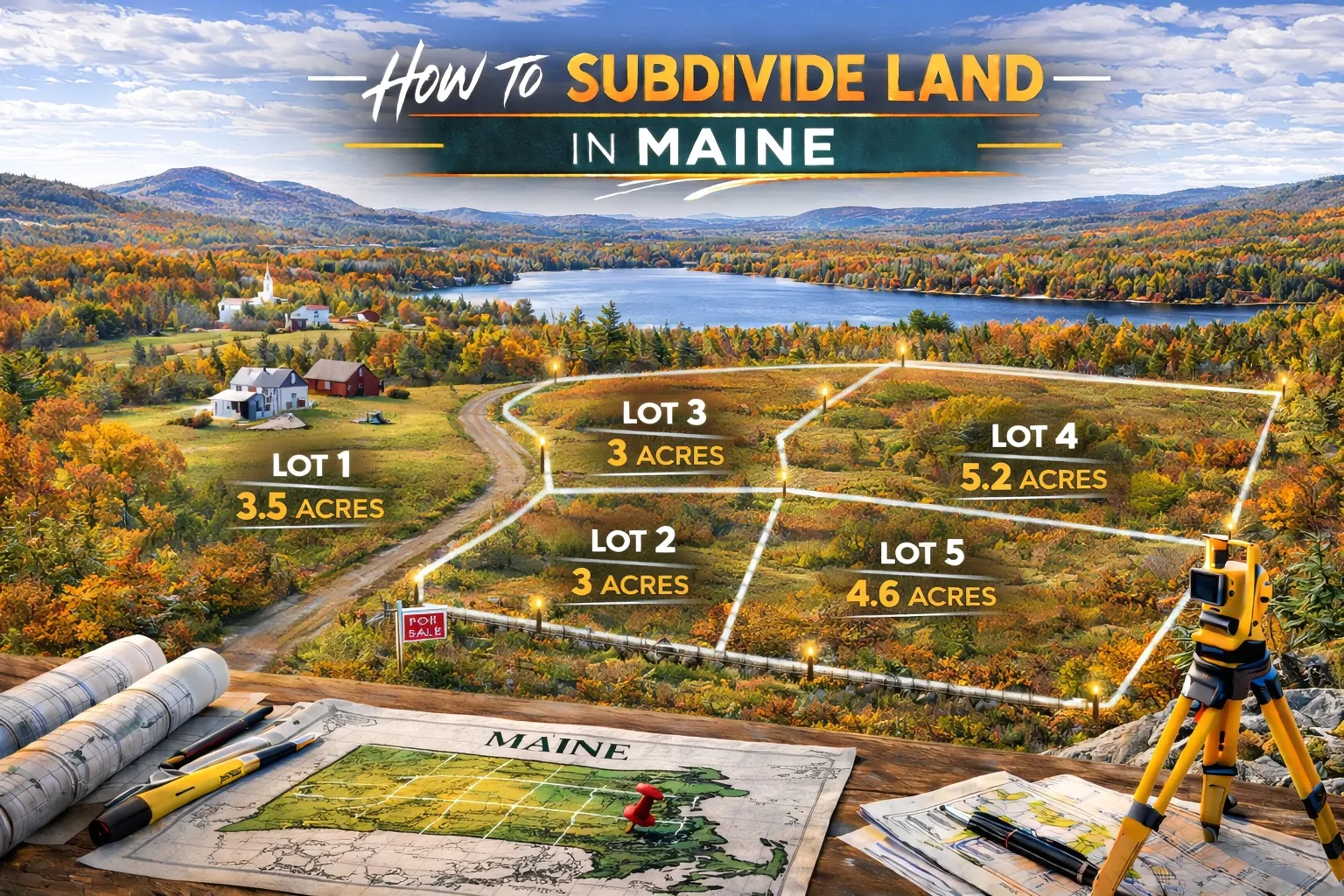
Maine offers some of the most beautiful rural acreage and timberland in the country. Many landowners eventually consider splitting their property to sell off parcels or unlock trapped equity.
Dividing land here requires navigating a highly specific set of state laws, local municipal ordinances, and environmental regulations. As a National Land Acquisition Specialist and Certified Commercial Investment Member (CCIM), I evaluate rural property and hunting land daily. The regulatory environment in Maine is unique and strict.
You must understand the exact statutory definitions of a subdivision before you hire a surveyor. This guide provides a detailed breakdown of Maine subdivision laws, the required steps for approval, and a realistic look at the costs involved.
Understanding the Maine Subdivision Law
Maine statutory law dictates exactly when a parcel of land becomes a legal subdivision. The state focuses heavily on the frequency and quantity of land divisions to protect natural resources.
The 3 in 5 Rule Explained
The core of Maine land division is found in Title 30 A M.R.S.A. Section 4401. A legal subdivision is created the moment you divide a tract of land into three or more lots within any five year period.
The first division of your land creates two lots. You can generally execute this first split without triggering the state subdivision threshold. If you or a subsequent owner divide either of those two lots again within five years, you create a third lot. That third lot immediately triggers the legal definition of a subdivision.
Once your land is classified as a subdivision, you become subject to rigorous local and state regulatory review.
Simple Lot Division vs. Legal Subdivision
A simple lot division involves splitting one parcel into two separate tracts. This action usually avoids the heavy regulatory burden of a full subdivision under state law. You still need to comply with local zoning requirements regarding minimum lot size and road frontage.
A legal subdivision involves three or more lots and requires formal Planning Board approval. The reviewing authority will analyze traffic impacts, stormwater management, and groundwater quality. You will spend significantly more time and capital securing approvals for a legal subdivision.
Organized Towns vs. Unorganized Territories (LUPC)
Many rural areas in Maine lack local municipal governments. If your property is located in an organized town, you will work directly with the local municipal Planning Board.
If your property sits within the Unorganized Territories, you fall under the jurisdiction of the Maine Land Use Planning Commission. You can review their specific zoning rules at the Maine Land Use Planning Commission official website.
The LUPC governs over 10 million acres of land. They restrict subdivisions heavily in Management districts to preserve timberland and wildlife habitat. You must confirm your governing authority before spending any money on site plans.
Key Exemptions to Maine Subdivision Rules
Maine law provides specific exemptions that allow you to transfer land without triggering the subdivision rule. You must meet the exact statutory criteria to utilize these exemptions safely.
The Family Gift Exemption
You can give a lot to a relative without it counting toward the three lot subdivision threshold. Maine law defines a relative as a spouse, parent, grandparent, sibling, child, or grandchild.
You must have owned the property for a continuous period of at least five years before making the gift. The relative receiving the land must also hold the property for five years. If they sell the lot to a non relative early, the exemption is voided.
Sales to Abutting Landowners
Transferring land to an abutting neighbor is another common exemption. If you sell a portion of your tract to a direct neighbor and it merges with their existing parcel, it does not create a new standalone lot.
This action does not count toward the subdivision threshold. The neighbor must keep the transferred land merged with their original parcel for at least five years to maintain the exempt status.
The Step by Step Process to Subdivide Land in Maine
Subdividing land requires a systematic approach. You must follow a precise sequence of events to ensure compliance and avoid costly revisions.
Step 1: Determine Your Jurisdiction and Zoning
Your first action is identifying the regulatory body overseeing your land. Check with the local town office or the LUPC to determine your specific zoning district.
You need to identify the minimum lot size, minimum road frontage, and shoreland zoning restrictions. You should also conduct a title search to ensure there are no existing deed restrictions prohibiting a subdivision.
Step 2: Hire Your Professional Team
You must hire a Maine licensed Professional Land Surveyor to shoot the boundaries and draft the formal subdivision plat. You also need a licensed Site Evaluator to conduct soil tests.
Complex projects with new roads or significant drainage requirements will also require a Professional Engineer to design stormwater management systems.
Step 3: Preliminary Planning Board Meeting
Most Maine municipalities require a sketch plan meeting. You will present a rough drawing of your proposed lot layout to the Planning Board.
This allows the board to identify major red flags before you spend thousands of dollars on final engineered plans. Incorporate all their feedback into your formal submission.
Step 4: Environmental Permitting and Soil Testing
Every new lot must prove it has access to adequate utilities and waste disposal. Your Site Evaluator will provide an HHE 200 form for each lot, proving the soils can handle a septic system.
Large projects creating 15 or more lots trigger the Maine Site Location of Development Act. These large projects require direct permitting from the Maine Department of Environmental Protection.
Step 5: Final Approval and Registry of Deeds
Once your professional team completes the final subdivision plat, you submit the package to the Planning Board for a public hearing. Abutting neighbors will have the opportunity to comment on your project.
If approved, the board will sign the final survey plan. You must take this signed plan to your county Registry of Deeds and pay the recording fee to make it legally complete.
Estimated Subdivision Costs and Fees in Maine
Subdividing land is a capital intensive process. You must budget for surveying, environmental testing, municipal fees, and legal counsel.
Itemized Expenses for a Typical Project
Your costs will vary heavily based on the size of your tract and the topography. Below is a realistic breakdown of the expenses you will encounter when subdividing a standard rural parcel into three or four lots.
| Expense Category | Estimated Cost Range | Description |
|---|---|---|
| Boundary & Topographic Survey | $3,500 to $8,000 | Full boundary survey and drafting the subdivision plat for municipal review. |
| Soil Testing & Site Evaluation | $900 to $1,800 | Test pits and HHE 200 forms to prove lots can support septic systems. |
| Municipal Application Fees | $500 to $1,200 | Base review fees plus a per lot fee charged by the town. |
| Engineering & Stormwater Design | $2,500 to $6,000 | Required for formal stormwater management plans or new access roads. |
| Legal Fees & Deed Prep | $1,000 to $2,500 | Drafting new deeds, road maintenance agreements, and plat review. |
| Total Estimated Costs | $8,400 to $19,500 | Base estimate before physical road construction or clearing. |
Total Estimated Subdivision Costs
For a straightforward three to four lot subdivision on rural land without new paved roads, your total estimated costs will range from $8,400 to $19,500. If your project requires state level DEP permitting or extensive environmental mitigation, those costs can easily double.
You must spend this money out of pocket long before you can sell a single lot.
Is Subdividing Your Maine Land Worth It?
As an MSRE, I advise landowners to perform a strict financial feasibility analysis before breaking ground. You must weigh the gross retail value of the finished lots against the massive upfront costs and the holding time.
Securing Planning Board approval, finding available surveyors, and waiting for the ground to thaw for soil testing can stretch a project into a 12 to 18 month endeavor. During this time, you are responsible for property taxes and the opportunity cost of your tied up capital.
Read the full text of the Maine subdivision statute Title 30 A to understand the absolute legal compliance required. Subdividing makes financial sense only if your property is located in a high demand growth corridor and you have the liquidity to fund the entire entitlement process.
An Easier Alternative: Sell Your Maine Land for Cash
Many property owners look at the timeline, surveying fees, and bureaucratic red tape of the Maine subdivision process and realize they have no desire to become land developers. If your goal is to liquidate your asset and free up your capital without managing soil scientists and planning boards, there is a much simpler path forward.
Bubba Land Company specializes in buying vacant rural acreage, timberland, and hunting properties directly from landowners. We provide a clean cash transaction where you sell the property entirely “as is” and bypass the surveying costs and prolonged holding periods. If you are ready to evaluate a direct cash offer, explore our Maine buying process and request your offer today.