How to Subdivide Land in New Jersey: NJ Rules & Reality
Overview: Subdividing land in New Jersey is primarily governed by the Municipal Land Use Law (MLUL), which gives individual townships and boroughs the power to dictate their own zoning ordinances. Landowners often find that state environmental protections enforced by the NJ DEP add significant hurdles, making the process highly dependent on both local master plans and regional ecological rules.
Key Points:
- Local Control (MLUL): There is no statewide standard for minimum lot sizes or setbacks; every municipality enforces its own specific zoning codes.
- Minor vs. Major Subdivisions: Minor subdivisions (typically 2 to 4 lots with no new roads) are much faster to process than major subdivisions, which require extensive infrastructure planning and public hearings.
- Environmental Red Tape: Projects must comply with strict NJ DEP regulations, particularly if the land is located in the Highlands, Pinelands, or near protected wetlands.
- High Upfront Costs: Landowners must pay out-of-pocket for land surveyors, civil engineers, soil tests, and legal representation before any approval is guaranteed.
Side Note: If the bureaucracy, engineering costs, and months of public hearings are becoming a time sink, some landowners choose to sell their NJ land directly for cash and move on without the prolonged stress of development.
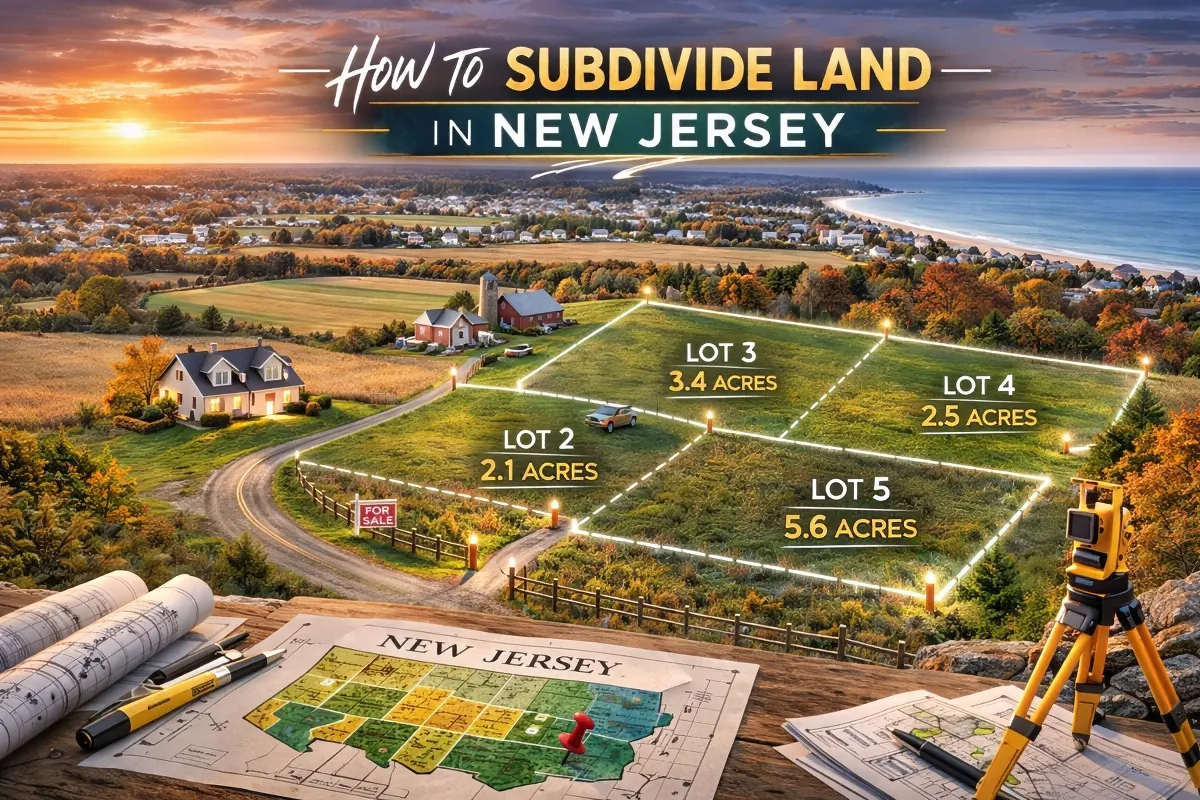
Subdividing land in New Jersey presents unique challenges compared to much of the country. Because it is the most densely populated state in the U.S., local municipalities fiercely protect their open spaces, and the state enforces rigorous environmental regulations. If you own vacant rural acreage, timberland, or an inherited property, understanding exactly what it takes to carve up your parcel is essential before you invest time and money into the process.
The Foundation: Municipal Land Use Law (MLUL)
Every land division in the state is dictated by the Municipal Land Use Law (MLUL). Instead of a blanket statewide zoning code, the MLUL empowers individual townships, boroughs, and cities to create and enforce their own master plans and zoning ordinances. This means the required minimum lot size, road frontage, and building setbacks for a property in Sussex County will be entirely different from one in Salem County.
Classifying Your Subdivision: Minor vs. Major
Before you draw up plans, you need to determine which classification your project falls under, as this dictates your timeline, costs, and approval process.
Minor Subdivisions
A minor subdivision is the simplest route. Generally, this applies when you are splitting a parent tract into a small number of lots (usually two to four, depending on the municipality). To qualify as minor, the project cannot require the creation of new streets or the extension of off-tract municipal infrastructure. Once your application is deemed complete, local Planning Boards are required to act on it within 45 days. If approved, you have 190 days to file the new deed or plat with your county clerk.
Major Subdivisions
If you are creating more lots than the minor threshold allows, or if your project requires building new roads, extending water/sewer lines, or installing significant drainage infrastructure, it is a major subdivision. This triggers a much longer, multi-stage approval process requiring preliminary plat approval, final plat approval, and mandatory public hearings.
Navigating New Jersey’s Environmental Red Tape
New Jersey has some of the strictest environmental protections in the nation. Beyond local zoning, you must often secure approvals from the New Jersey Department of Environmental Protection (NJ DEP).
- The Highlands and Pinelands: If your land is in the northern Highlands region or the southern Pinelands National Reserve, development is highly restricted. These areas have dedicated commissions that enforce extreme limits on impervious coverage, mandate massive buffers around open water, and dictate stringent wetland delineation.
- Wetlands and Flood Zones: Under the Freshwater Wetlands Protection Act and Flood Hazard Area Control Act, you may need to obtain Letters of Interpretation (LOIs) from the DEP just to prove your land is buildable before a town will even consider your subdivision application.
- Septic and Well Regulations: For rural acreage without access to municipal water and sewer, you must pass rigorous soil permeability testing (perc tests) to ensure each newly created lot can legally support an independent septic system.
Estimated Costs to Subdivide Land in New Jersey
Subdividing is an expensive upfront investment. Even for a simple minor subdivision, property owners should prepare for the following estimated costs:
- Land Surveying ($2,500 – $10,000+): You need a licensed New Jersey Land Surveyor to create detailed boundary and topographic maps.
- Civil Engineering & Soil Testing ($3,000 – $15,000+): Engineers are required to design stormwater management plans, map wetlands, and conduct septic viability testing.
- Legal Representation ($2,000 – $8,000+): Navigating the MLUL typically requires a specialized land use attorney to represent your application before the Planning or Zoning Board.
- Municipal Application and Escrow Fees ($1,000 – $5,000+): Towns charge application fees and require you to fund an escrow account to pay for their own municipal engineers and planners to review your plans.
For major subdivisions, these costs can easily triple, often exceeding $50,000 before a single shovel hits the dirt.
The Faster Alternative: Selling Your Land As-Is
Subdividing land in New Jersey requires months or even years of waiting, demands public hearings, and carries thousands of dollars in nonrefundable upfront costs. Landowners bear the full financial risk of securing soil tests and DEP approvals.
You can bypass the bureaucracy, holding costs, and red tape entirely. Bubba Land Company buys vacant acreage, hunting land, timberland, and inherited properties for cash right here in the Garden State. We specialize in simplified land divestment and provide a hassle-free, as-is cash sale for New Jersey landowners who want to avoid the steep fees and long timelines of traditional real estate development.
Skip the planning board completely and get a direct cash offer for your New Jersey land today.