How to Subdivide Land in New York: Costs, Laws, & Steps
Overview: Subdividing land in New York is primarily governed by local municipalities under the state’s “home rule” principle, giving individual towns and villages the authority to set their own zoning ordinances.
Key Points:
- Local Control: Minimum lot sizes and road frontage requirements vary entirely by municipality; every local planning board enforces its own specific bulk regulations.
- SEQRA Review: Projects must undergo environmental evaluation under the State Environmental Quality Review Act (SEQRA) before any planning board approval is granted.
- Special Jurisdictions: Land located within the Adirondack Park (APA) or New York City watersheds faces additional, rigorous layers of state and local oversight.
- Upfront Costs: Landowners pay out-of-pocket for licensed land surveyors, soil percolation tests, engineering designs, and municipal fees to complete the subdivision process.
Alternative Option: For landowners seeking a faster route without the municipal coordination and engineering expenses, choosing to sell your NY land directly for cash provides a straightforward exit strategy.
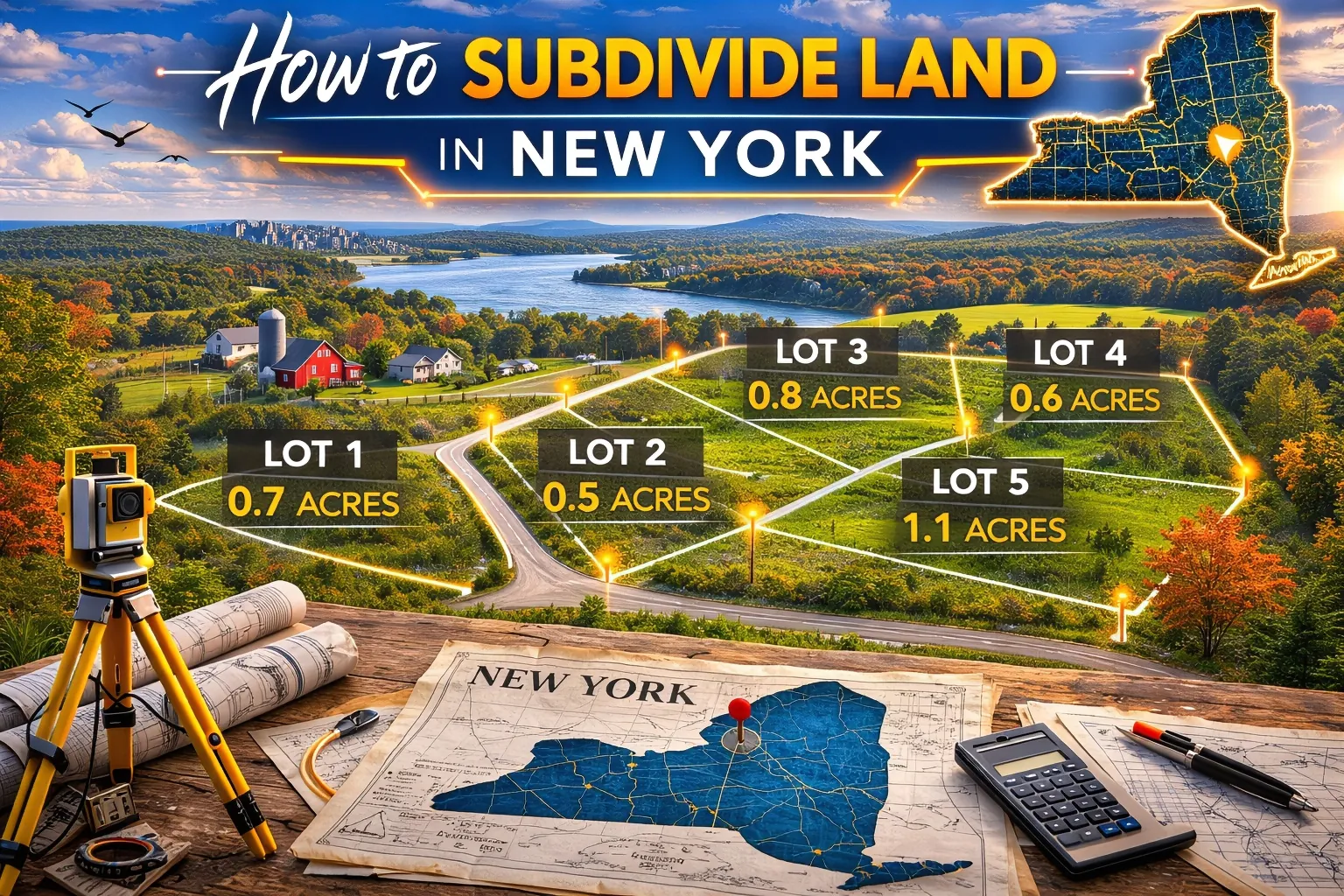
Subdividing land in New York unlocks property value and creates new opportunities for development. The process requires navigating local zoning boards, state environmental regulations, and county health departments. This guide details the exact steps, legal requirements, and costs you will encounter when splitting land in the Empire State.
Understanding New York Subdivision Laws and Regulations
New York operates under “home rule,” meaning local municipalities dictate zoning and subdivision approval under New York State Town Law Section 276. Minimum lot sizes and road frontage requirements vary entirely by municipality. Your first step is always consulting the local planning board.
Local Zoning Boards and Bulk Regulations
Every town or village enforces specific bulk regulations. These dictate the physical dimensions required for new lots.
- Minimum Lot Size: Depending on the zone, minimum sizes range from a quarter acre in suburban areas to over ten acres in rural agricultural zones.
- Road Frontage: Municipalities require new parcels to have dedicated frontage on an approved public or private road to ensure access for emergency vehicles.
- Setbacks: New property lines must maintain specific distances from existing structures, wells, and septic systems.
Minor vs. Major Subdivisions
Most New York towns classify lot splits into two categories, which dictates the length and complexity of the approval process.
- Minor Subdivisions: Typically defined as the creation of two to four lots that front an existing public street and require zero extension of municipal utilities or new road construction. The approval process is faster and usually requires fewer public hearings.
- Major Subdivisions: Involves the creation of five or more lots, or any subdivision requiring the construction of new streets, utility extensions, or centralized stormwater management systems. Major subdivisions require extensive engineering plans and a rigorous environmental review.
The State Environmental Quality Review Act (SEQRA)
Every discretionary action by a local or state agency in New York is subject to the State Environmental Quality Review Act (SEQRA). Before a town planning board approves your subdivision plat, they must evaluate the environmental impact.
- Environmental Assessment Form (EAF): You must submit an EAF to help the lead agency determine the environmental significance of your project.
- Action Classifications: Subdivisions are classified as Type I, Type II, or Unlisted actions. Larger subdivisions usually trigger a Type I review, which is highly scrutinized.
- Determinations: When the board issues a “Positive Declaration,” you must fund and prepare a comprehensive Environmental Impact Statement (EIS) to identify mitigation strategies.
New York State Realty Subdivision Laws
Dividing a tract of land into five or more parcels, where those parcels are five acres or less, triggers the New York State Realty Subdivision Law.
- This law requires review by the Department of Health (DOH) or the Department of Environmental Conservation (DEC).
- You must prove the land can support safe drinking water and on-site wastewater treatment systems.
- Parcels larger than five acres are generally considered non-jurisdictional under this specific health law, though local zoning ordinances still apply.
Special Jurisdictions in New York State
Upstate New York contains protected regions that apply additional oversight to land development.
Adirondack Park Agency (APA) Regulations
Owning land inside the “Blue Line” of the Adirondack Park means you fall under the jurisdiction of the Adirondack Park Agency (APA).
- Permit Requirements: The APA regulates land use across millions of acres. Subdividing land here often requires an APA permit in addition to town approvals.
- Land Use Classifications: The APA maps land into classifications such as Hamlet, Moderate Intensity, Rural Use, and Resource Management. Resource Management lands have strict density guidelines, sometimes requiring over 42 acres per principal building.
New York City Watershed Regulations
Land located in the Catskills or the Hudson Valley falls under the regulation of the NYC Department of Environmental Protection (DEP). To protect the city drinking water supply, the DEP enforces strict guidelines on stormwater runoff, impervious surfaces, and septic system placement.
The Step-by-Step Process to Subdivide Land in New York
Dividing a parcel requires coordination between licensed professionals and local government officials. Here is the standard municipal process.
- Step 1: Local Feasibility Review. Meet with your town planner or zoning enforcement officer to review current zoning codes, minimum acreage requirements, and road frontage rules.
- Step 2: Title Search and Deed Review. Pull your property deed to check for restrictive covenants, conservation easements, or right-of-way agreements that affect a subdivision.
- Step 3: Hire a Licensed Land Surveyor. A New York licensed surveyor will map the property boundaries, identify topographic features, and draft the preliminary subdivision plat.
- Step 4: Soil and Septic Testing. For lots relying on private septic systems, hire an engineer to conduct deep hole and percolation (perc) tests. The county health department must approve the proposed septic design for each new lot.
- Step 5: Submit the Preliminary Plat. File your surveyed plat, EAF, and application fees with the local planning board for official review.
- Step 6: Attend Public Hearings. New York law requires public hearings for subdivisions. Abutting neighbors are notified and will ask questions regarding traffic, drainage, or community impact.
- Step 7: Final Plat Approval and Filing. Once the planning board signs the final plat, you have a strict window (often 62 days) to file it with the County Clerk. After filing, the local tax assessor assigns new tax map parcel numbers to each lot. You must have these new tax IDs generated before legally selling the individual parcels.
The True Cost to Subdivide Land in New York
Subdividing land requires upfront capital. Costs vary heavily based on the county, parcel size, and terrain. Engineering and surveying fees represent the bulk of the initial investment.
Below is a breakdown of estimated expenses for a standard minor subdivision (2 to 4 lots) in New York.
| Expense Category | Estimated Cost Range | Description |
|---|---|---|
| Professional Land Surveyor | $2,000 to $8,000+ | Boundary mapping, topography, and preliminary plat drafting. |
| Engineering and Soil Testing | $1,500 to $4,000 | Perc tests, deep hole tests, and septic system design. |
| Application and Legal Fees | $1,000 to $3,500 | Municipal fees, SEQRA review, and attorney representation. |
| Health Department Fees | $500 to $1,500 | DOH review for water supply and wastewater treatment. |
| Total Estimated Cost | $5,000 to $17,000+ | Excludes physical infrastructure like roads or utilities. |
Creating a major subdivision with new roads, utility extensions, and drainage retention ponds pushes these costs well past $50,000.
Sell Your New York Land As-Is
If you prefer to liquidate your asset quickly and bypass the municipal coordination, selling the entire parcel for cash is an excellent alternative. Bubba Land Company buys vacant rural land, timberland, and hunting acreage nationwide for cash.
We provide a hassle-free, as-is cash sale so you can unlock your equity and avoid surveyor fees and real estate commissions. Request a cash offer today and sell your New York land directly to us.