How to Subdivide Land in North Dakota: Step-by-Step Guide
Overview: Subdividing land in North Dakota is governed by the North Dakota Century Code, which gives distinct authority to either rural county commissioners or city planning boards through Extraterritorial Jurisdiction (ETJ).
Key Points:
- Jurisdictional Divide: Check if your property falls under county control or a city ETJ to confirm your specific zoning and minimum lot size requirements.
- Minor vs. Major Classifications: Minor subdivisions (four or fewer lots, no new roads) offer a much faster and cheaper process than major developments.
- Significant Out-of-Pocket Expenses: Expect to pay upfront for licensed land surveyors, soil tests, and county filing fees well before receiving plat approval.
Side Note: If navigating county zoning boards, paying thousands in survey fees, and waiting through winter weather delays feels overwhelming, many property owners choose to sell their ND land directly for a fast cash closing to avoid the hassle altogether.
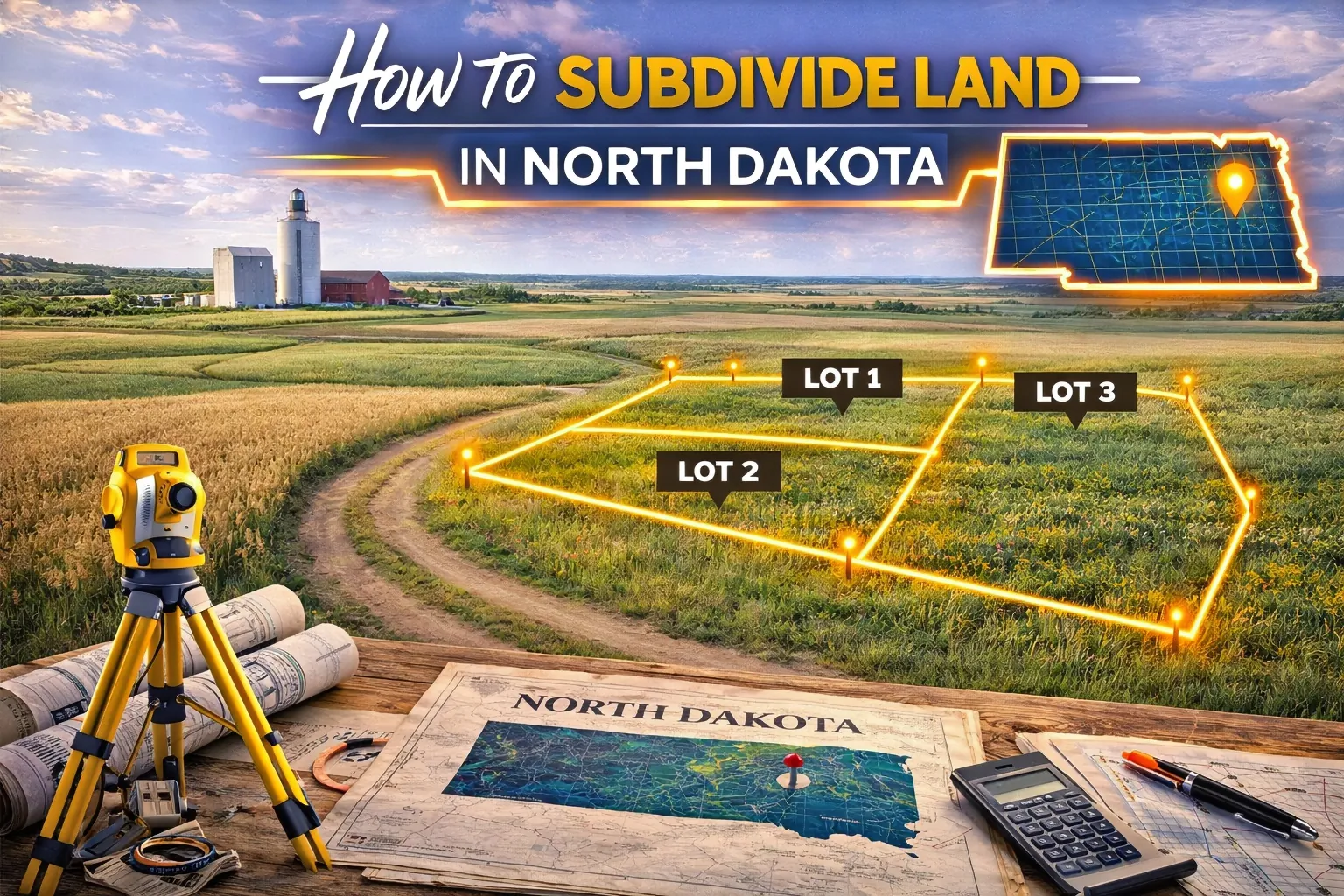
Splitting land can significantly increase its value or simplify settling an inherited estate. Subdividing allows you to liquidate a portion of your North Dakota acreage while retaining the rest. This guide details the legal definitions, jurisdictional rules, step by step approval processes, and the financial costs required to successfully subdivide your property.
Understanding Land Subdivision Laws in North Dakota
The state of North Dakota governs the division of land through specific legislative codes. A subdivision is legally defined as the division of a lot or tract to create one or more new lots for sale or building development. This process requires compliance with the North Dakota Century Code Chapter 11-33.2. Local Boards of County Commissioners hold the power to approve plats, establish filing fees, and ensure alignment with the county master plan. You must commission a formal plat map that works within the framework of local zoning laws to meet minimum lot size requirements.
Knowing Your Jurisdiction: County vs. City ETJ
County Zoning and Townships
For rural land located far from urban centers, the Board of County Commissioners and local Township Supervisors govern the subdivision process. Agriculture is heavily protected in North Dakota. Rural agricultural zones often mandate minimum lot sizes of 2, 10, or even 40 acres to manage population density. Review your specific county comprehensive plan to verify these density requirements before investing in a professional survey.
City Extraterritorial Jurisdiction (ETJ)
If your rural land sits within one to two miles of a municipal city limit, it likely falls under the city Extraterritorial Jurisdiction. Growing municipalities like Fargo, Bismarck, and Minot control development in these buffer zones. The North Dakota Century Code Chapter 40-48 grants cities authority to enforce their master plans outside corporate limits. In these ETJ zones, you must apply for subdivision approval directly through the city planning commission.
Minimum Lot Size Requirements by County
Minimum lot size rules vary significantly across North Dakota counties. What is permitted in a suburban Cass County development may be completely prohibited in an agricultural zone in Divide or Sioux County. The table below reflects general minimums for rural and agricultural zones across a selection of major counties. Always confirm current requirements directly with your county planning office before proceeding, as these figures are subject to change through local ordinance updates.
| County | Agricultural Zone Minimum | Rural Residential Minimum | Notes |
|---|---|---|---|
| Cass County | 40 acres | 2.5 acres | Fargo ETJ applies within 2 miles of city limits |
| Burleigh County | 40 acres | 5 acres | Bismarck ETJ extends into unincorporated areas |
| Ward County | 40 acres | 5 acres | Minot ETJ applies to nearby rural parcels |
| Grand Forks County | 40 acres | 2 acres | City ETJ rules apply near Grand Forks |
| Morton County | 40 acres | 5 acres | Rural parcels governed by county commission |
| Williams County | 40 acres | 10 acres | Oil activity may complicate surface-only splits |
| Stark County | 40 acres | 5 acres | Dickinson ETJ in effect near city limits |
| Mountrail County | 40 acres | 10 acres | Bakken region; mineral rights issues common |
A Critical North Dakota Issue: Mineral Rights and Subdivision
North Dakota sits at the heart of the Bakken Formation, one of the largest oil and natural gas producing regions in the United States. This makes mineral rights one of the most important and frequently overlooked factors when subdividing land in this state. Unlike most other parts of the country, a significant portion of North Dakota land has already had its mineral rights severed from the surface estate. This means the person who owns the surface may not own what lies beneath it.
When you subdivide your property, you are generally splitting the surface estate. If mineral rights were previously severed by a prior owner, those rights are typically not divided by your plat and remain under separate ownership. However, if you still own both the surface and the minerals, you must make a deliberate decision about how to handle the mineral estate during the subdivision process. Failing to address this clearly in your deed language can create legal confusion for future buyers and title companies.
Key issues to address with your real estate attorney before finalizing any subdivision plat in North Dakota include:
- Confirm mineral ownership status: Order a title search that specifically traces the mineral chain of title, not just the surface. Many landowners are surprised to discover their minerals were severed decades ago.
- Decide how minerals are conveyed: When you sell a subdivided lot, state clearly in the deed whether minerals are included or reserved. Silence in a deed can lead to legal disputes.
- Oil and gas lease obligations: If your land is currently under an active oil or gas lease, subdividing the surface does not automatically release or reassign that lease. Your attorney must address how existing lease royalties and obligations are handled across the new parcels.
- Surface use agreements: If mineral rights are owned by a third party, that party retains legal access to the surface for extraction activities. Buyers of your subdivided lots need to understand this before purchase.
The NDSU Extension Service land ownership resources can help landowners understand the basics of mineral rights and surface estates before consulting an attorney. Addressing mineral rights proactively protects your subdivision from title complications and liability down the road.
Township Road Access in North Dakota
North Dakota has one of the most extensive township road grids in the country, a legacy of the original Public Land Survey System that divided the state into one-mile sections. On paper, this grid appears to give rural landowners reliable road access on all sides of a parcel. In practice, not all of these roads are maintained, legally opened, or physically passable.
Before you finalize a subdivision, verify the following with your county engineer and township board:
- Is the bordering road legally opened? A road may appear on a plat map as a dedicated right of way but never have been formally opened or constructed. Selling a lot fronting an unopened road can create serious access problems for buyers.
- Who maintains the road? Township roads are maintained by the local township board, not the county. Funding and maintenance quality vary widely from township to township. A road that is impassable in spring thaw may not meet county standards for residential lot access.
- Does your new parcel have adequate frontage? Most North Dakota counties require a minimum road frontage of 33 to 66 feet for a legally created lot. Confirm your proposed split meets this standard before committing to a survey.
- Landlocked parcels require easements: If your proposed subdivision creates a parcel without direct road frontage, you must establish a legally recorded access easement across an adjacent parcel before the plat can be approved. This requires a separate legal agreement and adds cost and time to the process.
Minor vs. Major Subdivisions
The Minor Subdivision
A minor subdivision involves splitting a parent parcel into a very small number of lots, typically defined as four or fewer. Minor subdivisions require no new public infrastructure like newly paved roads or municipal water lines. This represents the fastest and most cost effective route for landowners looking to sell off a small section of acreage.
The Major Subdivision
A major subdivision applies to projects creating five or more lots or requiring the construction of new public infrastructure. This triggers a rigorous approval process. Landowners must submit extensive engineering reports and environmental assessments. Major subdivisions require multiple public hearings and often take well over a year to reach final approval.
The Step by Step Process to Subdivide Land in North Dakota
- Step 1: Feasibility and Zoning Verification: Visit your local planning office to review the zoning map and comprehensive plan. The North Dakota GIS Hub is a free state-run tool that lets you view county parcel boundaries, road networks, and land classifications before your first meeting with a planner. Confirm your minimum lot size and ensure your property has the required public road frontage, as landlocked parcels require legally binding access easements.
- Step 2: The Pre-Application Meeting: Schedule a review meeting with your county planner. Bring a rough sketch of your proposed split so staff can outline local requirements, provide the correct application checklist, and identify any red flags like floodplain overlaps.
- Step 3: Hiring a Professional Land Surveyor: Hire a licensed North Dakota land surveyor to draft the preliminary plat. They will map exact boundaries, calculate acreage, set physical monuments, and identify utility easements to meet strict state mapping standards.
- Step 4: Soil Testing and Environmental Health: Rural lots needing private septic systems require a percolation test. Hire a soil professional to conduct this test, which the local district health unit must approve to ensure the soil can safely absorb and treat septic waste.
- Step 5: Submitting the Preliminary Plat Application: Submit your development application, preliminary plat, title opinions, and nonrefundable filing fees. The planning department will then distribute your plat to the county engineer and utility providers for a deep technical review.
- Step 6: Public Hearings and Commission Review: The planning department will notify adjacent neighbors. You must attend the Planning and Zoning Commission public hearing to present your project and answer questions before the commission votes on a recommendation.
- Step 7: Final City or County Commission Approval: The Board of County Commissioners or City Commission will hold a final public review. They will verify the subdivision aligns with the county master plan before signing the final approved plat document.
- Step 8: Final Recording with the County: Take the signed plat to the County Recorder office. The subdivision becomes legally recognized only after it is officially filed, prompting the tax assessor to issue new parcel identification numbers.
Estimated Costs to Subdivide Land in North Dakota
Subdividing land requires upfront capital that varies based on property size, topography, and geographic location. Urban ETJ zones typically command higher professional fees than remote rural counties. Below is a detailed breakdown of the typical expenses you will encounter during a minor residential or rural land subdivision in North Dakota.
| Expense Category | Description of Service | Estimated Cost Range |
|---|---|---|
| Professional Land Survey | Boundary establishment, setting pins, and drafting the formal plat map. | $2,000 to $6,000+ |
| Application & Platting Fees | Nonrefundable filing fees paid directly to the city or county planning department. | $300 to $1,000 |
| Soil & Percolation Testing | Mandatory testing to verify the land can legally support a private septic system. | $500 to $1,500 |
| Title Opinion & Legal Fees | Verifying clear property title, removing liens, and resolving ownership issues. In North Dakota, this should include a dedicated mineral rights title search. | $400 to $1,500 |
| Recording Fees | Final filing fees paid to the North Dakota County Recorder for the plat. | $50 to $100 |
| Total Estimated Expense | Complete minor subdivision process from start to finish. | $3,250 to $10,100+ |
FAQs About Subdividing Land in North Dakota
Can I subdivide agricultural land in North Dakota?
Yes, but most rural agricultural zones require a minimum of 40 acres per new parcel. Some counties allow smaller splits of 2 to 10 acres under specific conditions. Confirm your zoning classification with your county planning office before assuming a split is feasible.
Do mineral rights transfer automatically when I subdivide?
Not necessarily. If minerals were previously severed by a prior owner, they are not yours to convey. If you do own the minerals, address how they are handled in your deed before any lot is sold. Have a North Dakota real estate attorney review your deed language before listing.
How long does the subdivision process take?
A minor rural subdivision with no complications typically takes three to six months. Major subdivisions or projects inside city ETJ zones routinely take twelve to twenty-four months due to public hearings and engineering reviews.
What if my proposed parcel has no road frontage?
A landlocked parcel cannot be approved without a recorded access easement across an adjacent property. This requires a separate legal agreement and adds cost and time to your project.
Is a percolation test always required?
Yes, for any new lot relying on a private septic system. If your parcel will connect to a municipal sewer, a perc test is generally not required. Most rural North Dakota lots will need one.
Is Subdividing the Right Move for Your Property?
Navigating local zoning laws, paying thousands in upfront survey costs, and waiting months for approvals requires significant resources. For landowners who want to avoid the high professional fees and endless red tape associated with traditional development, an immediate cash sale offers a simplified alternative. You can liquidate your acreage exactly as it sits today without spending a dime on surveyors or engineering. If you value a fast, hassle free divestment, explore your options to sell your land in North Dakota directly to Bubba Land Company for a fair cash offer and a closing on your exact timeline.