How to Subdivide Land in Vermont: Avoid the Mess
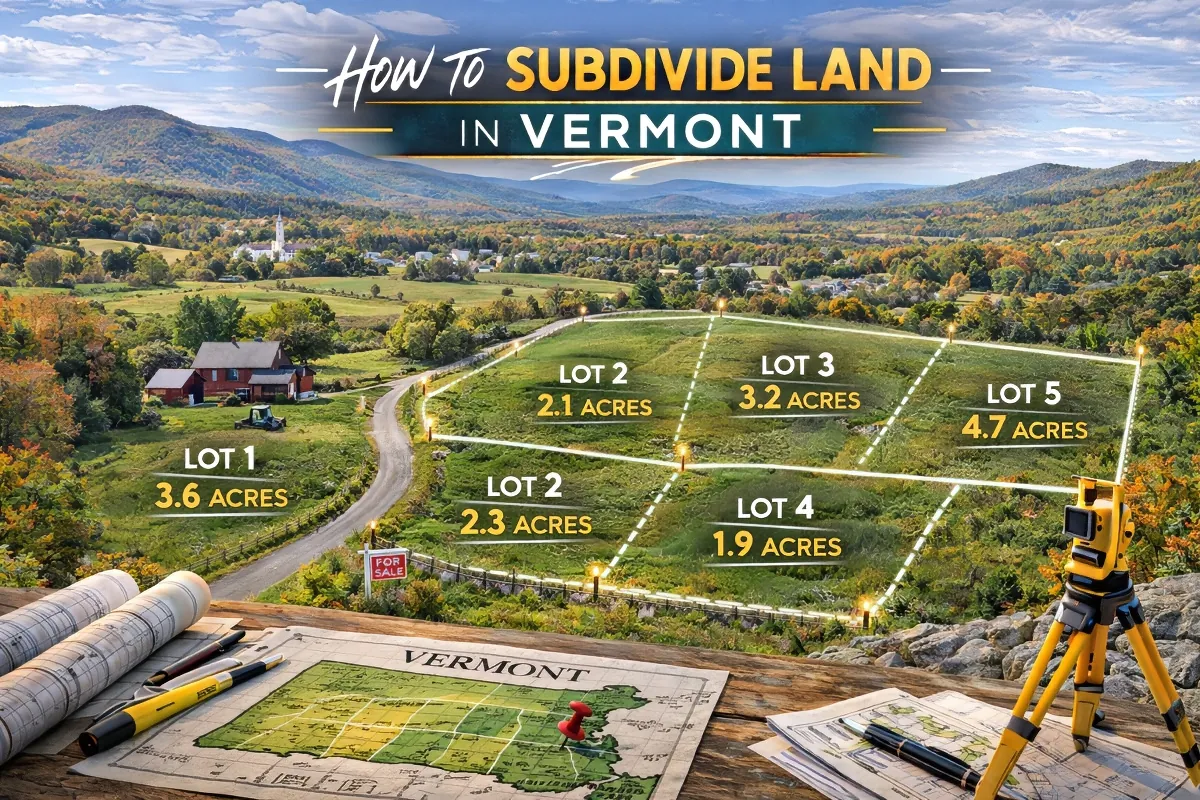
Overview: Subdividing land in Vermont is governed heavily by local municipal zoning and Act 250, the state’s primary land use and development law.
Key Points:
- Act 250 Rules: State oversight depends on local zoning strength. “1-Acre Towns” face strict state review, while “10-Acre Towns” retain more local control.
- Water Regulations: The Agency of Natural Resources requires approved soil percolation tests and permits for all new septic and potable water systems.
- Environmental Red Tape: Projects must comply with strict wetland, floodway, and wildlife habitat protections that limit buildable areas.
- High Upfront Costs: Landowners must pay out-of-pocket for land surveyors, environmental engineers, soil tests, and state permit fees before any approval is guaranteed.
Side Note: If the bureaucracy, engineering costs, and months of public hearings are becoming a time sink, some landowners choose to sell their Vermont land directly for cash and move on without the prolonged stress of development.
As the Founder of Bubba Land Company, I review vacant land opportunities across the country every day. My name is Bubba Peek. I hold a Master’s in Real Estate (MSRE) and a Certified Commercial Investment Member (CCIM) designation. Land valuation and market analysis are my specialties.
Vermont offers beautiful rural acreage, hunting land, and timberland. Demand for these properties is consistently high. Subdividing a large parcel of Vermont land can unlock significant value. You can turn one large asset into multiple profitable lots.
The process is highly regulated. Vermont protects its natural beauty through strict environmental and zoning laws. You must navigate local municipal boards and state agencies to complete a legal subdivision.
This guide provides a clear roadmap. We will explore the exact laws, steps, and costs required to successfully subdivide your property in the Green Mountain State.
Evaluating Your Land’s Financial Potential
You must evaluate the financial viability of the project before spending money on permits. As a CCIM designee, I always start with a Highest and Best Use analysis. You need to verify that the subdivided lots will sell for significantly more than the intact parcel.
Compare the current market value of your bulk acreage to the projected retail value of the smaller lots. Subtract the holding costs, the property taxes, and the total subdivision expenses. The profit margin must justify the months of bureaucratic effort. Subdividing makes financial sense when land values are high and you are creating highly desirable lots.
Understanding Act 250: The Core of Vermont Land Law
Act 250 is Vermont’s unique land use and development law. Passed in 1970, it aims to protect the environment and ensure development does not overwhelm local municipalities. Anyone looking to subdivide land must determine if their project triggers Act 250 jurisdiction.
The 1-Acre vs. 10-Acre Rule
Jurisdiction depends heavily on your town’s zoning laws. Vermont divides towns into two distinct categories based on their local regulations.
- 10-Acre Towns: These are municipalities with permanent zoning and subdivision bylaws. Act 250 is triggered if you create a subdivision of 10 or more lots. It is also triggered if you begin commercial development on more than 10 acres.
- 1-Acre Towns: These are municipalities lacking robust local zoning. Act 250 jurisdiction is much stricter here. Commercial development on just a single acre triggers state review. Subdividing into 6 or more lots also requires a permit.
The 10 Criteria of Act 250
If your subdivision falls under Act 250, a District Environmental Commission will evaluate your application against 10 specific criteria. You must prove your project meets these standards before moving forward.
- Criterion 1: Your project must prevent undue water and air pollution.
- Criterion 2 and 3: You must secure sufficient water without burdening existing water supplies.
- Criterion 4: You must prevent unreasonable soil erosion.
- Criterion 5: The subdivision must avoid causing unsafe traffic conditions.
- Criterion 6 and 7: Your project cannot place an unreasonable burden on local schools or town services.
- Criterion 8: You must protect the scenic beauty, historic sites, and necessary wildlife habitats.
- Criterion 9: The project must align with the town’s ability to accommodate growth and protect primary agricultural soils.
- Criterion 10: The subdivision must conform to all duly adopted local and regional plans.
You can learn more about these specific statutory requirements directly from the Vermont Natural Resources Board.
Wastewater System and Potable Water Supply Rules
Water management is the biggest hurdle for rural land development. Vermont mandates that all new subdivided lots have an approved method for handling wastewater and securing potable drinking water.
The Agency of Natural Resources strictly enforces the state Wastewater System and Potable Water Supply Rules. You must obtain a permit before creating a new lot, constructing a new building, or modifying an existing wastewater system.
Securing a Potable Water and Wastewater Permit
Every new lot requires a state permit proving it can support a well and a septic system. You need to hire a Vermont Licensed Designer or a Professional Engineer to evaluate the land.
They will conduct soil percolation tests. These perc tests determine how quickly water drains through the soil. Fast-draining soil is ideal for conventional septic systems. Poor-draining soil requires expensive engineered mound systems or alternative wastewater solutions.
The state requires detailed site plans showing the exact location of proposed wells, septic tanks, and leach fields. The designer must prove these systems maintain proper isolation distances from property lines, streams, and wetlands. For detailed technical standards on wastewater compliance, review the official documentation provided by the Vermont Department of Environmental Conservation.
Environmental Constraints: Wetlands and Floodways
Vermont vigorously protects its natural resources. The presence of water on your property changes your development options immediately.
Wetlands are strictly regulated. The state categorizes wetlands into three classes. Class I and Class II wetlands are protected under the Vermont Wetland Rules. You cannot build, dig, or clear trees within a designated wetland or its required buffer zone. The standard buffer zone is 50 feet for a Class II wetland. You must hire an environmental consultant to delineate the wetland boundaries before the surveyor finalizes the lot lines.
Floodways and river corridors also restrict development. You cannot place a septic system or build a structure in a mapped flood hazard area. These environmental constraints often reduce the buildable envelope of your land, forcing you to adjust your subdivision plans.
Working with Local Municipalities
State laws are only half the battle. Every town in Vermont has its own set of rules. Always begin your research at the town clerk’s office.
Zoning Regulations
Zoning dictates what you can do with the land. Your property might be zoned for agricultural, residential, or commercial use. Verify the minimum lot size required for your specific zone. If the minimum lot size is 5 acres, you cannot split a 10-acre parcel into three lots.
Road Frontage and Access
Towns require each new lot to have adequate access. You usually need a minimum amount of road frontage on a public highway. If your new lot sits behind another parcel, you must secure a legally binding right-of-way easement for a driveway.
The Step-by-Step Subdivision Process
Follow this proven sequence to keep your project moving forward smoothly.
Step 1: Request a Jurisdictional Opinion. Contact your local Act 250 District Coordinator. Request a formal document stating whether your project requires an Act 250 permit. This clarifies your roadmap immediately.
Step 2: Hire a Vermont-Licensed Surveyor. A professional land surveyor will research the deed, locate boundary markers, and draft a new plat map. They will also map the topography, wetlands, and access points.
Step 3: Complete Soil Testing and Engineering. Hire a Licensed Designer to conduct perc tests, design the septic system, and file the permit application with the state.
Step 4: Submit Municipal Applications. Submit your surveyor’s plat map and engineering plans to the local zoning or planning board. You will likely need to attend a public hearing.
Step 5: Record the Final Plat. Once the town approves your subdivision and you have all state permits, record the final plat map with the town clerk. The subdivision is legally recognized after filing.
The Costs to Subdivide Land in Vermont
Subdividing requires significant capital. You must pay professionals and government agencies long before you can sell a new lot. Budget for the following major expenses.
Surveying Costs
Surveyors charge based on the size of the parcel, the terrain, and the complexity of the boundary lines. A standard boundary survey for a simple lot split typically ranges from $2,500 to $5,000. Larger parcels or heavily wooded terrain can push surveying costs well over $10,000.
Engineering and Soil Testing Fees
You must pay a Licensed Designer to dig test pits and design wastewater systems. This process generally costs between $1,500 and $3,500 per lot. Poor soil requires a complex engineered system and higher design fees.
Application and Permit Fees
The government charges for every review. The state wastewater permit application fee is typically $300 to $500. Municipal subdivision applications often cost between $200 and $800. If your project triggers Act 250, application fees are calculated based on total construction costs and easily exceed $1,000.
Total Expected Fees
For a straightforward subdivision creating two distinct lots, expect total fees to range from $4,500 to $10,500. Complex subdivisions involving Act 250 review, new road construction, wetland delineation, and multiple lots will scale into the tens of thousands of dollars.
The Simplified Solution for Landowners
Navigating Act 250 criteria, paying thousands in upfront surveyor fees, and enduring months of zoning board hearings is exhausting. Many property owners simply want to liquidate their vacant acreage without taking on the risks and capital requirements of land development.
We buy rural acreage, hunting land, timberland, and inherited properties nationwide for cash. We provide a fast and entirely hassle-free exit strategy. If you want to skip the perk tests, bypass the permit delays, and sell your property “as-is”, we are ready to help. At Bubba Land Company, we handle all the heavy lifting so you can walk away with funds in hand. To get started today, you can easily secure a direct cash offer for your Vermont acreage and let our team simplify the entire process for you.