How to Subdivide Land in Washington: The Shorelines Rules
Overview: Subdividing land in Washington is primarily governed by the Growth Management Act (GMA) and Chapter 58.17 RCW, which delegate significant authority to individual counties and cities to enforce local zoning ordinances.
The Essentials:
- County-Level Control: Zoning laws, minimum lot sizes, and subdivision thresholds vary significantly between jurisdictions like King, Pierce, or Spokane counties.
- Short Plats vs. Long Plats: Short plats (typically 4 to 9 lots) offer a streamlined administrative process, while long plats demand extensive infrastructure development and public hearings.
- Environmental Compliance: Subdivisions must navigate the State Environmental Policy Act (SEPA) and strict water availability rules enforced by the Department of Ecology.
- High Upfront Investment: Landowners must cover substantial out-of-pocket costs for professional land surveyors, civil engineers, soil tests, and infrastructure before securing final approval.
Real Talk: If navigating county bureaucracy, engineering fees, and multi-year timelines seems overwhelming, many landowners choose to sell their Washington land directly for cash to bypass the stress of development.
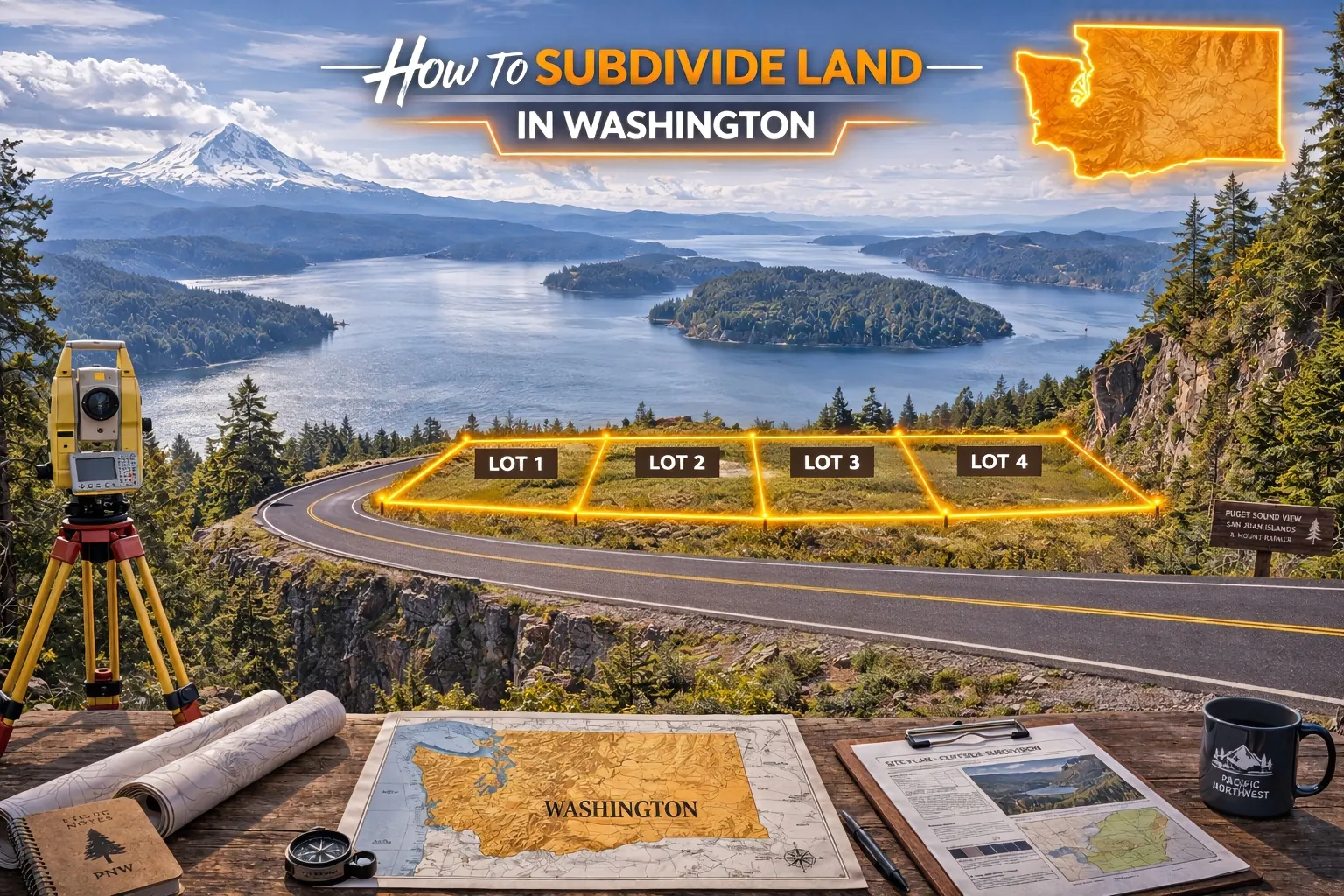
Understanding Land Subdivision in Washington
Washington delegates significant power to local counties under the Growth Management Act (GMA). This means the rules and timelines in King County will differ significantly from those in Spokane County or Pierce County. The foundation of state land division is found in the Revised Code of Washington, specifically Chapter 58.17 RCW. Before hiring a surveyor, you must understand the different subdivision classifications recognized by the state.
What is a Short Plat?
A short plat is the administrative process for creating smaller subdivisions. By state definition, a short subdivision involves dividing land into four or fewer lots. Local city or county ordinances can increase this threshold up to nine lots within designated urban growth areas. This route is faster, involves less red tape, and is generally more affordable for the average property owner.
What is a Long Subdivision?
A long subdivision, commonly called a long plat, is required when dividing land into five or more lots. If your local municipality allows short plats up to nine lots, a long subdivision triggers at ten lots. This process requires extensive infrastructure development, public hearings, and detailed reviews by the local Planning Commission or Hearing Examiner.
Unit Lot Subdivisions Explained
Washington has expanded options for middle housing. Unit lot subdivisions allow property owners to divide land for townhomes and similar attached housing types without adhering to standard minimum lot size requirements. This creates separately owned unit lots from a parent parcel, promoting housing density in urban areas while simplifying the legal ownership structure.
Key Requirements for Washington Property Owners
Zoning Laws and Minimum Lot Sizes
Local zoning strictly dictates whether your parcel is eligible for division and how many lots you can create. Your property must meet the minimum lot size requirements for its specific zone after the division is complete. Washington’s Growth Management Act specifically restricts high-density subdivisions outside of designated Urban Growth Areas to preserve rural character and agricultural lands, meaning rural zoning often demands much larger minimum lot sizes.
The State Environmental Policy Act (SEPA)
Projects creating a certain number of lots or impacting critical areas trigger an environmental review under SEPA. The Municipal Research and Services Center (MRSC) outlines how these regulations ensure developments mitigate their impact on wetlands, steep slopes, and local wildlife habitats. Depending on your property, you may need to hire specialists to draft wetland mitigation plans, tree retention strategies, or geotechnical reports.
Road Access and Right of Way Standards
Every newly created lot requires legal and physical access. Counties enforce strict standards for right of way widths, paving requirements, and emergency vehicle turnarounds. You must factor road construction into your plans if your property lacks adequate frontage. This often includes securing legal access easements from neighboring property owners if your parcel is situated off the main road.
Water Rights and Septic Approvals
You must prove each new lot has an adequate, legally secure water supply. In Washington, water availability is heavily regulated by the Department of Ecology. You often need to drill wells and prove adequate water flow before receiving final county approval. Parcels without municipal sewer access must pass soil percolation tests to guarantee they can support independent septic systems, which can be challenging in areas with high water tables or rocky terrain.
The Step by Step Guide to Subdividing Your Land
Step 1: The Pre Application Conference
Meet with your local county planning department to review the feasibility of your project. This meeting helps identify major red flags, zoning constraints, and critical area overlays before you spend money on engineering and surveying.
Step 2: Hiring Your Professional Team
Subdividing land requires experts. You need to hire the following professionals to build a successful application:
- Registered professional land surveyors to map boundaries and topography.
- Civil engineers to design roads, utilities, and drainage systems.
- Soil scientists to evaluate the land for septic design.
- Land use attorneys or planners to navigate county bureaucracy and represent you at hearings.
Step 3: Submitting the Preliminary Plat
Your team will submit the preliminary plat application. This includes detailed site plans, title reports, and environmental studies. The county reviews these documents to ensure compliance with all local ordinances, state laws, and public health codes.
Step 4: Constructing Required Improvements
Upon preliminary approval, you enter the construction phase. You must install roads, run utilities, and build stormwater drainage systems. Some jurisdictions allow you to post a completion bond instead of finishing all construction upfront, but the infrastructure must eventually be built to county standards.
Step 5: Final Plat Approval and Recording
The county completes a final review once all physical improvements are finished or bonded. You must pay all outstanding property taxes in full. The final step is officially recording the signed plat map with the county auditor, legally creating your new individual buildable lots.
Financial Breakdown: Costs to Subdivide in Washington
Subdividing land requires significant upfront capital. Costs vary wildly based on parcel size, topography, and county regulations. The table below outlines estimated expenses for a typical 4-lot short plat in a moderately regulated Washington county.
| Expense Category | Estimated Cost Range | Description |
|---|---|---|
| Surveying & Engineering | $8,000 to $25,000 | Boundary mapping, topography, and civil engineering plans. |
| County Application Fees | $3,000 to $8,000 | Preliminary and final plat fees, plus SEPA review if triggered. |
| Infrastructure & Utilities | $20,000 to $100,000+ | Road paving, power extension, water lines, and drainage installation. |
| Environmental Studies | $2,000 to $10,000 | Soil testing, wetland delineation, and habitat assessments. |
| Total Estimated Cost | $33,000 to $143,000+ | Varies heavily by project scope, location, and existing utilities. |
Surveying and Professional Engineering Fees
Surveyors and engineers form the bulk of your initial soft costs. Complex terrain or heavily wooded parcels increase the hours required for precise mapping and design, driving up professional fees significantly.
County Application and Permitting Costs
Local governments charge for reviewing your plans. These fees cover planning department hours, health department septic reviews, and impact fees designed to offset the burden your new lots will place on local schools, parks, and traffic infrastructure.
Infrastructure and Utility Installation Expenses
Physical construction is the most expensive phase of land division. Running power lines, paving county standard roads, and installing municipal water systems or drilling private wells require major investment before you ever sell a lot.
Evaluating Your Options: Is Subdividing Worth It?
Potential Return on Investment
Selling multiple individual, buildable lots yields a higher total sale price than selling one large vacant tract. Investors and landowners willing to fund the infrastructure and navigate the timeline can secure strong profits by catering to builders looking for shovel-ready land.
Common Pitfalls and Delays
Subdividing is time intensive. Short plats typically take six to eighteen months from concept to recording. Long subdivisions can easily take two to three years. Unexpected environmental restrictions, neighbor opposition, or surveyor backlogs escalate holding costs and delay your return on investment.
A Hassle Free Alternative: Sell Your Washington Land As Is
Bubba Land Company offers a direct solution for landowners wanting to bypass the massive upfront costs, multi-year timelines, and county bureaucracy. We buy vacant rural land, hunting acreage, and inherited properties nationwide for cash, providing a streamlined exit strategy.
Skip the red tape and expensive engineering fees by requesting a cash offer today. We cover all closing costs and purchase properties in their current condition, ensuring a fast and straightforward transaction. If you are ready to turn your property into cash without the headaches of subdividing, you can sell your Washington land directly to us.