Illinois Fence Laws: A Comprehensive Guide (2026 Update)
Overview: Illinois fence laws are governed primarily by state statute (the Illinois Partition Fence Act) for rural land, farmland, and shared boundary fences, and by local ordinances for city lots, subdivisions, and residential neighborhoods. If you’re dealing with a boundary fence, livestock issues, or a neighbor dispute, the most important first step is identifying whether state partition fence rules or local zoning rules actually apply to your property.
Key Points:
- Fence-In State: Illinois requires livestock owners to keep animals contained and assigns liability when animals run at large.
- Partition Fence Duty: On rural and agricultural land, Illinois law can require neighbors to share construction and maintenance costs for boundary fences.
- Local Control: Inside city limits and subdivisions, fence height, materials, setbacks, and permits are typically controlled by municipal code or HOA rules.
Side Note: If boundary disputes, fence costs, and neighbor disagreements are blocking your plans, you can sell your Illinois land directly and move on without the ongoing conflict.

Who This Guide Is For
Illinois fence law usually doesn’t come up until something goes wrong. A fence needs repairs, livestock get out, a neighbor demands payment, or a survey reveals the fence isn’t where everyone thought it was. At that point, vague advice and generic blog posts stop being helpful. This guide is written for Illinois landowners who need clear, practical answers to the questions that surface once a fence becomes a legal issue—not a weekend project.
You’ll find direct guidance here if you’re asking questions like:
- Cost-sharing: “Do I legally have to pay for half of my neighbor’s fence in Illinois?”
- Boundary disputes: “What happens if my neighbor refuses to repair or replace a shared fence?”
- Farmland questions: “Do fence rules change when agricultural land is involved?”
- Livestock liability: “If cattle or horses escape, who is actually responsible for damage?”
- City and subdivision limits: “How high can my fence be if I’m inside city limits or an HOA?”
If you’re already dealing with a disagreement—or trying to avoid one—this guide is designed to help you understand which rules apply, why they exist, and how they’re enforced in real situations.
Illinois Fence Laws: State Rules vs. Local Rules
Most fence disputes in Illinois start because people apply the wrong rule set. Here’s the clean way to think about it:
- State rules answer questions like: “Who pays for a shared boundary fence?” and “What happens when livestock get out?” These rules matter most on rural property and agricultural land.
- Local rules answer questions like: “How tall can my fence be?” and “Do I need a permit?” These rules matter most in cities, subdivisions, and HOA communities.
Why this matters: Many people lose leverage by arguing fence height or materials when the real issue is a shared boundary duty, or by quoting state law when local zoning actually controls the outcome.
What Counts as Agricultural Land in Illinois
Illinois partition fence duties most often arise when at least one property involved is treated as agricultural land. This matters because Illinois law treats farmland boundaries differently than residential lots, especially when shared fence responsibility and cost-sharing are involved.
In practical terms, agricultural land commonly includes:
- Land used for crop production or hay
- Land used for grazing or livestock
- Acreage historically treated as farm ground, even if currently idle
Key takeaway: Whether you personally own livestock is often less important than how the land itself is classified and used. Many Illinois fence disputes turn on land use, not animal ownership.
What Is a Partition Fence in Illinois?
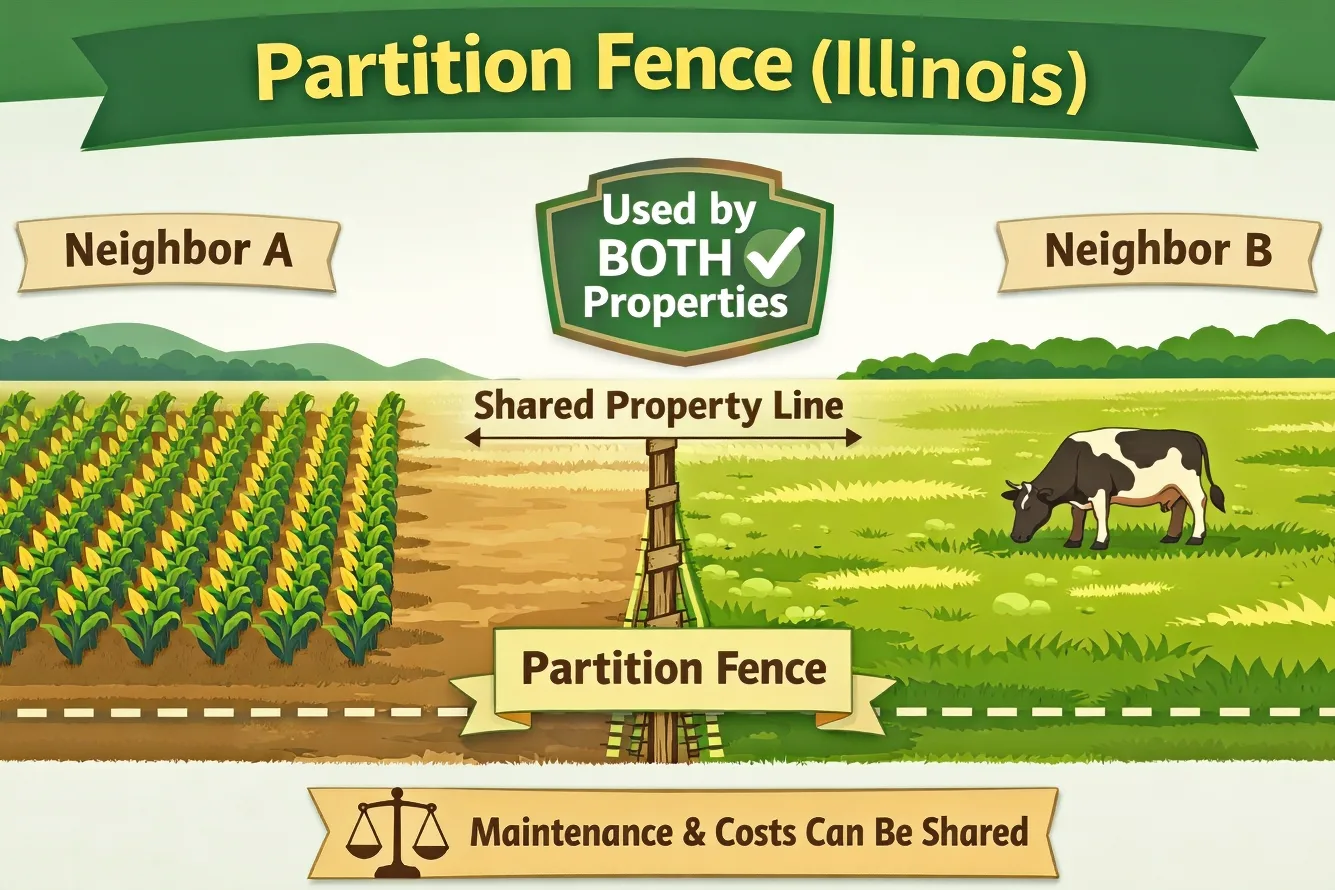
A partition fence is a boundary fence that separates two adjoining properties and is treated as a shared obligation under Illinois law. Once a fence qualifies as a partition fence, legal duties related to construction, maintenance, and cost-sharing can be enforced.
In real life, a fence is commonly treated as a partition fence when:
- It runs along the recognized or surveyed boundary line
- Both owners rely on it as the dividing fence between properties
- It serves a containment or boundary function, not just decoration
Real-world context: If two parcels share a long farm boundary, differences in land use alone do not eliminate shared responsibility when the fence functions as the boundary fence.
Do I Have to Pay for Half of My Neighbor’s Fence in Illinois?
Often—yes. Illinois law generally requires adjoining owners to share the cost of a lawful partition fence when state fence rules apply to the property.
Whether payment responsibility applies often depends on the specific facts of how the fence was built and maintained, including:
- Whether the fence was built without proper notice
- Whether the fence exceeds what is reasonably necessary
- Whether the fence is actually located on the true boundary line
Practical advice: If you receive a demand for payment, confirm the fence location, land classification, and notice history before agreeing or refusing to pay.
What Is Considered a Lawful Fence in Illinois?
Illinois law focuses on function over appearance. A lawful fence is one that is reasonably capable of restraining ordinary livestock under normal conditions.
A lawful fence typically includes:
- Wire or woven fencing suitable for farm use
- Board or rail fencing
- Posts firmly set at reasonable intervals
- A height sufficient to contain animals (commonly around 4.5 feet)
Important: In disputes, “lawful” is often judged by effectiveness. A fence that looks acceptable but fails to contain animals can lose legal protection.
When a Neighbor Refuses to Cooperate
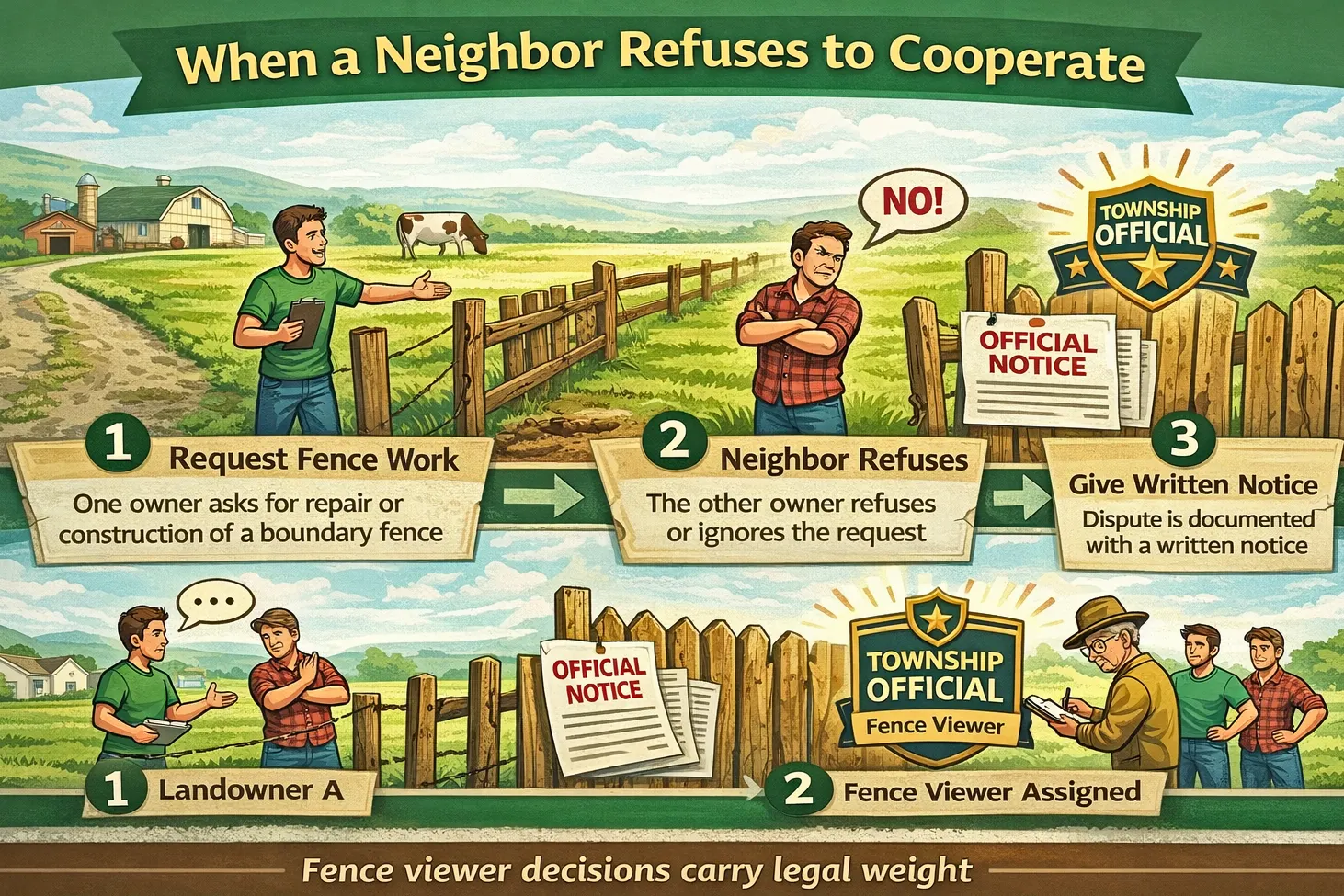
Illinois law provides a dispute-resolution process designed to avoid immediate lawsuits. When neighbors cannot agree on a shared boundary fence, the issue is often handled through township fence viewers.
Fence disputes commonly follow this sequence:
- One owner requests repair or construction of the boundary fence
- The other owner refuses or ignores the request
- Written notice is provided to document the dispute
- Township officials inspect the fence and assign responsibility
Why this matters: Fence viewer decisions carry legal weight and can be enforced if a landowner refuses to comply.
Livestock Running at Large
Illinois is a fence-in state, meaning livestock owners are expected to keep animals contained on their property to prevent damage and safety risks.
When animals escape, the issue quickly shifts to liability and enforcement concerns, including:
- Civil liability for property damage caused by escaped animals
- Escalating disputes when incidents happen repeatedly
- No excuse for poor maintenance, even when fences are shared
Practical tip: Fix containment issues first. Fence cost disputes are much harder to defend when animals continue to get out.
Local Fence Rules Still Matter
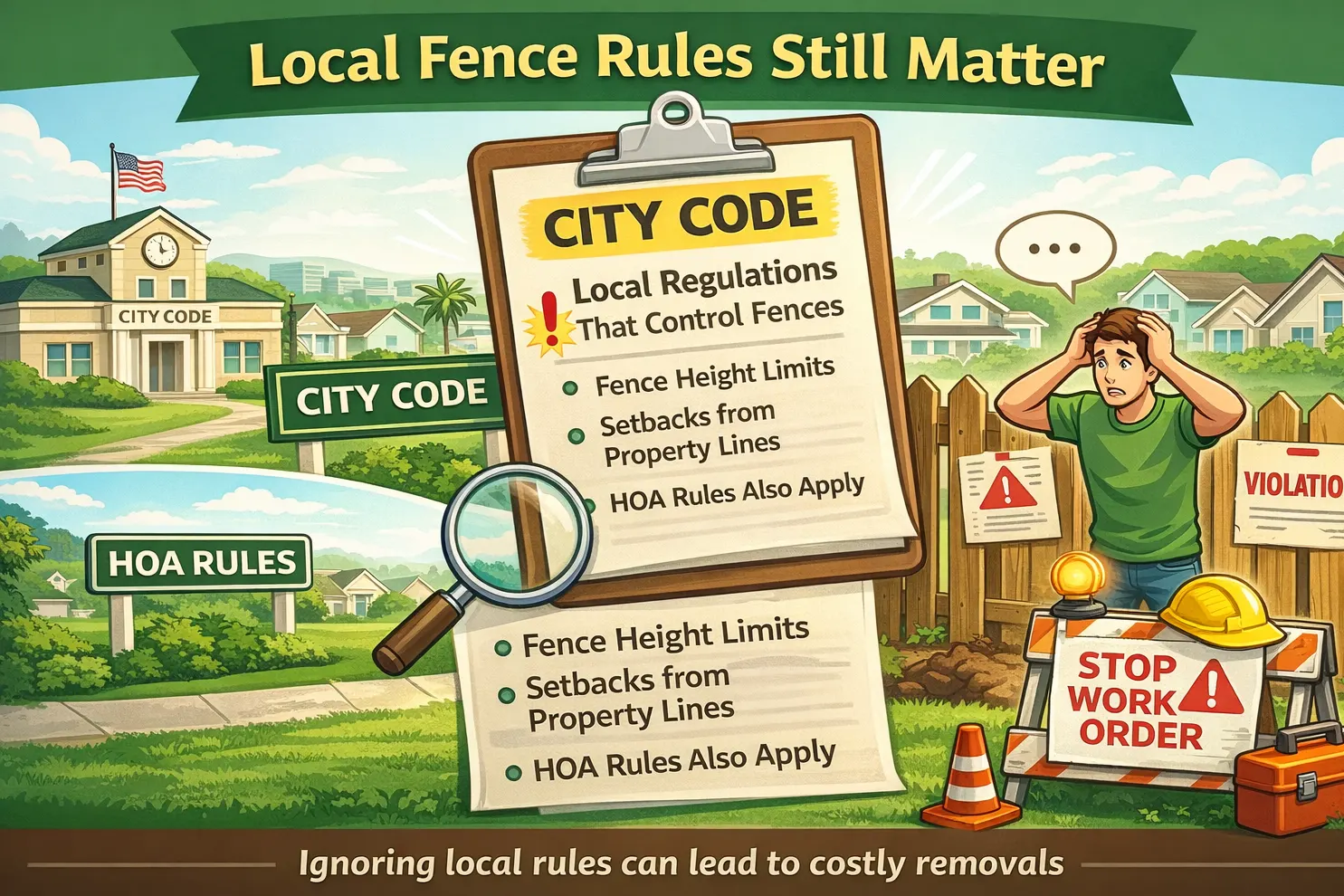
State fence law does not override city ordinances or HOA rules. In residential areas, local regulations often control whether a fence is allowed and how it must be built.
Local rules commonly regulate:
- Fence height limits
- Setbacks from sidewalks or property lines
- Corner lot visibility requirements
- Approved materials and fence styles
- Permit requirements before construction
Important: Ignoring local rules is one of the fastest ways to be forced to remove a newly installed fence.
Property Lines, Surveys, & Encroachment Risk
Fence disputes often expose deeper boundary problems. Many conflicts are not really about the fence itself, but about where the property line is legally located.
Common risks when a fence is misplaced include:
- Encroachment claims from a neighboring landowner
- Forced removal after installation
- Title and sale complications when the property is transferred
Best practice: If the boundary line is unclear, a professional survey is usually far cheaper than a prolonged dispute later.
Checklist: What to Do Before You Build or Repair a Fence
- Identify which rules apply: State partition fence law (rural/ag) or local ordinance / HOA rules (city or subdivision).
- Confirm land use: Determine whether agricultural land is involved on either side of the boundary.
- Verify the boundary line: Use a survey if the property line is unclear—do not rely on old fences or verbal agreements.
- Confirm it’s a partition fence: Shared duties usually apply only if the fence sits on the boundary and serves as the dividing fence.
- Provide written notice: Document requests for repair, replacement, or cost-sharing before spending money.
- Address livestock containment: Fix escape points immediately to reduce liability and escalation.
- Check local restrictions: Review height limits, setbacks, materials, permits, and HOA approvals.
- Call 811 before digging: Utility marking is required before installing or replacing fence posts.
🛠️ Free Resource: The Professional Fence & Boundary Audit 🛠️
Don’t risk legal liability or neighbor disputes by guessing. We’ve developed this comprehensive 4-phase field guide to help you audit boundaries, verify compliance, and document communication like a pro.
📥 Download the Printable PDF Audit
Print this out to use as a worksheet while you walk your property line.
Illinois Fence Law Case Studies: Real Court Decisions
These Illinois court decisions show how fence disputes are resolved in practice. Rather than relying solely on fence placement or age, Illinois courts focus on boundary by acquiescence, intent of the parties, and long-term conduct. These cases demonstrate how judges analyze fence-related disputes involving boundary lines, long-standing fences, and conflicting survey evidence.
Joiner v. Janssen (1981)
In Joiner v. Janssen, neighboring landowners disputed whether an old fence line controlled the legal boundary between their properties. One party argued that the fence had been treated as the boundary for many years and should override the deed description. The Illinois Supreme Court held that a boundary may be established by acquiescence when adjoining landowners mutually recognize and accept a fence as the dividing line for a long period of time, even if the fence does not match the surveyed boundary.
- Legal Principle: Illinois recognizes boundary by acquiescence when long-term mutual recognition is proven.
- Key Limitation: Mere existence of a fence is not enough; intent and conduct matter.
- Case Takeaway: “Can a fence override a deed?” Yes — but only with mutual recognition.
McMahon v. Hines (2000)
In McMahon v. Hines, the Illinois Appellate Court examined whether a fence that had existed for decades established the boundary line between neighboring parcels. The court reviewed evidence showing how the parties used, maintained, and relied on the fence. The court concluded that long-term acceptance and use of the fence as the dividing line supported a finding of boundary by acquiescence, even though later surveys showed a different line.
- Case Context: Long-standing fence versus conflicting survey evidence.
- Legal Principle: Boundary by acquiescence may override deed descriptions when mutual recognition is shown.
- Case Takeaway: “What does enough evidence of acquiescence look like?” Long-term behavior beat the paper survey.
Bremer v. Lake (1991)
In Bremer v. Lake, the court considered whether a fence erected for practical purposes—rather than to mark a boundary—could later be treated as the legal property line. The Illinois Appellate Court rejected the fence-as-boundary claim, finding insufficient evidence that both parties intended the fence to establish the boundary. The court emphasized that fences built for convenience, livestock, or temporary use do not automatically control title.
- Case Context: Fence built for practical use versus boundary intent.
- Legal Principle: Boundary by acquiescence requires clear mutual intent, not mere convenience.
- Case Takeaway: “What is NOT boundary by acquiescence?” A fence built for convenience without shared boundary intent.
FAQs
Do I have to pay for half of my neighbor’s fence in Illinois?
Often yes, if the fence is a lawful partition fence on rural or agricultural land. Inside city limits or HOAs, cost-sharing is usually controlled by agreements or local rules.
What is a partition fence?
A partition fence is a boundary fence between two properties that Illinois law treats as a shared responsibility under certain conditions.
Who resolves fence disputes in Illinois?
Fence disputes are commonly handled by township fence viewers when neighbors cannot agree.
What counts as a lawful fence?
A lawful fence is one that is reasonably capable of restraining livestock, using common agricultural fencing methods.
Are fence rules different inside city limits?
Yes. City ordinances and HOA rules often control fence height, placement, materials, and permits.
Conclusion
Illinois fence laws are built around a simple principle: when a fence serves as a shared boundary—especially on rural or agricultural land—responsibility is often shared as well. In those situations, state partition fence rules control issues like cost-sharing, maintenance, and enforcement. Inside city limits and subdivisions, however, local zoning rules and HOA covenants usually matter far more than state statute.
Most fence disputes escalate because the wrong legal framework is applied to the situation. A boundary fence issue gets treated like a height dispute, or a livestock problem turns into a property line argument. Identifying whether state law or local code applies—before money is spent or positions harden—can prevent unnecessary conflict and protect your leverage.
If fence disputes, surveys, or ongoing neighbor disagreements are holding your property back, there is also a simpler option. You can avoid the back-and-forth entirely by choosing to sell your Illinois land and move forward without the ongoing legal and personal friction.