Iowa Fence Laws: Partition Fences, Liability, & Cost Sharing
Overview: Iowa fence law isn’t automatic—it’s triggered. Neighbors don’t split costs by default, but once the process starts, sharing can be enforced. Disputes go to township “fence viewers,” and fence standards vary based on livestock use.
Key Points:
- No Automatic Fence Duty: Sharing a boundary alone does not require either owner to build a fence.
- Partition Fences: Once properly requested, costs and maintenance can be split between neighbors.
- Lawful vs. Tight Fence: The state law sets specific construction standards based on land use and livestock.
Side Note: If township hearings, surveys, and fence disputes start to feel like more than you want to deal with, you can explore selling your Iowa land directly and step away from the back-and-forth.

Iowa Fence Laws Explained (2026 Guide for Landowners)
Iowa fence laws don’t work the way most landowners expect. There’s no automatic requirement to build or share a fence just because two properties meet. Instead, everything hinges on a formal process under Chapter 359A—covering partition fences, cost-sharing, and dispute resolution through township “fence viewers.” Understanding how and when that process is triggered is what determines who pays, who builds, and who’s responsible.
Do Iowa Fence Laws Apply Statewide?
Yes. Iowa fence laws apply statewide, but they function differently than in many neighboring states. Iowa does not require property owners to fence their land by default. Instead, the law allows a fence to become mandatory only after one landowner formally invokes the partition fence process outlined in IA Code Chapter 359A.
What Is a “Partition Fence” in Iowa?
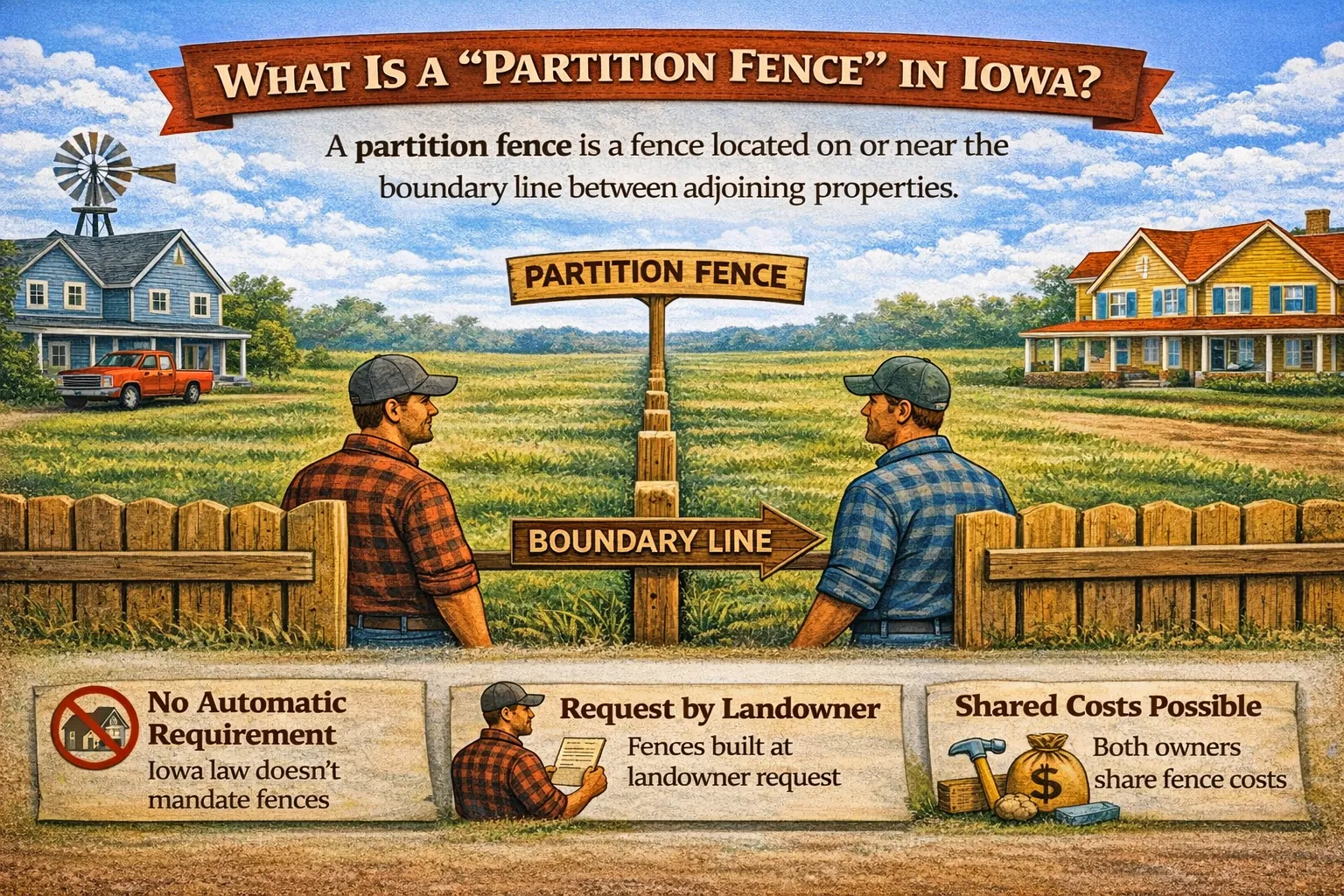
A partition fence is located on or near the boundary line between adjoining properties. Properties do not automatically require a fence just because they touch. However, a landowner can officially request a partition fence if it is necessary for a lawful land use. Once the proper statutory process outlined in IA Code §§ 359A.1 through 359A.6 is followed, both neighbors may be required to share the construction and ongoing maintenance costs.
What Defines a “Lawful Fence”?
Iowa provides a clear statutory definition of a lawful fence under IA Code § 359A.18. To be legally sufficient, a fence must be built with approved materials like wire, boards, or rails, and feature posts that are properly set and spaced according to state guidelines. The structure must successfully restrain the type of livestock customarily kept in that specific area. Fences failing to meet these minimum standards are generally not enforceable under state law.
Quick Reference: Iowa Fence Law Summary
What is a “Tight Fence”?
Iowa law recognizes a stricter category known as a tight fence, governed by IA Code §§ 359A.19 through 359A.21. This upgraded standard is typically required when the land is used to pasture sheep or swine, when a neighboring landowner makes a proper statutory demand, or if local fence viewers determine a tighter standard is necessary. Once established, each landowner becomes legally responsible for maintaining their assigned portion of the fence to this exact tight-fence standard.
The “Right-Hand Rule”: Is It Law?
The so-called right-hand rule—where each neighbor maintains the fence to their right when facing the boundary—is a common practice in the state. However, it is not required by statute. Fence viewers or written agreements between landowners determine responsibility. Relying on tradition alone can lead to disputes if a disagreement arises.
Fence Disputes and Fence Viewers (Township Trustees)
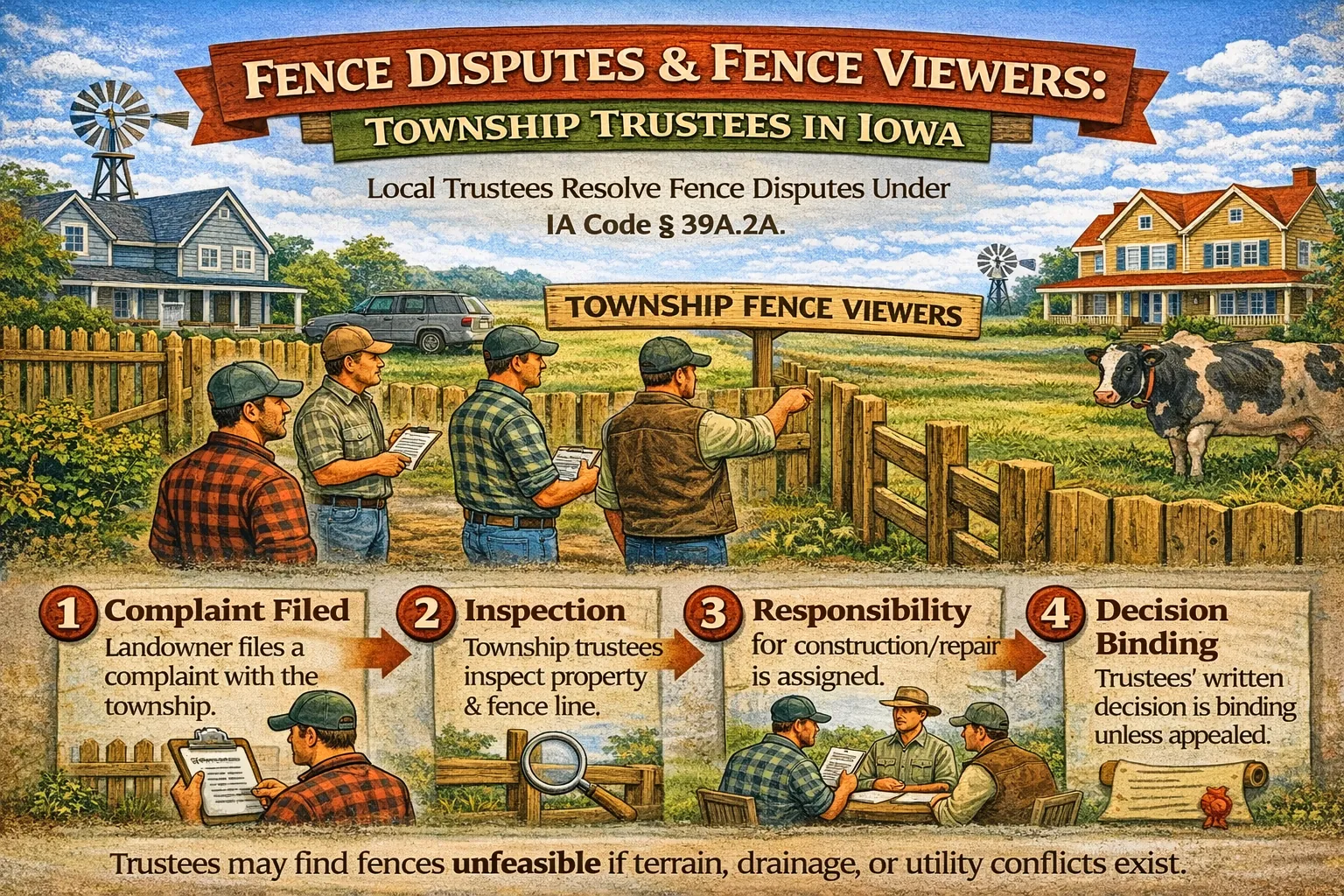
Iowa resolves fence disputes through township trustees acting as fence viewers under IA Code § 359A.2A.
The process typically works as follows:
- A landowner files a complaint or request with the township.
- The trustees inspect the property and fence line.
- They assign responsibility for construction or repair.
- Their written decision is binding unless appealed.
Fence viewers may also determine that constructing a fence is unfeasible due to terrain, drainage, or utility conflicts.
Livestock Trespass and Fence Maintenance Liability
Iowa generally follows a fence-in approach for livestock liability. Livestock owners are usually responsible for damages caused by animals that escape their property. However, under IA Code Chapter 169C, a livestock owner may avoid liability if the escape occurred through a partition fence that the other landowner failed to maintain as required under Chapter 359A.
Property Lines, Fence Lines, and Boundary by Acquiescence
In Iowa, a fence line can become the legal boundary through boundary by acquiescence. If both landowners recognize and treat a fence as the boundary for 10 consecutive years, that fence line may become the legal property line—even if a later survey shows otherwise. Because of this risk, building a fence without a survey can permanently affect property boundaries.
Local Fence Ordinances and Permits
Cities and counties in Iowa may impose additional fence rules through zoning and municipal codes.
Local regulations often address:
- Maximum fence height in front and rear yards
- Approved materials and safety restrictions
- Barbed wire or electric fence limitations
- Which side of the fence must face outward
Local ordinances cannot contradict state law, but they frequently add compliance requirements.
Checklist: What to Do Before You Build a Fence in Iowa
- Confirm Land Use: Determine whether a lawful or tight fence standard applies.
- Survey the Boundary: Do not rely on old markers or assumptions.
- Provide Written Notice: Follow Chapter 359A procedures before demanding cost-sharing.
- Contact Township Trustees: Use fence viewers if disputes arise.
- Check Local Codes: Verify permits, height limits, and material rules.
🛠️ Free Resource: The Professional Fence & Boundary Audit 🛠️
Don’t risk legal liability or neighbor disputes by guessing. We’ve developed this comprehensive 4-phase field guide to help you audit boundaries, verify compliance, and document communication like a pro.
📥 Download the Printable PDF Audit
Print this out to use as a worksheet while you walk your property line.
Iowa Fence Law Case Studies: Real Court Decisions
These Iowa court decisions show how fence disputes are resolved in practice under Iowa law. Rather than relying on rigid fence measurements alone, Iowa courts focus on long-term land use, mutual conduct between neighbors, and whether a fence was actually treated as the legal boundary. These cases reflect how Iowa judges analyze disputes involving boundary fences, acquiescence, and conflicts between old fence lines and surveyed property boundaries.
Carpenter v. Ruperto (1987)
In Carpenter v. Ruperto, neighboring landowners disputed whether a fence line that had existed for decades should control the legal boundary instead of the deeded survey line. One party argued that long-term acceptance of the fence established ownership through acquiescence. The Iowa Supreme Court rejected that argument, holding that boundary by acquiescence requires more than the mere existence of a fence—it requires clear proof that both parties mutually recognized and treated the fence as the boundary for the statutory period.
- Legal Principle: Iowa recognizes boundary by acquiescence only when both parties clearly and mutually treat a fence as the boundary.
- Key Limitation: Silence, inattention, or assumption is not enough to establish acquiescence.
- Key Takeaway: In Iowa, long-standing fences do not become legal boundaries without clear evidence of mutual intent.
Mitchell v. Jones (1983)
In Mitchell v. Jones, the court examined whether a fence that had been maintained for many years controlled the boundary between adjoining properties. One landowner relied on historical fence placement, while the other relied on a professional survey. The Iowa Supreme Court emphasized that surveys and deed descriptions control unless there is strong, affirmative evidence of boundary by acquiescence. The fence’s age alone was not enough to override recorded title.
- Case Context: Conflict between a long-standing fence and a surveyed boundary line.
- Legal Principle: Iowa courts favor surveys unless acquiescence is proven with clear evidence.
- Key Takeaway: A fence does not replace a survey in Iowa without strong proof of mutual boundary recognition.
Eldridge v. Herman (1999)
In Eldridge v. Herman, the court addressed whether neighboring landowners’ conduct over time established a boundary different from the legal description. The dispute centered on a fence that had been treated as the dividing line for years, even though no formal agreement existed. The court clarified that acquiescence requires a shared understanding and consistent treatment of the fence as the boundary—not mere convenience or assumption.
- Legal Standard: Boundary by acquiescence in Iowa requires mutual recognition, not passive acceptance.
- Evidence Matters: Courts look at conduct, maintenance, and how the land was actually used.
- Key Takeaway: Iowa courts require clear, objective proof that both neighbors accepted the fence as the boundary.
Frequently Asked Questions About Iowa Fence Laws
Who pays for a fence between neighbors in Iowa?
In Iowa, fence costs are only shared after the partition fence process is properly initiated under Chapter 359A.
What is a lawful fence in Iowa?
A lawful fence meets the construction standards outlined in IA Code § 359A.18 and must be sufficient to contain livestock common to the area.
Are fences required between properties in Iowa?
No. Iowa does not require fences by default. A fence becomes mandatory only after a landowner formally requests a partition fence.
What do fence viewers do in Iowa?
Township trustees act as fence viewers and resolve disputes by inspecting the property and issuing binding decisions.
Navigating Iowa Boundary and Fence Laws
Iowa fence laws balance agricultural tradition with modern property rights. Understanding when a fence is mandatory and how disputes are resolved helps prevent costly mistakes. Compliance requires knowing the state statutes, understanding lawful fence standards, and formally documenting all neighbor agreements.
Managing boundary disputes, township trustee hearings, and complex surveys requires significant time and resources. Landowners seeking a simpler exit strategy often choose to divest their property entirely. If you want a straightforward, “as-is” solution that transfers the legal and boundary complexities to a new owner, you can sell your Iowa land fast to a direct cash buyer.