Landlocked Property Illinois 🔓 Unlocking Your Land
Illinois Landlocked Property Basics:
- Formal Agreements Required: Physical access is not legal access. You must establish a recorded express easement or court order to guarantee property rights.
- Illinois Easement Laws: State courts grant access through easements by necessity or prescriptive easements, which require 20 years of continuous adverse use.
- Valuation Impact: Landlocked parcels trade at a discount and fail traditional financing. Direct cash buyouts bypass lengthy legal processes.
Skip the Hassle: Bubba Land Company specializes in problem acreage, allowing you to sell your Illinois land as is and close quickly.
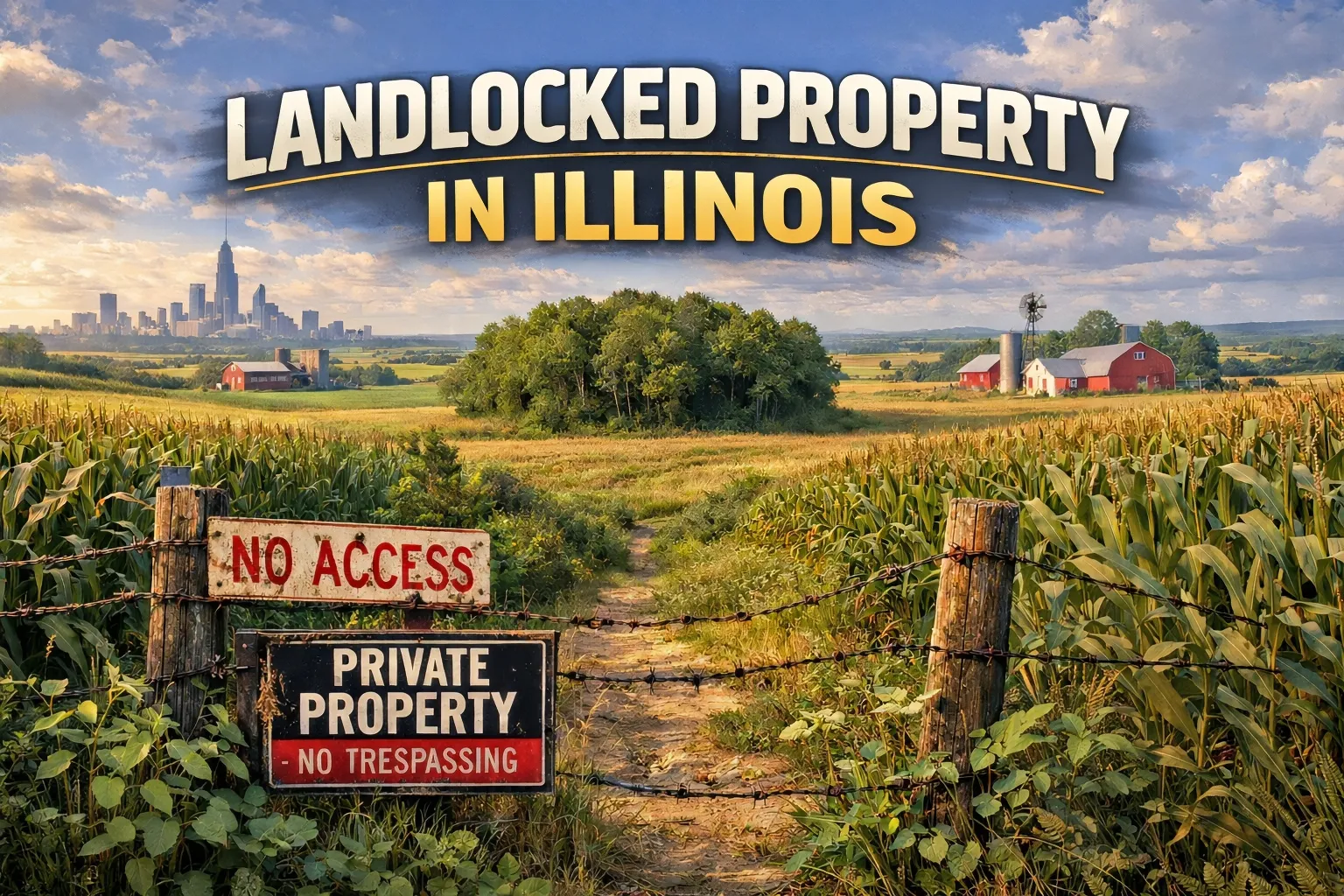
The Legal Definition of Illinois Landlocked Property
A property is considered landlocked when it has no direct legal access to a public road or right of way. You must physically cross another person’s private property to reach your own land. Physical access and legal access are two entirely different concepts. You might have driven a truck across a neighboring farmer’s field for decades. That historical physical access guarantees absolutely nothing regarding your legal rights. Without a recorded document explicitly granting you the right to cross that adjacent parcel, you hold a landlocked property.
In legal terms, the property that benefits from an access route is called the dominant estate. The property that provides the access route is the servient estate. Establishing a legal connection between these two estates is mandatory for achieving full property utility and marketability.
How Lack of Access Impacts Land Valuation
Access issues create severe bottlenecks for property development, utilization, and financing. Traditional lending institutions require deeded access before approving a mortgage or construction loan. Buyers requiring financing are immediately eliminated from your potential buyer pool.
This lack of legal ingress and egress heavily suppresses the fair market value of the parcel. Timber companies require legal road access to bring heavy harvesting equipment onto the property. Hunters need guaranteed legal routes to access their hunting land without risking trespassing charges. Real estate developers need guaranteed right of ways to pull building permits and install utilities. When we conduct our market analysis, we find that landlocked parcels trade at a substantial discount compared to identical parcels with established road frontage. The cost to cure the access issue is always factored directly into the valuation.
Understanding Illinois Easement Laws
Illinois law provides several legal mechanisms to establish access rights across neighboring land. Understanding these specific legal avenues is crucial for any landowner attempting to resolve an access dispute.
Express Easements
An express easement is the most secure and desirable form of legal access. This is a formal written agreement between two landowners. The owner of the servient estate explicitly grants the owner of the dominant estate the right to cross their land. This agreement is formalized in a legal document, signed, notarized, and recorded with the local county clerk. Once recorded, the easement runs with the land. It remains intact even if both properties are sold to new owners in the future.
Easements by Implication and Necessity
Illinois courts may grant an easement by necessity under very specific historical conditions. This legal mechanism applies when a single, larger property was historically subdivided into smaller parcels, leaving one of the newly created parcels completely landlocked. The legal theory implies that the original owner fully intended for all resulting parcels to have road access.
To win this type of case, you must prove through historical deed research that the two properties were once unified under a single owner. You must also prove that the easement is strictly necessary for the beneficial use of the land. Convenience is insufficient. If another, albeit more difficult, access route exists, the court will deny the easement by necessity.
Prescriptive Easements and the 20 Year Rule
A prescriptive easement operates similarly to the concept of adverse possession. It is established through continuous, visible, open, and uninterrupted use of another person’s land for a specific statutory period. In Illinois, the statutory requirement for this continuous adverse use is 20 years.
The use must be without the owner’s permission. If the neighbor granted you verbal permission to use the path, the use is not adverse, and a prescriptive easement cannot be formed. Formalizing this right requires gathering substantial evidence, such as historical photographs or sworn affidavits from previous owners, and filing a lawsuit. For specific details on state property laws, you can review the Illinois Compiled Statutes directly.
Water Access and Navigable Rivers
Many landowners mistakenly believe that bordering a navigable river or lake resolves access issues. Physical access via a waterway does not guarantee legal overland access. You still need a place to legally park a vehicle and cross land to reach the water. Furthermore, navigating a waterway to reach a landlocked parcel does not grant you the right to anchor on or cross neighboring private riverbeds. Securing guaranteed overland rights is always the superior strategy to ensure full property utility.
Practical Steps to Establish Legal Access
Taking proactive steps will clarify your property rights and improve the marketability of your rural acreage.
Conduct a Comprehensive Title Search
Hire a reputable title company or real estate attorney to perform a deep historical title search. Forgotten express easements are sometimes buried in old deed records from decades ago. An updated title commitment will reveal any existing recorded access rights that were simply omitted from your most recent deed.
Order a Professional Boundary Survey
Engage an Illinois licensed professional land surveyor to map your exact property boundaries. The survey will identify historical access routes, old logging roads, and the precise property lines of all adjacent neighbors. This document is essential for any future negotiations or court proceedings.
Negotiate an Access Agreement with Neighbors
Speak directly with your adjacent neighbors to negotiate the purchase of an express easement. Approach the conversation professionally and be prepared to offer fair market compensation for the strip of land required for the driveway. Presenting a clear survey and a fair financial offer is the most efficient way to resolve the issue outside of a courtroom.
Initiate a Quiet Title Action
Retain a qualified real estate attorney to file a quiet title action in the local circuit court if neighbor negotiations fail. This lawsuit asks a judge to officially recognize an easement by necessity or a prescriptive easement. This process requires significant capital for legal fees and often takes years to resolve.
Frequently Asked Questions
Can a neighbor legally block my access in Illinois?
Yes. If you do not possess a recorded deeded easement, your neighbors have the absolute legal right to erect fences, install gates, and deny you access across their private property. They are protecting their own servient estate from trespassing.
Is landlocked property in Illinois completely worthless?
No. Landlocked property still holds intrinsic value. It is highly valuable to the adjacent neighbors who can easily absorb it into their existing footprint. It is also valuable to specialized land buyers like Bubba Land Company who possess the capital and legal expertise to cure the access defects over time.
Can I force my neighbor to give me an easement?
You cannot force a neighbor to grant an express easement through simple demand. You must file a lawsuit and prove to a judge that you meet the strict legal requirements for an easement by necessity or a prescriptive easement. The burden of proof falls entirely on you as the landowner seeking access.
Conclusion
Owning landlocked property in Illinois presents significant challenges regarding utilization and valuation. Establishing a legal right of way requires navigating complex easement laws, engaging in delicate neighbor negotiations, or funding lengthy court battles. If you want to bypass the stress, my team at Bubba Land Company is ready to help. We offer a fast, hassle-free cash sale for your rural acreage, allowing you to walk away from the legal headaches quickly.
Resolving Midwest Property Access
Managing isolated acreage outside of Illinois requires a firm grasp of different municipal right-of-way regulations. Securing legal entry to landlocked parcels in neighboring states involves navigating unique statutory easements and boundary codes. Whether you own rural farmland or timber tracts, understanding these regional access rules is essential for maintaining your property’s overall marketability. Explore our specialized guides below to confidently handle easement laws in adjoining jurisdictions.
- Indiana Property Access Laws: Navigate the Hoosier State’s specific legal pathways for establishing private ways of necessity to your isolated acreage.
- Iowa Landlocked Parcel Guide: Understand the Hawkeye State’s statutory procedures for securing legal entry and resolving boundary disputes over farmland.
- Michigan Easement Law Guide: Master the Great Lakes State’s requirements for unlocking remote timberland and recreational tracts.