Landlocked Property Nebraska 🔓 Unlocking Your Land
Nebraska Land Access Essentials:
- Documentation is Required: A worn ranch two-track or a handshake is not legal access. Only a recorded express easement or court order secures your right to cross adjoining ground.
- State Easement Mechanisms: Nebraska recognizes easements by express grant, necessity, implication, and prescription — prescriptive claims require 10 years of continuous adverse use under Neb. Rev. Stat. § 25-202.
- Valuation Impact: Parcels without deeded access commonly trade 40-60% below comparable acreage with road frontage, and most lenders will not finance them.
Direct Cash Buyer: Bubba Land Company purchases problem acreage directly, allowing you to sell your Nebraska land completely as is.
Legal Definition of Nebraska Landlocked Property
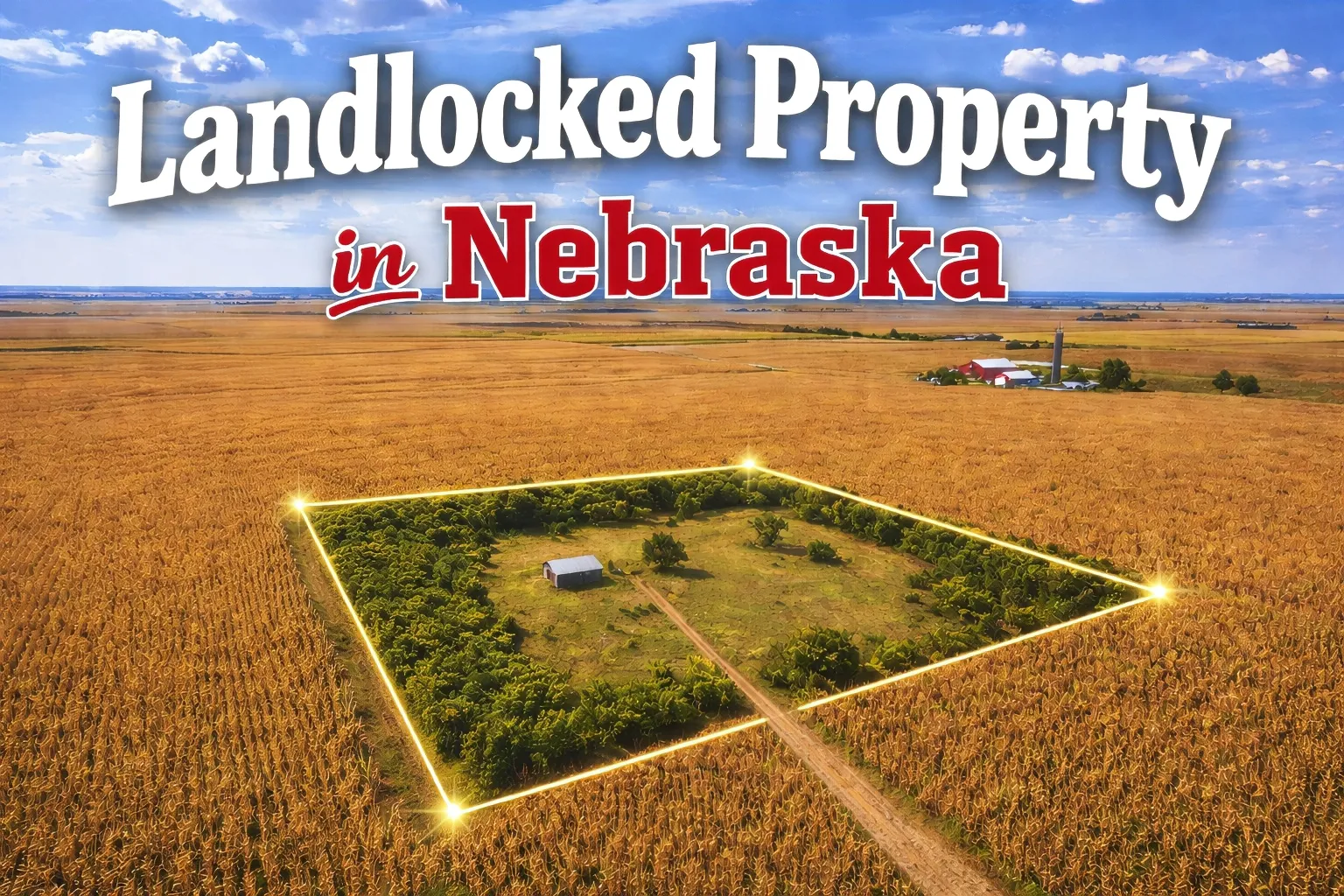
A Nebraska parcel is landlocked when no public road touches its boundary and no recorded easement grants a legal route across adjoining land.
The common misunderstanding in Nebraska is equating physical access with legal access. Driving a pickup across a neighbor’s hayfield for 30 years to reach your quarter section proves nothing about your legal rights. What matters is a document on file at the county register of deeds.
Two terms you will see in every easement dispute:
- Dominant estate — the parcel that benefits from the access route (your landlocked acreage)
- Servient estate — the neighboring parcel that carries the route
A landlocked property has a dominant estate in search of a servient one. Until that relationship is recorded in a deed, your acreage is legally stranded.
Why Nebraska Landlocked Parcels Sell at a Discount
Lack of legal ingress and egress hits value from three directions at once. After a decade analyzing land deals across the Great Plains, I see the same pattern across the Sandhills, the Panhandle, and the loess hills along the Missouri River.
The three hits to value:
- Financing dies. Traditional lenders require recorded access before underwriting. Strip that away and your buyer pool shrinks to cash-only purchasers.
- Buyer pools collapse. Cattle operators need legal routes to trail stock and haul feed. Pivot-irrigation farmers along the Platte need equipment paths and wellhead service. Hunters chasing whitetail or mule deer need a legal way in so a trespass charge does not end the season.
- Appraisals get marked down. The cure cost — survey, legal fees, quiet title, or an express easement buyout — gets subtracted from fair market value every time.
Nebraska Easement Laws
Nebraska law provides four paths to establish legal access across a neighbor’s ground. Each carries a different evidentiary burden and a different price tag.
Express Easements
An express easement is a written, signed, and notarized grant from the servient owner to the dominant owner, recorded at the county register of deeds.
- Cleanest instrument in Nebraska real estate
- Runs with the land — survives future sales of either parcel
- Should be your first move if the neighbor will negotiate
Easements by Implication and Necessity
A Nebraska court can impose an easement by necessity when a single original tract was subdivided and one resulting parcel was left without public road access. You must prove two things:
- Common historical ownership of both parcels at the moment of severance
- Strict necessity — not mere convenience — for beneficial use of the land
An easement by implication is a close cousin. It covers situations where a pre-existing access route was in obvious use at the moment the tract was divided. Both doctrines turn on old deed chains, not new excuses.
Prescriptive Easements and the 10-Year Rule
A prescriptive easement in Nebraska requires 10 years of continuous adverse use. The Nebraska Supreme Court ties this clock to the state’s 10-year real-property statute of limitations. In Fiese v. Sitorius, 247 Neb. 227 (1995), the court laid out six required elements:
- Use that is adverse (not permissive)
- Under a claim of right
- Continuous and uninterrupted for the full 10 years
- Open and notorious — visible to the servient owner
- Exclusive to the claimant
- With the servient owner’s knowledge and acquiescence
Permission is fatal. If a rancher ever said “go ahead and cut across” — even once, even informally — the use is not adverse and the clock never starts. Formalizing a prescriptive claim requires old aerial photography, affidavits from prior owners, and a lawsuit.
For the statutory anchor, see Neb. Rev. Stat. § 25-202 on the Nebraska Legislature’s official site.
Sandhills Isolation and the Water-Access Illusion
Nebraska’s state-specific access problems concentrate in two places:
- The Sandhills. Roughly 20,000 square miles of north-central Nebraska with some of the lowest public-road densities in the country. Many ranch sections are reached only by private two-tracks that wander across multiple ownerships — the exact fact pattern that breeds prescriptive easement disputes when a parcel changes hands and the new neighbor closes the gate.
- The Platte and Missouri corridors. A parcel that touches navigable water looks accessible on a map, but the public right to navigate the river does not grant you a place to legally park a vehicle, cross a neighbor’s riparian strip, or launch equipment. Water frontage is not a substitute for a recorded overland easement anywhere in Nebraska.
Practical Steps to Establish Legal Access
Work the problem in order. Cheaper, faster fixes come first.
Conduct a Comprehensive Title Search
Hire a Nebraska title company or a real estate attorney to run a full historical chain of title on your parcel and each adjoining parcel. Forgotten express easements from homestead-era deeds surface regularly, especially in counties west of I-80 where tracts were first patented in the late 1800s.
Order a Professional Boundary Survey
Engage a Nebraska-licensed professional land surveyor to:
- Set monuments on your actual boundary
- Map existing two-tracks and any apparent access routes
- Flag encroachments from neighboring uses
You will need this document for every subsequent step. In my work as a CCIM-designated land specialist, I have never seen a productive easement negotiation happen without a current survey on the table.
Negotiate an Access Agreement with Neighbors
Approach the adjoining landowner directly with the survey and a fair cash offer for a permanent express easement. Nebraska ranchers and farmers generally prefer a clean recorded deal over the uncertainty of a future lawsuit. Offering to cover the legal drafting and recording fees on your side usually closes the gap.
Initiate a Quiet Title Action
If negotiation stalls, a Nebraska real estate attorney can file a quiet title action in district court asking a judge to confirm an easement by necessity, implication, or prescription.
- Timeline: 12 to 24 months
- Cost: meaningful legal fees — often five figures
- When to use: only after cheaper paths have failed
Frequently Asked Questions
Does Nebraska recognize automatic section-line public roads like the Dakotas?
No. Nebraska does not have a strong statewide section-line public-road doctrine comparable to South Dakota or North Dakota. Public roads exist only where they were actually established by the county and remain open. Assuming the section line on your plat gives you a legal route is a costly mistake.
How is adverse possession different from a prescriptive easement in Nebraska?
- Adverse possession transfers ownership of the land itself after 10 years of open, exclusive, continuous, and adverse use under a claim of ownership.
- Prescriptive easement grants only a right to use a portion of another’s land — typically for access — after the same 10-year period.
Both clocks live in Neb. Rev. Stat. § 25-202, but the remedies are very different.
Who pays for the survey and legal fees in a Nebraska easement dispute?
The landowner seeking access generally pays. The dominant estate carries the burden to prove entitlement, fund the survey, draft the easement, and file any lawsuit. Servient owners occasionally agree to split recording costs as part of a negotiated deal — do not plan on it.
Conclusion
Nebraska landlocked property rarely fixes itself. Sandhills isolation, a strict 10-year prescriptive clock, and the absence of a statewide section-line rescue mean most owners face a survey, a negotiation, or a quiet title action before the parcel regains full value. If you would rather move on than spend two years in district court, my team at Bubba Land Company pays cash for rural land in Nebraska, closes quickly, and handles the access problem ourselves.