Landlocked Property New York 🔓 Unlocking Your Land
New York Landlocked Property Basics:
- Some NY Parcels Have No Legal Solution: Private inholdings surrounded entirely by New York State Forest Preserve cannot get a court-ordered easement — ever. Article XIV of the NY Constitution bars it absolutely, and no court has the authority to override it.
- Strict Necessity Is a High Bar: New York courts require proof of absolute necessity at the time of severance under Simone v. Heidelberg (2007). If any legal access existed when the parcel was split off — even impractical access — the claim fails.
- The Merger Doctrine Wipes Out Old Easements: When two parcels come under common ownership, any easement between them is extinguished. Under Simone v. Heidelberg, it does not automatically revive when the parcels are re-separated. Many upstate NY parcels lost their road rights this way.
- 10-Year Prescriptive Period — With a 2008 Trap: CPLR § 212(a) sets a 10-year period. But a 2008 RPAPL amendment requires “good faith” belief in a right to use the land — which knocks out most informal rural road claims before they even start.
Holding a Landlocked New York Parcel? Bubba Land Company buys landlocked land in all 62 New York counties — no easement required, no court order, no APA permit process. Sell your New York land for cash and close on your schedule.
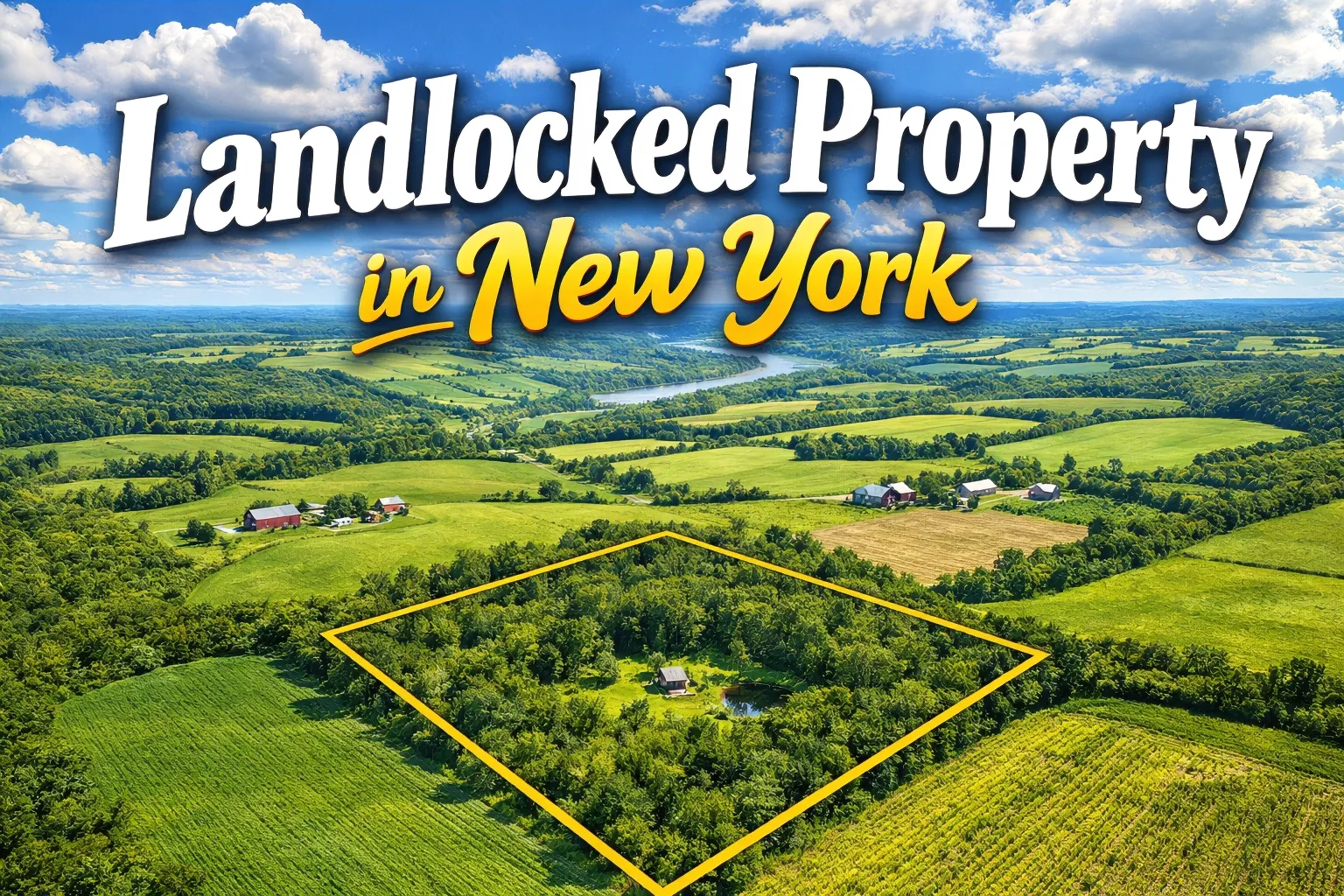
The New York Landlocked Problem Nobody Tells You About
When There Is No Legal Path Forward
Most landlocked owners assume the law will eventually give them a road. In most states, that assumption is at least partially correct — a judge can compel access, a statute gives you a petition right, or twenty years of walking the same trail ripens into a prescriptive easement.
New York has a category of landlocked parcel where none of those paths exist — where no court, no agency, and no legislature can give you legal access without amending the state constitution. If your property is completely surrounded by New York State Forest Preserve, you are not just landlocked. You are constitutionally stranded.
Article XIV and the “Forever Wild” Clause
New York Constitution, Article XIV, § 1 declares that state Forest Preserve lands “shall be forever kept as wild forest lands” and “shall not be leased, sold or exchanged, or be taken by any corporation, public or private.”
The Court of Appeals confirmed in Protect the Adirondacks! Inc. v. NYSDEC (2021) that this clause is absolute — even state agencies cannot take actions that diminish the “forever wild” character of Forest Preserve lands without a constitutional amendment. A constitutional amendment requires passage in two consecutive legislative sessions plus statewide voter approval. No amendment has ever been passed for private access benefit. None is coming.
The Forest Preserve covers roughly 3 million acres of the 6.1-million-acre Adirondack Park and nearly 300,000 acres of the Catskill Park. Private landowners whose parcels are entirely enclosed by Forest Preserve have exactly one option: negotiate with the state to sell the parcel under the Open Space Conservation Program. The state knows this. They will not overpay.
Where New York Landlocked Property Concentrates
The Adirondack Park — Six Million Acres, Thousands of Problem Parcels
The Adirondack Park is larger than Yellowstone, Yosemite, the Grand Canyon, Glacier, and the Great Smoky Mountains combined. Roughly 52% is private land. That private land was subdivided throughout the 20th century — hunting camps, seasonal cabins, and investment parcels were split off from large timber holdings without recording easements, relying instead on verbal agreements and informal road use.
Hamilton County has the lowest population density of any county east of the Mississippi River (approximately 3.4 persons per square mile). Parcels sat for decades without anyone pressing an access claim. When those parcels finally come to market — through estates, divorces, or tax distress — the access problem surfaces for the first time.
High-concentration counties: Hamilton, Essex (northern sections), Franklin (eastern portions), St. Lawrence (southern forested areas), Herkimer (northwestern).
The Catskills and Southern Tier
The Catskill Park covers 700,000 acres across Delaware, Sullivan, Greene, and Ulster counties, with roughly 40% state Forest Preserve. Sullivan County’s mid-century resort subdivision era created numerous interior lots when large farms were broken up and sold in parcels with paper-road access that was never built. Greene County has mountain parcels accessible only via steep, unmaintained routes that do not qualify as legal public highways.
The Merger Doctrine Graveyard — Upstate New York
Throughout the 20th century, timber companies, land speculators, and developers assembled large upstate tracts from smaller parcels — extinguishing the easements between them by merger in the process. When those large tracts were later re-subdivided, the easements were not re-created unless explicitly written into deeds. Thousands of upstate parcels have historical road access that is legally unenforceable because the easement was killed by merger and never documented on re-division.
The Court of Appeals confirmed this in Simone v. Heidelberg, 9 NY3d 177 (2007): easements extinguished by merger do not automatically revive upon re-severance. If it wasn’t in the deed when the parcels were separated, it doesn’t exist.
Hudson Valley and Long Island
Dutchess, Columbia, Putnam, Orange, and Ulster counties saw waves of farm subdivision from the 1950s through 1980s. Many original farm access arrangements were never recorded. Interior lots were created as farms were broken up; access over adjacent lots was assumed informal. Those informal arrangements broke down as properties changed hands to buyers with no knowledge of the prior arrangement — and no legal obligation to honor it.
Eastern Suffolk County (North Fork and South Fork) has some of the highest land values in the state and some of the most bitterly contested landlocked disputes. A small access deficiency on a $1 million parcel produces litigation that often costs more than the access is worth to negotiate.
New York’s Legal Options for Landlocked Owners
| Method | Legal Basis | Key Requirement | You Pay Neighbor? | Estimated Cost |
|---|---|---|---|---|
| Express Easement | NY Statute of Frauds | Written, notarized, recorded | Negotiated | $1,000–$10,000 |
| Easement by Necessity | NY common law; Mau v. Schusler (2015) | Unity of title + absolute necessity at severance | No | $8,000–$30,000 |
| Private Road by Jury | NY Highway Law §§ 300–331 | Strictly landlocked; jury of view assesses damages | Yes — assessed damages | $15,000–$50,000+ |
| Prescriptive Easement | CPLR § 212(a) | 10 years adverse, open, continuous use; good faith | No | $10,000–$35,000 |
Express Easement — The Only Path That Works Simply
If a neighbor will negotiate, a written, notarized easement recorded with the county clerk is the cleanest and fastest resolution. Define exact location, width, permitted uses, and maintenance. Once recorded, it binds every future owner of both parcels. In the Adirondack Park, confirm before building whether APA permit review is triggered — a recorded easement is not the same as permission to construct a road.
Easement by Necessity — Strict, Not Reasonable
New York applies a strict necessity standard. Under Mau v. Schusler, 2015 NY Slip Op 00052 (4th Dept.), you must establish by clear and convincing evidence:
- Unity and subsequent severance of title — the landlocked parcel and the proposed servient parcel were once owned by the same person
- Absolute necessity at the time of severance — no legal access existed when the parcels were divided
- Continuing necessity — no alternate legal access exists today
“Absolute” means precisely that. If any legal access existed at severance — even a route that was expensive, inconvenient, or impractical — the claim fails. New York is not a “reasonable necessity” state.
Private Road by Jury — Highway Law §§ 300–331
New York retains a 19th-century procedural mechanism almost unknown in modern practice. A landlocked owner may petition the town superintendent, who impanels a jury of local viewers to inspect the land and determine whether a private road is necessary. If necessity is found, the jury assesses damages; the applicant pays those damages before the road opens. The process is slow, rarely used, and produces no guarantee of a favorable jury verdict — but it exists as a last resort when court-based remedies are unavailable.
Prescriptive Easement — 10 Years With a 2008 Trap
Ten continuous years of adverse, open, notorious, actual, and uninterrupted use without permission creates a prescriptive easement under CPLR § 212(a). Exclusivity is not required — a meaningful NY distinction that makes prescriptive easements somewhat easier to establish than adverse possession.
The trap: a 2008 amendment to RPAPL § 501 added a “good faith” requirement to adverse possession. While that amendment technically applies to title claims, not prescriptive easements, courts have extended its spirit to access disputes where neighbors claim a longstanding right to use informal rural roads. If you knew — or should have known — that you had no right to use the neighbor’s land, courts look skeptically at the hostile use element. The “neighborly cooperation” exception also blocks most informal rural road claims: if the neighbor ever said “you’re welcome to use it,” the adverse use element collapses to zero.
The Adirondack Park Double Burden
Win in Court, Then Fight Again
In every other state, winning an easement by necessity or private road proceeding means you build your road. In the Adirondack Park, a court victory is step one of two.
The Adirondack Park Agency Act (NY Executive Law Article 27) requires an APA permit for new road construction on private land within the park that meets the threshold for “land use and development” review. In Resource Management zones — the classification that covers most remote forest parcels — virtually all new road construction requires a full APA permit with environmental impact analysis. The APA’s review criteria cover impacts on natural, scenic, aesthetic, ecological, and wildlife resources of the park.
This means a landlocked Adirondack owner who wins an easement by necessity in state court must then apply for an APA permit before opening a single foot of road. The APA can condition, delay, or deny that permit on independent grounds. A court-ordered easement does not bind the APA. Two proceedings, two sets of costs, two separate chances to lose.
What Landlocked Status Does to New York Land Value
The Numbers
- Landlocked parcels in upstate New York trade at a 40–70% discount to comparable parcels with legal road access in the same county
- No conventional lender — bank, credit union, or USDA Farm Service Agency — will finance a landlocked parcel without insurable legal access
- Title insurance companies will not issue standard title policies on landlocked parcels; buyers must accept “access exception” endorsements that carve out coverage for the access problem
- Buyer pool shrinks to adjacent landowners, cash investors, hunting clubs, and conservation organizations — all of whom demand steep discounts
- In Adirondack counties, rural accessible land trades at $1,000–$5,000 per acre; comparable landlocked parcels move at $200–$1,500 per acre depending on timber value and location
The Carrying Cost That Doesn’t Stop
- Property taxes accumulate annually on land you cannot use or sell at full value
- Estate partitions multiply title complexity across heirs who have never seen the parcel
- Evidence for prescriptive easement claims — testimony about historic road use — disappears as witnesses age
- APA permit fees and legal costs to open a court-ordered road in the Adirondacks can run $15,000–$40,000 on top of the litigation cost
Frequently Asked Questions
Can a New York court force my neighbor to give me road access?
Yes — through easement by necessity or the Highway Law jury-of-view process. But the standard is strict absolute necessity, not reasonable necessity, and you must document common ownership. Neither route is fast or cheap, and neither applies to Forest Preserve land.
What happens to my parcel if it’s surrounded by state Forest Preserve?
No court or agency can compel access across Forest Preserve land. The “forever wild” clause in the NY Constitution is absolute. Your realistic options are to negotiate a license with DEC, apply to the Open Space Conservation Program, or sell to the state.
How long does a prescriptive easement take in New York?
Ten years under CPLR § 212(a). Use must be adverse, open, notorious, actual, and uninterrupted. Neighborly permission — even informal — kills the claim entirely. Formalizing it requires a quiet title action in Supreme Court.
What is the Simone v. Heidelberg merger doctrine trap?
When two adjacent parcels come under common ownership, any easement between them is extinguished by merger. When the parcels are later separated, the easement does NOT automatically revive — it must be expressly re-created in the deed. Many upstate NY parcels lost their historical road rights this way without anyone realizing it until a sale was attempted.
Do I need an APA permit to build a road in the Adirondack Park?
Usually yes. In Resource Management zones and most Low Intensity areas, new road construction requires an APA permit even if a court has already granted you an easement. The APA review is a separate proceeding with its own criteria and timeline.
Is landlocked New York land worth buying at a discount?
For adjacent landowners who already have access: often yes. For cash investors with capital to litigate and build a road: sometimes. For most buyers, it’s a specialized purchase that requires knowing exactly what remedy is available — and whether the cost of pursuing it makes economic sense given the land’s value with access.
Cash Buyers for Landlocked New York Land
Landlocked property in New York can still have real value, but fixing access is usually slow, expensive, and uncertain. Whether it is Adirondack timberland, a Catskills back-lot, or an upstate hunting parcel, holding costs keep adding up while the title and access issues get harder to solve.
Bubba Land Company buys landlocked New York land for cash, including parcels other buyers avoid. We can buy without legal road access and close on your timeline. Sell New York land