Landlocked Property Oklahoma 🔓 Unlocking Your Land
Oklahoma Landlocked Property Basics:
- Oklahoma Lets You Condemn Your Neighbor’s Land: Under 27 O.S. § 6, a landlocked owner can file a private condemnation action in district court to force road access — and since Childers v. Arrowood (2023), utility access too. No unity of title required.
- But Not If It’s Allotted Indian Land: If the parcel you need to cross is an allotted or restricted fee tract, state court jurisdiction may not exist. Post-McGirt, this is a real risk across most of eastern Oklahoma.
- Section Lines Are an Overlooked Escape Route: Oklahoma’s PLSS grid means every section line is a statutory right-of-way corridor. Petitioning the county to open an adjacent section line is often faster and cheaper than litigation — and most owners don’t know it exists.
- 15-Year Prescriptive Period: Oklahoma’s prescriptive easement clock runs 15 years under 12 O.S. § 93. Open, visible, and continuous use for 15 years raises a presumption of hostile use — but one “you’re welcome here” from a neighbor resets the entire clock.
Own a Landlocked Oklahoma Parcel? Bubba Land Company buys landlocked land in all 77 Oklahoma counties — no court order, no condemnation filing, no BIA process. Sell your Oklahoma land for cash and close on your schedule.
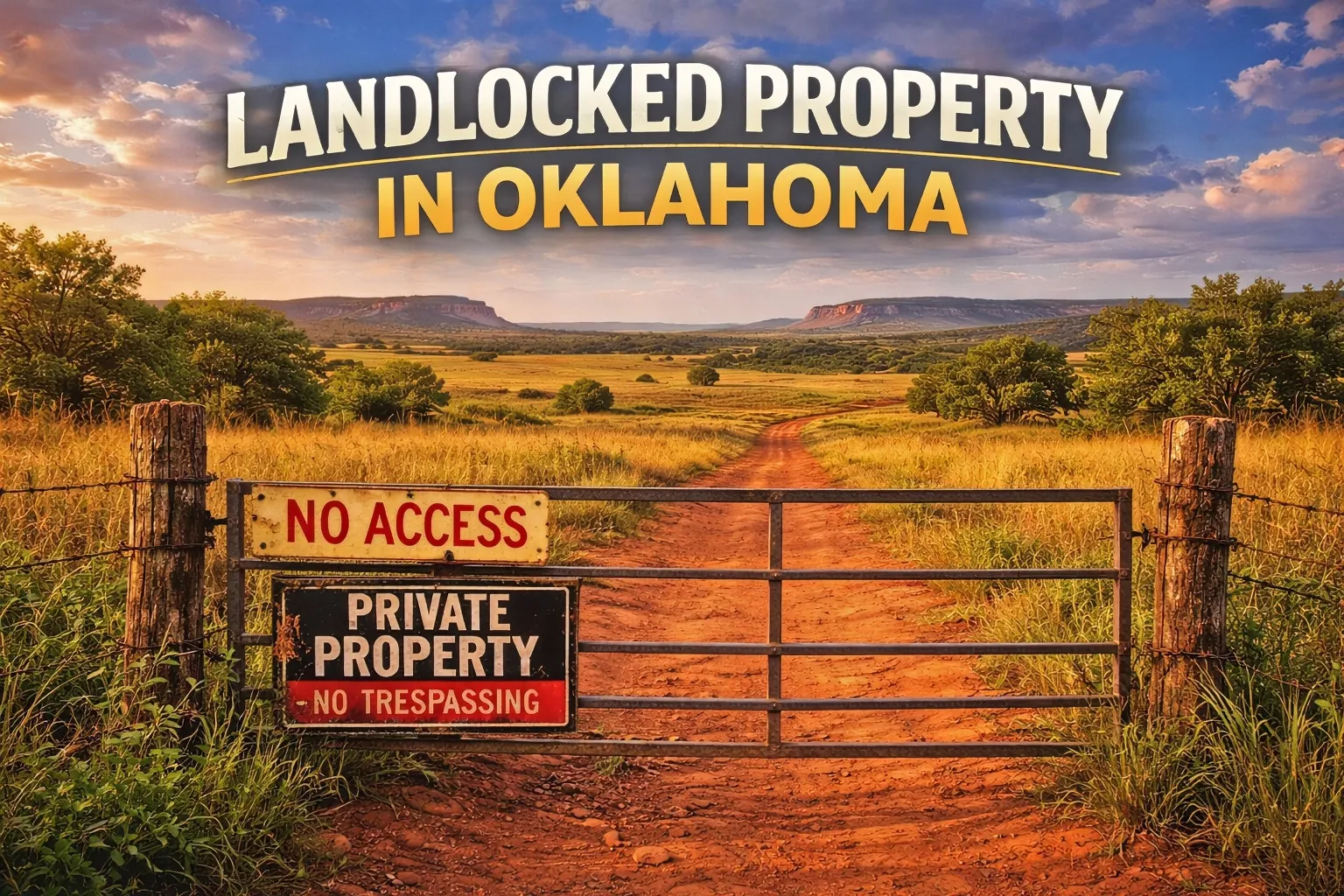
Oklahoma is one of the few states where a landlocked property owner can walk into district court and legally force access across a neighbor’s land — without proving shared ownership history, without waiting for a town board vote, and now, after a 2023 Oklahoma Supreme Court decision, without limiting the remedy to roads. That is a stronger hand than most states deal. The catch is that the remedy has a hard boundary: once you cross into eastern Oklahoma’s Indian Country, state court authority may stop at the property line of a tribal allotment, and a different set of federal rules takes over.
Understanding both sides of that equation — what Oklahoma law gives you and exactly where it stops — is the difference between a solvable access problem and an indefinite holding cost.
Oklahoma’s Private Condemnation Right — 27 O.S. § 6
What the Statute Actually Does
Title 27, Section 6 of the Oklahoma Statutes authorizes a private property owner to exercise eminent domain over a neighboring parcel to obtain a “private way of necessity.” This is not a petition to a county board or a discretionary court proceeding — it is a condemnation action, the same mechanism the state uses to acquire highway rights-of-way, applied by one private party against another.
You do not need to prove that your parcel and the neighbor’s parcel were once under common ownership. You do not need to prove necessity existed at the time of an original severance. You need to show:
- Present necessity — you cannot make effective use of your property without access today
- The route will not unreasonably burden the servient estate — the court has limited discretion to modify or deny a route that places excessive burden on the neighboring owner
- Payment of just compensation — assessed by three court-appointed freeholder commissioners
Childers v. Arrowood (2023) — Utilities Are Now Included
In 2023, the Oklahoma Supreme Court decided Childers v. Arrowood, 2023 OK 58, a Creek County case in which a landlocked landowner had road access but utility providers refused to connect service without a dedicated utility easement. The Supreme Court held that “private ways of necessity” under § 6 include utility easements — electricity, water, and other services necessary for the effective use and reasonable enjoyment of the property.
This was a question of first impression. No other state in the region has extended private condemnation rights to utility access as explicitly. The court framed it as an extension of Oklahoma’s fundamental public policy against rendering property “useless” by isolation.
Common-Law Easement by Necessity — Reasonable Standard
When the Common Law Route Makes Sense
If your parcel and the neighbor’s parcel share a common ownership history, common-law easement by necessity may be available — with no compensation required.
Oklahoma requires three elements, established in Story v. Hefner, 1975 OK, 540 P.2d 562:
- Prior unity of title — both tracts were once owned by the same person
- A conveyance that severed that unity
- Resulting necessity at the time of severance — the dominant parcel was landlocked when the split occurred
Importantly, Oklahoma follows a reasonable necessity standard — not the strict absolute necessity required in New York or Pennsylvania. If the existing access is genuinely inadequate for the reasonable use of the property, a court can find necessity even if some technical legal access exists. This is a more forgiving standard than most neighboring states apply.
One trap: the necessity must have existed at the time of severance. If your parcel had access when it was first split off and later became landlocked through subsequent transactions or road closures, the common-law remedy may be unavailable — leaving § 6 condemnation as your only path.
Oklahoma’s Legal Options for Landlocked Owners
| Method | Legal Basis | Unity of Title Required? | You Pay Neighbor? | Estimated Cost |
|---|---|---|---|---|
| Express Easement | Oklahoma Statute of Frauds | No | Negotiated | $1,000–$8,000 |
| Easement by Necessity | Story v. Hefner (1975) | Yes | No | $5,000–$20,000 |
| § 6 Private Condemnation | 27 O.S. § 6; Childers (2023) | No | Yes — just compensation | $10,000–$40,000+ |
| Section Line Opening | 69 O.S. § 1201; county board petition | No | No | $2,000–$8,000 |
| Prescriptive Easement | 12 O.S. § 93 | No | No | $8,000–$25,000 |
Section Line Access — Oklahoma’s Most Overlooked Remedy
Oklahoma was surveyed under the Public Land Survey System, which means section lines run at one-mile intervals across the entire state. Under 69 O.S. § 1201, every section line carries a statutory right-of-way. An abutting landowner can petition the Board of County Commissioners to open an adjacent section line as a public road. If the county opens it, maintenance costs fall to the county — not the petitioner. The petitioner pays only for the survey and petition.
For a landlocked owner in western or central Oklahoma whose parcel sits one section line away from a county road, this may be the cheapest and fastest resolution available. It doesn’t require proving unity of title, paying just compensation to a neighbor, or building a litigation file. It requires a survey, a petition, and a county board decision.
The limits: in forested SE Oklahoma, section line terrain may make opening impractical. In eastern Oklahoma, section lines crossing allotted Indian land carry the same federal jurisdiction complications as any other access remedy.
⚠ Eastern Oklahoma Tribal Land Warning
If the parcel you need road access across is an allotted, restricted fee, or tribal trust tract, Oklahoma state court may not have jurisdiction to hear your § 6 condemnation action. This matters across most of the former Five Civilized Tribes territories — roughly the eastern third of the state.
- Post-McGirt (2020): The Supreme Court confirmed the Muscogee (Creek) Nation reservation was never disestablished. Oklahoma courts subsequently confirmed the same for the Cherokee, Choctaw, Chickasaw, and Seminole reservations. Eastern Oklahoma is Indian Country.
- Enable Oklahoma Intrastate (10th Cir. 2018): A pipeline company’s state court condemnation was thrown out because the target parcel had a 1.1% tribal interest. Even a fractional undivided tribal interest can remove a parcel from state court jurisdiction.
- The federal alternative: Access across Indian allotted or trust land requires a right-of-way under 25 C.F.R. Part 169, administered by the Bureau of Indian Affairs. This is a federal administrative process — not a state court case.
- Osage County special rule: The Osage Nation owns the entire mineral estate of Osage County under federal trust. Any road construction involving excavation may require separate BIA/Osage Minerals Council approval beyond the surface access analysis.
Before filing a § 6 condemnation action in eastern Oklahoma, verify the land status of every parcel in the proposed access corridor. Your attorney should pull a BIA trust status certificate or TAAMS land records check before filing.
Where Oklahoma Landlocked Property Concentrates
SE Oklahoma — Ouachita Timber Country
LeFlore, McCurtain, and Pushmataha counties hold Oklahoma’s densest concentration of landlocked timber parcels. The Ouachitas were logged aggressively from the 1880s onward — Dierks Lumber built Pine Valley in LeFlore County in 1927, at the time the largest lumber town in the American South; Weyerhaeuser later operated the largest sawmill east of the Rockies at Wright City in McCurtain County. These companies acquired vast acreage following timber values, not road networks. When parcels were sold off over decades, remnant tracts were frequently left without recorded access.
The ridge-and-hollow Ouachita terrain compounds the problem — section line roads are frequently impassable or never opened, and the county road grid is thin. Buyers of SE Oklahoma timber tracts should treat access as contested until proven otherwise.
Eastern Oklahoma — Allotment Era Title Chains
The Dawes Commission created 100,000+ individual allotments across the former Indian Territory between 1898 and 1907. These allotments were surveyed without any systematic road access reservation. When restriction periods expired and allottees sold, land was broken up in small-acreage transactions that frequently produced interior parcels with no recorded access. Unlike the western federal public domain states, the former Indian Territory had no automatic section line road reservation built into the land opening framework.
A significant number of title chains in Cherokee, Muskogee, Sequoyah, Adair, and Delaware counties simply never include access easements — not because someone made a mistake, but because access was assumed informally and never recorded.
Western Oklahoma — Oil Field Road Trap
In SCOOP and STACK play counties — Garfield, Grady, Canadian, Kingfisher, Blaine — early oil development drove aggressive mineral severances from surface estates. When operators built roads to drill sites, they typically built them under license, not easement. When wells were plugged and operators moved on, those roads reverted to private land. A surface owner who bought an interior parcel trusting an oil field road may have no enforceable right to that road today.
What Landlocked Status Does to Oklahoma Land Value
- Landlocked parcels in rural Oklahoma typically trade at 50–80% below comparable accessible parcels in the same county
- At worst — foot access only, contested easement — a landlocked parcel can be worth as little as 25% of its accessible equivalent
- No conventional lender finances a landlocked parcel; title insurers routinely exclude access coverage — creating a strictly cash-only market
- In SE Oklahoma timber country, accessible land moves at $1,000–$2,000 per acre; landlocked comparable parcels trade between $200–$500 per acre between neighboring owners
- Every year the access issue sits unresolved, property taxes accumulate on land you cannot sell at full value
Frequently Asked Questions
Does Oklahoma guarantee road access to landlocked owners?
27 O.S. § 6 gives you a strong statutory right, not a guarantee. You must show present necessity, pay just compensation, and the route cannot impose undue burden on the neighbor. Courts have limited discretion — but it is a real right, not a request.
Can I get utility access under § 6, not just road access?
Yes. The Oklahoma Supreme Court confirmed in Childers v. Arrowood (2023) that utility easements — electricity, water — qualify as “ways of necessity” under § 6 when necessary for the effective use of the property.
What if the land I need to cross is an Indian allotment?
State court jurisdiction may not exist. If any undivided interest in the parcel is held by a tribe or enrolled member in trust or restricted fee status, the BIA rights-of-way process under 25 C.F.R. Part 169 is the correct channel. Consult a federal Indian law attorney before filing in state court.
What is a section line easement and how do I use it?
Under 69 O.S. § 1201, every section line in Oklahoma carries a statutory right-of-way. If your parcel abuts an unopened section line that connects to a public road, you can petition your Board of County Commissioners to open it. No unity of title required, no payment to a neighbor, and the county maintains it once opened.
How long does a prescriptive easement take in Oklahoma?
15 years of open, continuous, adverse use under 12 O.S. § 93. Once you prove 15 years of unmolested use, hostility is presumed — shifting the burden to the landowner. Any permission from the neighbor at any point restarts the clock entirely.
Is landlocked Oklahoma land worth buying at a discount?
For adjacent owners who already have access, often yes — the discount is steep and consolidation is straightforward. For outside investors, it depends on whether § 6 condemnation is available (no allotted land in the corridor) and whether the access cost is justified by the land’s value with access.
Your Oklahoma Land Has a Market — Even Without a Road
The legal toolkit in Oklahoma is better than most states. You have a statutory condemnation right that doesn’t require proving shared ownership history. You may have a section line remedy that requires nothing more than a county petition. You have a reasonable — not absolute — necessity standard for common-law easements. And since 2023, you can force utility access the same way you force road access.
What those tools don’t change is the time, cost, and uncertainty of using them. If you’ve been holding a landlocked parcel in McCurtain County, sitting on an allotment-adjacent eastern Oklahoma tract with no clear federal path, or carrying taxes on western Oklahoma ground where the oil field road disappeared with the last operator — Bubba Land Company buys it as-is. All 77 counties, any access status, cash offers, fast closes. Contact us today for a no-obligation offer.