Landlocked Property Pennsylvania 🔓 Unlocking Your Land
Pennsylvania Landlocked Property Basics:
- The 1836 Private Road Act Is Effectively Dead: Two Pennsylvania appellate decisions — O’Reilly v. Mitchhart (2010) and Stake v. McNulty (2013) — gutted the statute. Courts now require you to pay a neighbor who gains a windfall. Hundreds of landlocked parcels lost their only remedy overnight.
- Mineral Severances Created the Problem: Coal, oil, and gas severances from the 1880s through 1920s created Pennsylvania’s three-estate system — surface, mineral, and support rights owned separately. Those splits left surface parcels landlocked and complex title chains that still trap owners today.
- 21 Years Is the Longest in the Region: Pennsylvania’s prescriptive easement period is 21 years under 42 Pa.C.S. § 5530 — longer than Michigan (15), Wisconsin (20), or Missouri (10).
- Cash-Only Market: No lender will mortgage a landlocked parcel. Expect a 40–70% discount in rural Pennsylvania counties where there is no realistic path to access.
Stuck on a Pennsylvania Parcel You Can’t Access? Bubba Land Company buys landlocked land in all 67 Pennsylvania counties — no easement needed, no court order, no neighbor negotiation. Sell your Pennsylvania land for cash and close on your schedule.
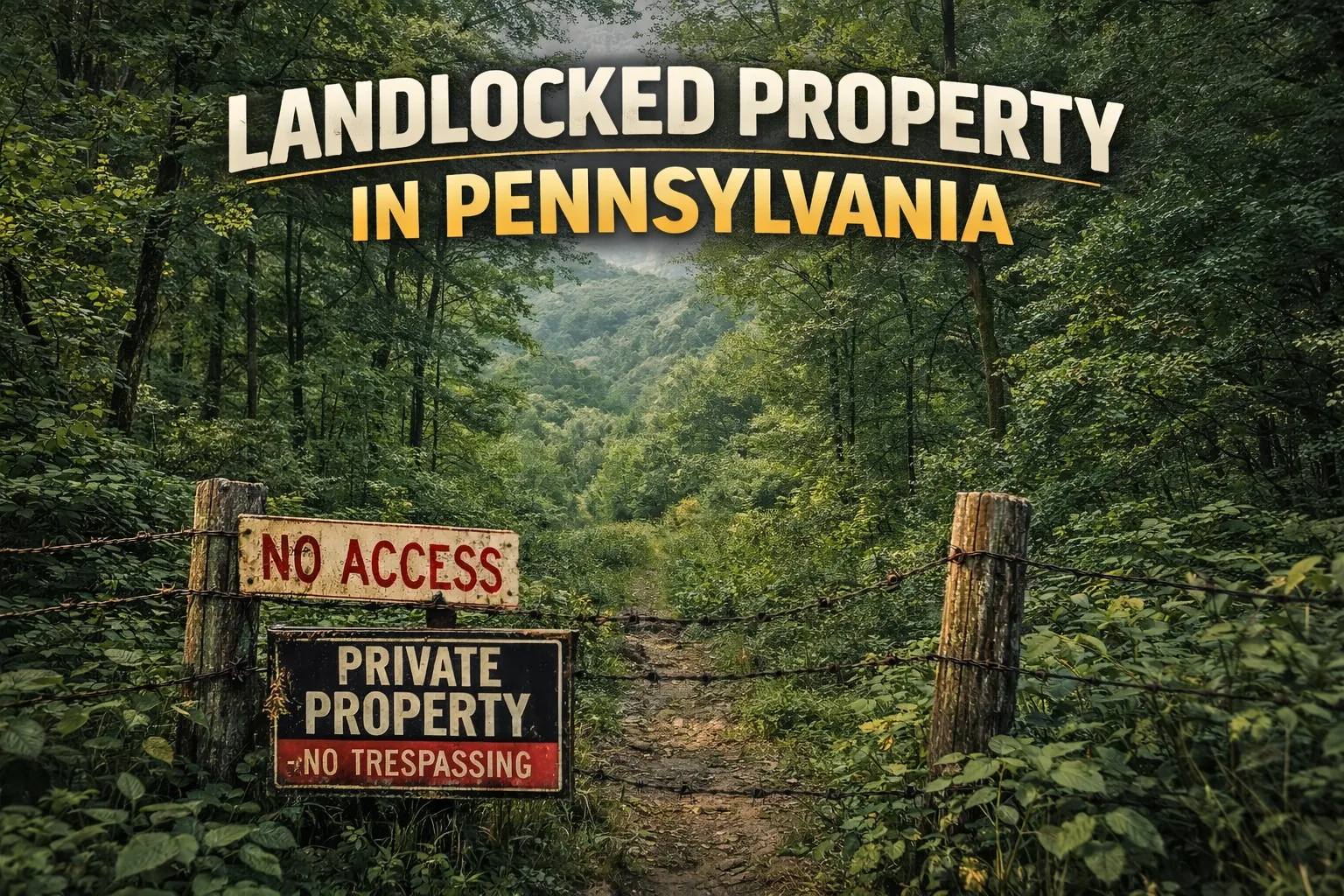
Pennsylvania’s Broken Landlocked Remedy — and What Happened to It
The 1836 Private Road Act: The Statute That Used to Help You
Pennsylvania passed its Private Road Act in 1836. The statute was straightforward: a landlocked owner could petition the Court of Common Pleas, which would appoint a jury of view to lay out a private road across a neighbor’s land. The neighbor received compensation. It worked for 170 years.
Then two appellate decisions changed everything.
O’Reilly v. Mitchhart (2010) and Stake v. McNulty (2013)
In O’Reilly v. Mitchhart, the Commonwealth Court held that a landowner whose parcel became landlocked through their own subdivision of a larger tract was not entitled to invoke the Private Road Act — because the seller caused the problem and should bear the cost of fixing it.
Stake v. McNulty extended that logic further. The court ruled that where a neighbor would receive “a windfall” from being forced to provide access — that is, where the neighbor’s land increases in value as a result of the road — the petitioner must pay that windfall premium on top of ordinary compensation. The result: petitioning under the Private Road Act became economically irrational in most northern Pennsylvania fact patterns.
In her dissent in a related proceeding, Judge Leadbetter wrote that the court’s interpretation would leave “hundreds or thousands of landlocked parcels forever inaccessible” with no viable statutory remedy. She was right.
The 1836 Act still exists on the books at 36 P.S. §§ 2731–2891. In practice, it is the most expensive and most uncertain path available.
Where Pennsylvania Landlocked Property Concentrates
The Pennsylvania Wilds and Northern Tier
Potter, Clinton, Lycoming, Tioga, and Sullivan counties form the core of Pennsylvania’s landlocked problem. Logging companies from the 1880s through the 1910s stripped these counties of white pine and hemlock, then sold off cutover tracts in irregular parcels with verbal access arrangements. The county road grid was never built to serve interior parcels. Today, the Pennsylvania Wilds contains more than 27,000 acres of landlocked public land — and private landlocked parcel counts are higher still.
Anthracite Coal Country
Luzerne, Lackawanna, Schuylkill, Carbon, and Northumberland counties carry the legacy of coal estate severances. From the 1880s forward, coal companies purchased mineral rights while leaving surface title in farmowner hands — then purchased adjacent surface parcels outright, surrounding the original farms and creating access problems that compounded through estate partitions and Depression-era tax forfeitures. These counties have some of Pennsylvania’s most complex title chains, with surface, mineral, and support estates in different hands across the same physical ground.
Pocono Mountains Subdivision Era
Wayne, Pike, Monroe, and Carbon counties saw massive recreational subdivision activity from the 1950s through the 1980s. Developers platted lake community lots with paper streets that were never built. Interior lots in those subdivisions have no road frontage and no recorded access — just a lot on a plat map with a street name that exists nowhere in the physical world.
Pennsylvania’s Three-Estate Problem
Surface, Mineral, and Support Rights
Most states deal with two estates: surface ownership and mineral rights. Pennsylvania coal country created a third — the support estate. When coal companies acquired subsurface rights, they often simultaneously severed the “support estate,” meaning they took the right to remove the coal even if the surface subsided as a result.
For landlocked surface owners in anthracite country, this creates a compounded problem:
- The surface parcel may be landlocked by surrounding private land
- The mineral estate owner has no legal obligation to provide surface access
- The support estate owner’s rights may limit what can be built on the surface
- Title searches in these counties require reviewing three separate chains of title
Buyers who purchase surface-only parcels in these counties without reviewing the mineral and support chains often discover post-closing that subsurface activity rights create encumbrances that complicate any future sale further.
Pennsylvania’s Legal Options for Landlocked Owners
| Method | Legal Basis | Key Requirement | You Pay Neighbor? | Estimated Cost |
|---|---|---|---|---|
| Express Easement | Pennsylvania Statute of Frauds | Written, notarized, recorded | Negotiated | $1,000–$8,000 |
| Easement by Necessity | Pennsylvania common law | Unity of title + strict necessity at severance | No | $5,000–$20,000 |
| Private Road Act Petition | 36 P.S. §§ 2731–2891 | Strictly landlocked; pay windfall premium post-Stake | Yes — FMV + windfall premium + costs | $20,000–$75,000+ |
| Prescriptive Easement | 42 Pa.C.S. § 5530 | 21 years adverse, continuous, uninterrupted use | No | $10,000–$30,000 |
Express Easement — Still the Only Clean Option
A written, notarized easement agreement recorded with the county recorder of deeds is the fastest and cleanest resolution. Define exact location, width (minimum 15 feet for vehicle access, wider for agricultural use), permitted uses, and maintenance responsibility. Once recorded, it runs with the land and binds every future owner of both parcels.
If your neighbor will negotiate, get this done. The other three options are slower, more expensive, and less certain.
Easement by Necessity — Common Law Route
Pennsylvania requires:
- Prior unity of title — your parcel and the neighbor’s were once under common ownership
- Necessity at the time of severance — when the parcels split, yours had no legal access
No payment to the neighbor is required if you succeed. But the unity-of-title requirement is a significant hurdle in anthracite coal country and northern tier parcels that changed hands multiple times during logging-era estate partitions. If you cannot document common ownership in a direct chain, this route closes.
Private Road Act — Post-Stake Reality
The 1836 Act remains on the books and can be invoked. The economics are brutal:
- File petition in Court of Common Pleas of the county where the road will run
- Court appoints a jury of view to assess damages
- You pay neighbor’s fair market value plus any windfall premium the court determines
- You pay all road construction costs
- Appeals are common — the process can run two to four years
For a 50-acre hunting parcel in Potter County worth $75,000 with access, paying $40,000 in petition costs and windfall premiums leaves a thin margin at best.
Prescriptive Easement — 21 Years With a High Bar
Pennsylvania requires 21 continuous years of open, notorious, hostile, and uninterrupted use under a claim of right. Tacking between successive owners is allowed with privity of estate.
The specific trap in Pennsylvania: courts look hard at whether use was permissive. Rural landowner custom in northern Pennsylvania — particularly around hunting camps and logging roads — has historically been neighborly and permissive. That custom destroys most prescriptive easement claims before the 21-year clock even finishes running.
State Game Lands and the Federal Inholding Problem
Pennsylvania State Game Lands Adjacency
Pennsylvania’s State Game Lands system covers more than 1.5 million acres. Parcels adjacent to or surrounded by Game Lands face a variation of the landlocked problem: the Pennsylvania Game Commission holds title to the surrounding land but has no statutory obligation to provide access to private inholdings. State Game Lands are managed under the Game and Wildlife Code — not the Private Road Act. Game Commission discretionary permits are the only path, and approval is not guaranteed.
Allegheny National Forest Inholdings
The Allegheny National Forest covers roughly 513,000 acres in Warren, McKean, Forest, and Elk counties. Private parcels inside the forest boundary face the same federal inholding problem that exists in Wisconsin’s Chequamegon-Nicolet and Missouri’s Mark Twain: state law doesn’t bind the federal government. Access requires a U.S. Forest Service Special Use Permit — a discretionary federal process. Owners of Allegheny National Forest inholdings who lack a recorded easement across federal land may have no enforceable state remedy at all.
What Landlocked Status Does to Your Pennsylvania Land Value
The Numbers
- Landlocked parcels in rural Pennsylvania typically sell at a 40–70% discount to comparable accessible land in the same county
- No conventional lender will issue a mortgage without insurable legal road access
- Buyer pool shrinks to adjacent landowners, hunting clubs, conservation buyers, and specialized cash investors
- In anthracite coal counties, complex title chains with split estates further narrow the market
- Timber value, deer habitat, and water features (trout streams, ponds) can reduce the access discount — but never eliminate it
Why Waiting Makes It Worse
- Property taxes continue every year — on land you cannot access, use, or sell at full value
- Estate partitions among heirs multiply title complexity over time
- Evidence needed for prescriptive easement claims degrades — witnesses die, use records disappear
- The Stake windfall premium problem grows as neighboring land values increase
Frequently Asked Questions
Does Pennsylvania guarantee road access to landlocked owners?
No. The 1836 Private Road Act gives you a petition process, but post-Stake, you must pay fair market value plus a windfall premium. The process is expensive, slow, and not guaranteed. Easement by necessity requires proof of common ownership history that many owners cannot document.
What is the prescriptive easement period in Pennsylvania?
21 years under 42 Pa.C.S. § 5530 — the longest of any surrounding state. Use must be continuous, open, hostile, and under a claim of right without permission. Any permissive use restarts the clock. Rural custom in northern Pennsylvania makes hostile use difficult to establish.
Can I use the Private Road Act if I own mineral rights separately from the surface?
The Private Road Act applies to surface access across neighboring surface parcels. Mineral estate ownership does not substitute for surface access rights. If your surface parcel is landlocked and your mineral rights are accessed separately, you may still need a Private Road Act petition or easement for surface use.
Does State Game Lands adjacency give me any access rights?
No. The Pennsylvania Game Commission is not bound by the Private Road Act and has no obligation to provide access to private inholdings. Access across State Game Lands requires a Game Commission permit — a discretionary administrative process.
Is landlocked Pennsylvania property worth buying at a discount?
It depends entirely on your plan. Adjacent landowners who already have legal access can consolidate at a steep discount. Investors with capital and patience to litigate the Private Road Act can profit in the right fact pattern. For most buyers, landlocked land is a specialized purchase — not a general one.
What if the neighbor who could grant access inherits the land through multiple generations — does unity of title still apply?
Yes. Pennsylvania easement by necessity requires tracing ownership all the way back to when your parcel and the neighbor’s parcel were last under common ownership — regardless of how many owners there have been since. The longer the chain, the harder the research and the harder it is to establish the claim.
Landlocked Doesn’t Mean Worthless
Bubba Land Company buys landlocked Pennsylvania land in all 67 counties — Tioga, Pike, Potter, Carbon, Luzerne, Clearfield, and everywhere in between. Cash offers, no easement required, no repairs, no commissions, and no waiting on a buyer who gets cold feet when they find out there’s no recorded road access.
If you’re holding a Pennsylvania parcel you can’t access, can’t mortgage, and can’t move through a traditional listing, you have more options than you think. Request your free cash offer on your Pennsylvania land today.