Landlocked Property South Dakota 🔓 Unlocking Your Land
South Dakota Land Access Essentials:
- Documentation is Required: Physical use does not equal legal access. A recorded express easement, a county road record, or a court order is what protects your ingress and egress.
- State Easement Mechanisms: South Dakota recognizes express, implied, necessity, and prescriptive easements — plus the statewide section-line doctrine under SDCL 31-18. The prescriptive clock is 20 years under SDCL 15-3-1.
- Valuation Impact: Lenders decline landlocked parcels, conventional buyers drop out, and the tract trades at a steep cost-to-cure discount.
Direct Cash Buyer: Bubba Land Company purchases problem acreage directly, allowing you to sell your South Dakota land completely as is.
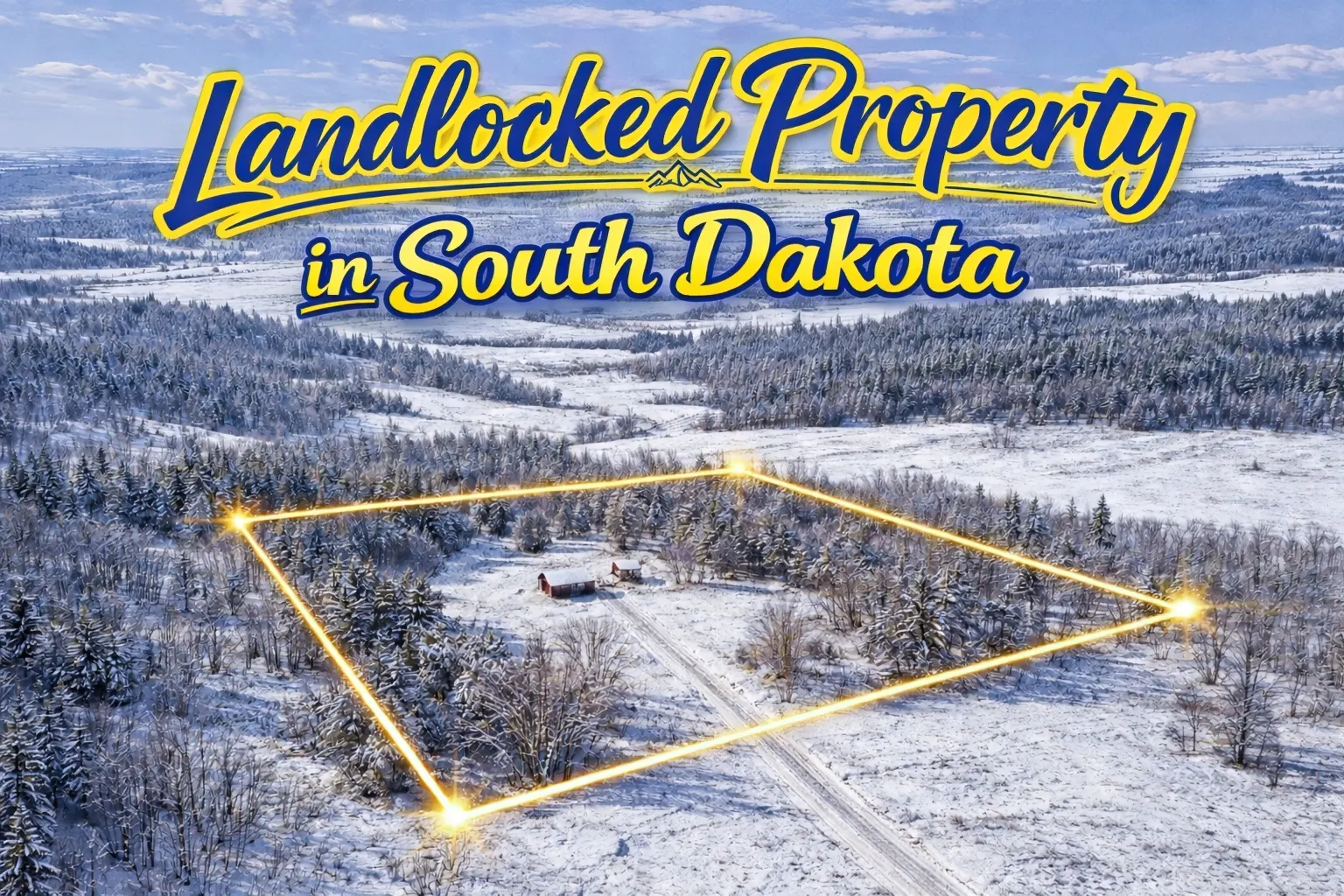
Legal Definition of South Dakota Landlocked Property
A parcel is landlocked when no recorded instrument gives the owner a legal route to a public road. Driving a pickup across the neighbor’s alfalfa stubble for thirty harvests is physical access, not legal access. In South Dakota, that difference decides whether a bank finances the tract, a title company insures it, and the sheriff sides with you or the neighbor on the trespass call.
The vocabulary is narrow. The parcel that needs the route is the dominant estate. The parcel that provides it is the servient estate. Until a recorded easement or a court judgment connects the two, the dominant estate is impaired — no matter how long prior ranchers drove the two-track.
What Landlocked Status Does to Market Value
Access defects compress value on every front. After a decade analyzing rural land transactions, I see the same pattern on every landlocked tract from the James River Valley to the west-river country outside the Black Hills: the parcel trades at a meaningful discount to comparable ground with deeded frontage, and the gap widens once a quiet title action becomes the only way out.
Who walks away from a landlocked parcel:
- Conventional financed buyers — the title commitment flags the defect and the loan dies
- Banks and Farm Credit branches — legal ingress/egress is underwriting gospel
- USDA FSA reviewers and county directors of equalization — both flag the defect in assessments
Who still bids:
- Adjoining ranchers folding the tract into a larger unit
- Hunting outfitters willing to haul in by ATV
- Specialty cash buyers who price the cure into the offer
South Dakota Easement Laws
Four legal paths can convert a landlocked tract into one with enforceable access. Knowing which fits your facts separates a productive kitchen-table conversation from a multi-year circuit-court filing.
Express Easements
An express easement is a written, signed, notarized, recorded grant from the servient owner to the dominant owner. It describes the route, the width, the permitted uses, and usually the maintenance split. Once recorded with the register of deeds, it runs with the land and survives future sales on both sides. Title companies and lenders insure it without hesitation. Every other mechanism below exists because an express easement was never negotiated or was lost to time.
Easements by Implication and Necessity
A court may imply an easement by necessity when the landlocked tract and a parcel with road frontage were once held under common ownership and were severed in a way that left the inner tract with no practical outlet. You must prove the historical unity of title through deed research and prove the easement is strictly necessary — not merely convenient. Any other legal route, however rough, weakens the claim. Easement by prior use is a close cousin recognized when a pre-existing, apparent, continuous use was in place at severance.
Prescriptive Easements and the 20-Year Rule
South Dakota applies the 20-year real-property limitations period in SDCL 15-3-1 to prescriptive easement claims. The use must be actual, open, visible, continuous, uninterrupted, and adverse — without the servient owner’s permission — for the full two decades. A friendly “drive across whenever” from the neighbor in 2012 is permissive use, and permissive use resets the clock. The full text sits in the South Dakota Codified Laws.
Adverse possession uses the same 20-year clock, shortened to 10 years under SDCL 15-3-15 when the claimant holds color of title and has paid taxes for ten successive years. Prescriptive easement gives you a right to cross. Adverse possession transfers title. Same clock, different remedies.
Section-Line Highways and South Dakota Access Rights
This is the angle that sets South Dakota apart from almost every other state. SDCL 31-18-1 declares every section line a public highway, and SDCL 31-18-2 fixes the default width at 66 feet — 33 feet each side of the line. In theory, you own a parcel surrounded on four sides by a statutory public right-of-way.
In practice, three complications surface repeatedly:
- Unopened corridors. The statute created the highway, but the county may never have opened, graded, or surveyed the road on the ground.
- Vacation orders. County commissioners can vacate section-line highways, and many rural counties west of the Missouri River and near Pine Ridge have formally vacated long stretches. Once vacated, the abutting landowners take the strip and public access is extinguished.
- Tribal trust land. A section-line right-of-way crossing federal tribal trust land cannot be enforced in a South Dakota circuit court — federal preemption and tribal jurisdiction control.
Before counting on a section line as your access, pull the county road records and confirm no vacation order sits in the register of deeds. On water: the Missouri River, Lake Oahe, and Lake Sharpe are navigable, but navigability lets the public float the water, not cross private land to reach it.
Practical Steps to Establish Legal Access
Run a Deep Title Search
Hire a title company or real estate attorney to trace the chain of title through every severance. Express easements from homestead- and railroad-era conveyances sometimes sit in nineteenth-century deed books and never made the jump to the latest title commitment. Finding one saves years and five figures in legal fees.
Order a Boundary Survey
A licensed professional land surveyor will stake the corners, map historical trails, and show where any section-line right-of-way sits relative to your tract. Commissioners, courts, and neighbors respond to a stamped survey — not to hand-drawn sketches.
Negotiate With the Neighbor First
In my work as a CCIM-designated land specialist, a clean cash offer for a recorded express easement closes faster and cheaper than any courtroom. Bring the survey, a draft easement, and a fair number. Most ranchers would rather pocket a check than hire a Pierre lawyer.
File a Quiet Title Action
If negotiation fails, a state circuit court can recognize an easement by necessity, confirm a prescriptive easement, or settle the status of a disputed section line through a quiet title action. Budget realistically: contested matters run well into five figures and often take more than a year — longer if tribal jurisdiction or a vacation order is in play.
Frequently Asked Questions
Does a section-line right-of-way automatically give me legal access in South Dakota?
Not always. SDCL 31-18-1 and 31-18-2 establish a 66-foot public highway along every section line, but the corridor may be unopened, obstructed, or formally vacated by the board of county commissioners. Confirm current status with the county before relying on it.
What happens if the county has vacated the section line next to my parcel?
Once a board of county commissioners records a vacation order, the public right-of-way is extinguished for that segment and the abutting landowners take the vacated strip. If that segment was your only theoretical outlet, you are back to negotiating an express easement or pursuing a court-ordered easement by necessity.
Can I pursue a prescriptive easement against tribal trust land?
No. State statutes of limitations — including the 20-year clock in SDCL 15-3-1 — do not run against the United States, and land held in trust for a South Dakota tribe or individual Indian beneficiary is federal land for that purpose. Access across trust land is governed by BIA right-of-way regulations under 25 C.F.R. Part 169 and by tribal law.
Conclusion
Landlocked tracts in South Dakota carry a specific mix of problems — section lines that look like highways on the plat but have been vacated or never built, a 20-year prescriptive clock that punishes any handshake permission in the chain, and trust-land boundaries that fall outside state-court reach. If another year of county hearings and circuit-court filings is not the plan, my team at Bubba Land Company makes cash offers on problem acreage and closes on the timeline South Dakota landowners actually need.