Landlocked Property Wisconsin 🔓 Unlocking Your Land
Wisconsin Landlocked Property Basics:
- Wisconsin Has a Dedicated Statute: Wis. Stat. § 82.27 gives landlocked owners a path to petition their town board for road access — but the board can simply say no.
- Courts Don’t Guarantee You an Easement: Under McCormick v. Schubring (2003 WI 149), Wisconsin courts run an equitable balancing test. Meeting both legal elements still doesn’t guarantee a ruling in your favor.
- The 20-Year Clock Has a Trap: Prescriptive easements require 20 years under Wis. Stat. § 893.28 — but use over open, unenclosed rural land is presumed permissive, which kills most northern Wisconsin claims before they start.
- Act 174 Changed the Rules: A 2022 Wisconsin law eliminated the 40-year re-recording deadline for access easements. Recorded easements created on or after January 1, 1960 now run perpetually.
Own a Landlocked Wisconsin Parcel? Bubba Land Company buys landlocked land in all 72 Wisconsin counties — no court order, no neighbor negotiation, no easement required. Sell your Wisconsin land for cash and close on your schedule.
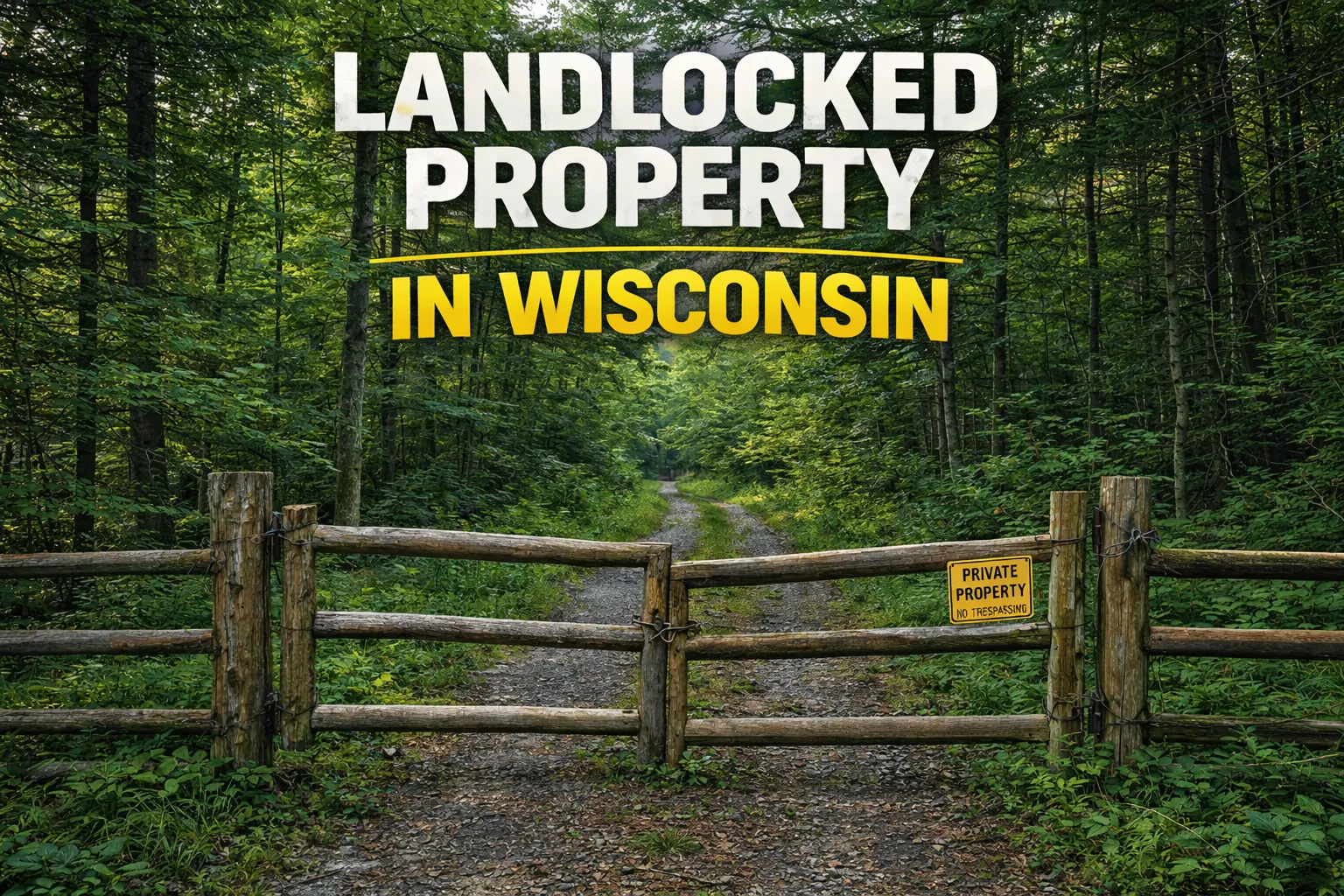
What Makes a Property Legally Landlocked in Wisconsin
The Definition That Matters
A landlocked parcel is one surrounded by other privately owned land — or private land and water — with no direct legal access to a public road. “Legal” is the operative word. A neighbor who lets you use their driveway, a logging trail you’ve driven for thirty years, a gate you have a key to — none of those are legal access. Without a recorded easement, a formal right-of-way, or road frontage, you are landlocked by Wisconsin law regardless of how long someone has been driving in.
Wis. Stat. § 82.27 is the statute Wisconsin legislators wrote specifically for this situation. It exists because the problem is not rare here — it is deeply embedded in northern Wisconsin’s history.
Why Wisconsin Has Tens of Thousands of Them
The northern Wisconsin “Cutover” is the root cause. From the 1840s through roughly 1910, massive logging operations stripped pine and hardwood from Vilas, Oneida, Forest, Price, Sawyer, Taylor, and Iron counties. When the timber was gone, companies sold off irregular cutover parcels to immigrant settlers — German and Scandinavian families recruited through pamphlets printed in three languages. Those settlers created dense patchworks of 40- and 80-acre parcels with verbal, never-recorded access arrangements.
Then came the estate partitions, tax forfeitures during the Depression, and the 1950s–1970s lake subdivision boom. Each generation of transactions compounded the problem. Today, more than 55,000 acres of Wisconsin’s own public land is inaccessible without crossing private property — and the privately-owned landlocked parcel count dwarfs that figure.
Wisconsin’s Four Legal Options for Landlocked Owners
| Method | Legal Basis | Who Decides | Neighbor Compensation? | Estimated Cost |
|---|---|---|---|---|
| Express Easement | Wisconsin Statute of Frauds | Willing neighbor | Negotiated | $1,000 to $8,000 |
| Town Petition (§ 82.27) | Wis. Stat. § 82.27 | Town board (discretionary) | Yes (assessed “advantages”) | $5,000 to $20,000+ |
| Easement by Necessity | Common law; McCormick v. Schubring | Circuit court (equitable balancing) | No | $8,000 to $25,000+ |
| Prescriptive Easement | Wis. Stat. § 893.28 | Circuit court (quiet title) | No | $10,000 to $30,000+ |
Express Easement — Cleanest Solution
If your neighbor will negotiate, a written, notarized, and recorded easement agreement is the fastest resolution. Define exact location, width, permitted uses, and maintenance responsibility. Under 2021 Wisconsin Act 174 (effective March 2022), once recorded, access easements created on or after January 1, 1960 run permanently — no re-recording required. The old 40-year expiration rule is gone.
Town Board Petition Under Wis. Stat. § 82.27
Wisconsin’s dedicated landlocked statute gives you a direct line to your local town board. Here’s how it works:
- File an application and sworn affidavit with the town clerk
- Prove you’re surrounded by others’ land and can’t buy access except at an exorbitant price
- The board reviews your petition — and their decision is entirely discretionary
- If approved, the road must be at least 66 feet wide
- You pay assessed “advantages” (the benefit value to your land) to the town treasurer within 30 days
- If reaching a highway in your town is impracticable, you can petition an adjacent town
Important: if a seller created the landlocked condition by splitting off a parcel without providing a 66-foot easement, the town can build the road over the seller’s remaining land at no compensation to the seller under § 82.27(6).
Easement by Necessity — Wisconsin Doesn’t Make It Easy
Wisconsin requires two elements, established in Richards v. Land Star Group, Inc., 224 Wis.2d 829 (Wis. App. 1999):
- Prior unity of title — the landlocked parcel and the servient parcel were once under common ownership
- Continued landlocked status — no legal access to a public road exists today
But proving both still doesn’t guarantee success. The Wisconsin Supreme Court in McCormick v. Schubring, 2003 WI 149, held that easement by necessity is not automatic in Wisconsin. The circuit court runs an equitable balancing test — weighing your benefit against the neighbor’s burden. If you bought the parcel knowing it had no legal access, courts extend less sympathy. The neighbor’s loss of land value, privacy, and use all factor in. A Wisconsin court can deny your easement even after you’ve met both elements.
Prescriptive Easement — 20 Years With a Built-In Trap
Under Wis. Stat. § 893.28, 20 continuous years of open, hostile, uninterrupted use without permission creates a prescriptive easement. Tacking between successive owners is allowed with privity.
The trap: Wisconsin courts presume that use of unenclosed, open rural land is permissive — not hostile. On the northern Wisconsin parcels where most landlocked disputes arise, the claimant must actively rebut this presumption with direct evidence of a claimed right. It’s a high bar. And under § 893.33(2), once the 20-year period is satisfied, the easement must be recorded within 30 years of when use began — or it expires.
Three Wisconsin-Specific Scenarios You Won’t Read About Elsewhere
The Chequamegon-Nicolet National Forest Inholding Problem
Wis. Stat. § 82.27 applies to towns — it does not reach federal land. If your parcel sits inside the Chequamegon-Nicolet National Forest’s 1.5 million acres, state law cannot compel access. You need a U.S. Forest Service Special Use Permit — a separate federal process, discretionary, with its own criteria. State court remedies do not bind the federal government. Documented private inholding owners in the Chequamegon-Nicolet have spent years in negotiations with the Forest Service over access. Know this before purchasing any parcel in the CNNF administrative boundary.
Wisconsin Lake Country — 15,000 Lakes, One Common Access Problem
Wisconsin’s back-lot lake parcels represent a distinct form of landlocked property. Back-lot owners hold a deeded access strip to the water — not riparian rights, and not ownership of the shoreline. Before 2022, if that easement strip was recorded but never re-recorded before its 40-year deadline, it legally expired under the old § 893.33(2) rule. Under 2021 Act 174, easements recorded on or after January 1, 1960 now run perpetually. If you own a lake back-lot and your access easement is recorded, your rights are now permanent. If it was never formally recorded, you may still have an issue.
One additional wrinkle: courts have held that property adjacent to a navigable lake or river may not legally qualify as “landlocked” at all — since water access to a navigable waterway technically constitutes public access. This argument has genuine traction in Wisconsin’s lake country.
Managed Forest Law (MFL) Landlocked Parcels — A Tax Trap
Wisconsin’s DNR Managed Forest Law program gives landowners significant property tax reductions in exchange for forest management commitments. But an MFL-enrolled parcel designated as “open” must have documented public access. If your MFL-open parcel is landlocked:
- You must provide marked access across your own non-enrolled land, or
- Change the designation from “open” to “closed,” or
- Withdraw from the MFL program entirely — which triggers a back-tax liability
Landlocked status and MFL enrollment are a collision course that can cost thousands in unexpected back-taxes. Check DNR records before assuming your enrolled parcel is compliant.
What Landlocked Status Does to Wisconsin Land Value
The Market Numbers
- Landlocked parcels in Wisconsin typically sell at a 50–80% discount to comparable accessible land in the same area
- No conventional lender will approve a mortgage without insurable legal road access — landlocked land is a cash-only market
- Buyer pool shrinks to adjacent landowners, specialized investors, hunting clubs, and conservation organizations
- Timber value, deer/turkey/grouse habitat quality, and proximity to lakes can partially offset the access discount — but never eliminate it
The Holding Cost Problem
Every year a landlocked parcel sits unsold, you pay:
- Property taxes (possibly without MFL benefit if the parcel is non-compliant)
- Potential liability for trespassers who access the parcel across neighboring land
- The compounding risk that heirs or future estate issues further cloud the title
Time does not improve a landlocked title. It complicates it.
Frequently Asked Questions
Does Wisconsin guarantee me an easement if my land is landlocked?
No. Wisconsin is one of the few states where easement by necessity does not arise automatically. Under McCormick v. Schubring (2003 WI 149), the circuit court runs an equitable balancing test even after both required elements are satisfied. If the burden on your neighbor outweighs your benefit, the court can deny the easement entirely. Wisconsin has no functioning statute that compels a private neighbor to grant access against their will.
What is Wisconsin Statute 82.27 and does it guarantee road access?
Wis. Stat. § 82.27 is Wisconsin’s specific landlocked property statute. It allows a landlocked owner to petition their town board for a road. But the town board’s decision is purely discretionary — they can deny the petition without detailed explanation. If approved, you pay assessed “advantages” to the town treasury within 30 days, and the road must be at least 66 feet wide. It is a tool, not a guarantee.
My land in the Chequamegon-Nicolet is surrounded by forest service land. What can I do?
Wis. Stat. § 82.27 and state court easement remedies do not apply to federal land. Your only option is to apply to the U.S. Forest Service for a Special Use Permit authorizing access across federal land. This is a federal administrative process, separate from Wisconsin law, and approval is discretionary. Contact the CNNF District Office for the county where your parcel is located to begin that process.
How long does a prescriptive easement take in Wisconsin, and is it worth pursuing?
Twenty years of continuous, hostile, open use is required under Wis. Stat. § 893.28. On open, unenclosed northern Wisconsin land, courts presume the use was permissive — meaning most claims fail before they reach the 20-year argument. Even after 20 years, you must file a quiet title action to formalize the easement, and then record it within 30 years of when use began. For most landlocked owners in northern Wisconsin, prescriptive easement litigation is expensive, slow, and uncertain.
Stop Paying Taxes on Land You Can’t Reach
Own landlocked property in Wisconsin? Whether it’s timberland in Price County, a hunting tract in Oneida, a back lot in Vilas County, or river-bottom acreage in the Driftless, the problem is the same: you keep paying taxes on land with no clear access. Legal fixes exist, but they are often slow, expensive, and uncertain. Waiting can mean more holding costs, more title issues, and fewer selling options.
Bubba Land Company buys landlocked Wisconsin land in all 72 counties. We buy timber tracts, hunting parcels, lake back-lots, and rural acreage for cash, and we do not need a recorded easement before closing. Get your no-obligation cash offer on your Wisconsin land today.