Michigan Fence Laws: A Comprehensive Guide (2026 Update)
At a Glance: Michigan fence laws are governed primarily by Michigan Compiled Laws (MCL) Chapter 433. These statutes grew out of agricultural land use and still control boundary fence responsibility across the state today. Michigan is a fence-in state, meaning livestock owners are generally responsible for keeping animals contained.
Worth Noting: If fence obligations and unclear boundaries feel overwhelming, you can sell your Michigan land directly to Bubba Land Company and avoid the legal complexities entirely.

Understanding Michigan’s Division Fence System
Michigan does not require every property owner to fence their land. A fence becomes legally relevant only when it is needed to restrain livestock or clearly define a boundary used for agricultural purposes.
Under MCL Chapter 433, a fence along a shared boundary is treated as a division fence. When such a fence is necessary, both adjoining landowners may be required to participate in its construction and ongoing maintenance—even if only one property is actively using livestock. This system exists to prevent livestock disputes and clarify responsibility, not to regulate privacy fencing or neighborhood aesthetics.
What Is a “Lawful Fence” in Michigan?
Michigan law requires a division fence to meet minimum construction standards before cost-sharing or liability rules apply. These standards are found in MCL 433.101–433.105.
A lawful fence must be:
- Constructed of materials reasonably capable of restraining ordinary livestock.
- Of sufficient height, strength, and spacing to perform that function.
- Maintained so it does not allow animals to escape.
A fence that is collapsed, poorly built, or allowed to deteriorate may be ruled not lawful, which can eliminate cost-sharing rights and affect liability if livestock escape.
Division Fence Costs and Responsibility
Michigan does not impose an automatic 50/50 split or a fixed “right-hand rule.” Responsibility depends on necessity, condition, and use.
In practice:
- If a lawful division fence is needed, both neighbors may be required to contribute.
- If one owner neglects their portion, responsibility may shift.
- If neighbors disagree, township fence viewers determine how costs and maintenance are allocated.
This flexible structure is intentional. Michigan law prioritizes fairness and functionality over rigid formulas.
Fence Viewers: How Michigan Resolves Fence Disputes
Michigan provides a formal, non-court dispute resolution process through fence viewers, authorized under MCL Chapter 433. Fence viewers are typically township officials such as supervisors or clerks. Their authority is limited to fence necessity, condition, and responsibility—they do not decide property lines.
When a dispute arises:
- A landowner files a fence complaint with the township.
- Fence viewers inspect the boundary and any existing fence.
- They decide whether a lawful fence is required.
- They assign construction or repair responsibility.
- A written decision is issued and becomes binding unless appealed.
This system allows most fence disputes to be resolved quickly without the expense of court litigation.
Livestock Trespass and Fence Liability
Because Michigan is a fence-in state, livestock owners are generally liable for damage caused when animals escape their property. This includes damage to crops, fencing, or neighboring land.
Liability becomes more complex when:
- A shared division fence exists.
- One neighbor fails to maintain their assigned portion.
- The escape occurs through a neglected or unlawful fence.
In these situations, fault may be shared or shifted based on fence condition and prior maintenance obligations.
Property Lines, Fence Lines, and Boundary by Acquiescence
Michigan recognizes boundary by acquiescence, a doctrine that can permanently alter property lines.
If both neighbors treat a fence as the boundary for many years—often 15 years or more, depending on the legal theory applied—courts may recognize that fence line as the legal boundary even if a later survey shows otherwise.
This makes building or relocating fences without a professional survey a long-term legal risk.
Local Fence Ordinances and Zoning Rules
While MCL Chapter 433 governs boundary fence responsibility, cities and townships regulate residential fences through zoning ordinances.
Local rules commonly address:
- Maximum fence height
- Approved or prohibited materials
- Setbacks from sidewalks or rights-of-way
- Permit and inspection requirements
Local ordinances cannot override state law on division fence responsibility, but they often add additional compliance requirements that must be followed.
Agricultural vs. Residential Fence Rules in Michigan
Key Distinction: Michigan’s fence statutes focus on livestock and boundary responsibility. Once land is used purely for residential purposes, local zoning ordinances—not MCL Chapter 433—govern fence height, materials, and permits.
Checklist: What to Do Before You Build a Fence in Michigan
- Confirm property use: Determine whether either property is agricultural, residential, or vacant, as fence obligations differ for farmland and shared boundary fences.
- Order a boundary survey: Do not rely on existing fences or markers; a licensed survey is the only reliable way to confirm the legal property line.
- Review partition fence rules: If the fence sits on a shared boundary and benefits both properties, Michigan law may treat it as a partition fence with shared responsibility.
- Check local ordinances: City, township, or county rules control fence height, setbacks, materials, and permit requirements.
- Communicate with your neighbor: Discuss fence location, materials, access, and cost expectations before construction begins.
- Document agreements: Any shared fence or non-standard arrangement should be put in writing to prevent future disputes.
- Call 811 before digging: The law requires underground utilities to be marked prior to installing fence posts.
- Verify HOA or deed restrictions: Homeowners’ associations and recorded covenants may impose stricter fence rules than state or local law.
- Confirm permit requirements: Many Michigan municipalities require fence permits, and failure to obtain one can result in fines or removal.
🛠️ Free Resource: The Professional Fence & Boundary Audit 🛠️
Don’t risk legal liability or neighbor disputes by guessing. We’ve developed this comprehensive 4-phase field guide to help you audit boundaries, verify compliance, and document communication like a pro.
📥 Download the Printable PDF Audit
Print this out to use as a worksheet while you walk your property line.
Michigan Fence Law Case Studies: Real Court Decisions
These Michigan court decisions show how fence disputes are resolved in practice under state law. Rather than relying on informal fence placement or assumptions, Michigan courts focus on boundary surveys, the doctrine of acquiescence, and statutory partition fence obligations. These cases reflect how Michigan judges analyze long-standing fence lines, shared boundary fences, and claims that a fence controls legal title.
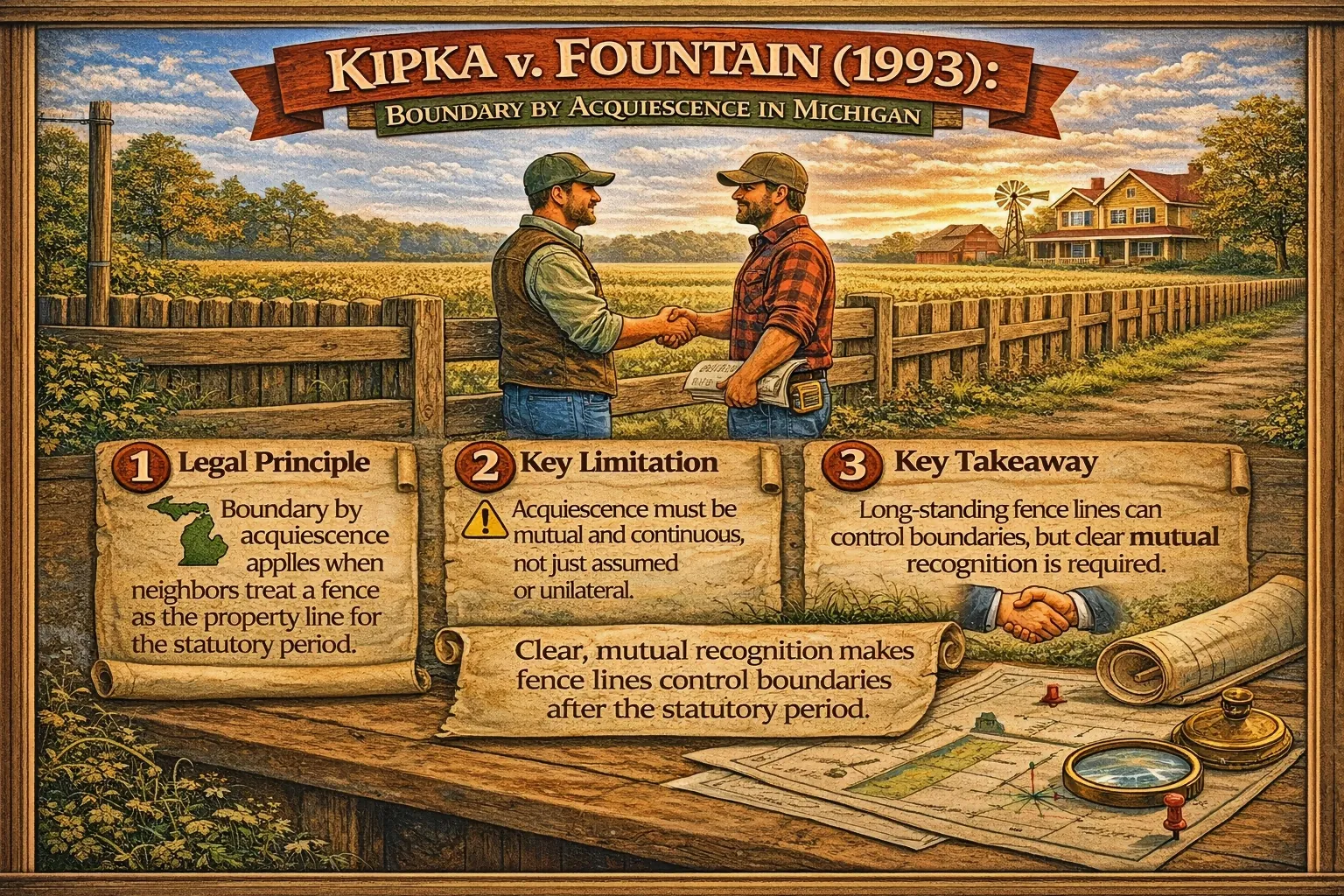
Kipka v. Fountain (1993)
In Kipka v. Fountain, neighboring landowners disputed whether an existing fence line established the true property boundary. One party argued that the fence, which had been treated as the dividing line for many years, should control over the surveyed deed description. The Michigan Court of Appeals held that a boundary may be established by acquiescence when adjoining owners treat a fence as the boundary for the statutory period, even if the fence does not match the deed line.
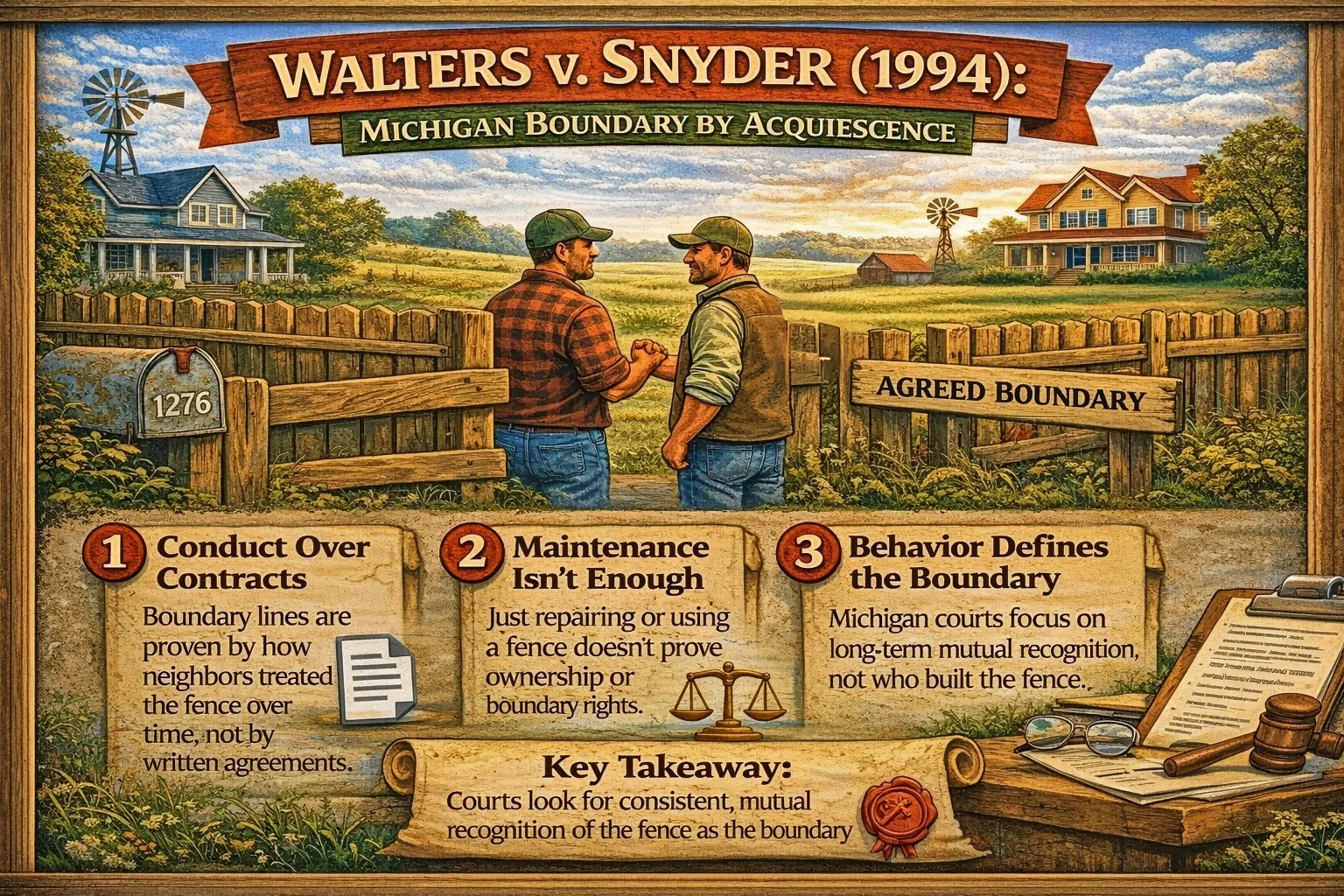
Walters v. Snyder (1994)
In Walters v. Snyder, the court examined whether a fence located off the surveyed boundary line could transfer ownership through long-term use. The Michigan Court of Appeals clarified that acquiescence does not require an express agreement, but it does require consistent conduct by both parties recognizing the fence as the boundary. The court rejected claims based solely on convenience or maintenance.
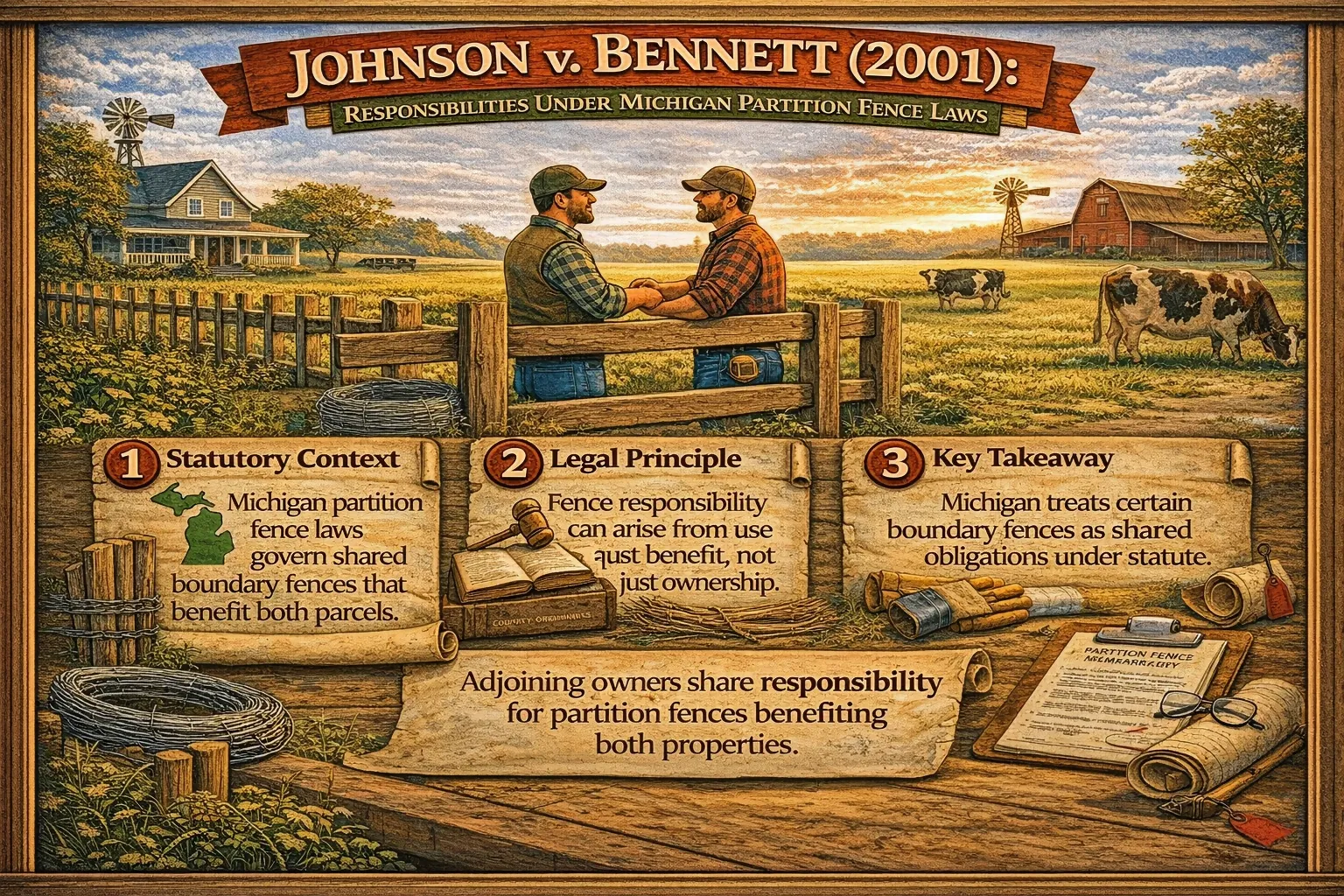
Johnson v. Bennett (2001)
In Johnson v. Bennett, a dispute arose over a shared boundary fence and responsibility for maintenance under Michigan’s partition fence statutes. The court emphasized that when a fence qualifies as a partition fence benefiting both properties, adjoining landowners may share legal responsibility regardless of who owns livestock or originally constructed the fence.
Midwest Fence and Property Line Regulations
While managing rural acreage in Michigan, it helps to know how the surrounding region handles boundary disputes. Reviewing fence laws in neighboring states gives landowners a better understanding of regional agricultural and property line standards.
- Boundary Rules in Indiana: Discover who is responsible for shared agricultural fencing.
- Illinois Property Statutes: Learn how local jurisdictions handle livestock and boundary disputes.
- Ohio Line Fence Legislation: Get the details on building and maintaining partition fences.
Michigan Fence Laws – Q&A
Do I have to pay for half of my neighbor’s fence in Michigan?
Not automatically. Michigan does not impose a blanket 50/50 rule. Cost-sharing applies only when a lawful division fence is necessary, and responsibility is often determined by township fence viewers based on necessity, condition, and fairness.
What qualifies as a lawful fence under Michigan law?
A lawful fence is one capable of restraining ordinary livestock and maintained in working condition under MCL Chapter 433. Fences that are poorly built or neglected may not qualify, which affects both liability and cost-sharing rights.
Who decides fence disputes in Michigan?
Township fence viewers—typically supervisors or clerks—inspect disputed fences and issue binding written decisions unless appealed to court.
Is Michigan a fence-in or fence-out state?
Michigan is a fence-in state. Livestock owners are generally responsible for keeping animals contained and are liable for damage caused by escaped animals.
Can a fence become the legal boundary in Michigan?
Yes. Under boundary-by-acquiescence doctrines, a fence treated as the boundary for many years may become the legal property line, even if a later survey shows a different boundary.
Good Fences Make Good Neighbors, But Cash Makes a Clean Exit
Interpreting statutory fence regulations and handling township viewer disputes under MCL Chapter 433 is a heavy burden for any landowner. When boundary risks and neighbor conflicts overshadow your property’s potential, the most efficient solution is a clean break. Bypass the legal headaches and ongoing maintenance obligations entirely when you choose to sell your Michigan land directly for a straightforward, as-is cash transaction.