Texas Fence Laws: The Comprehensive Guide (2026 Update)
Overview: Texas fence laws are not governed by a single statewide fence code. Instead, they are shaped by Texas Agriculture Code provisions, local stock laws, city ordinances, and private agreements between neighbors. Texas is often described as an open range state by default, but that label can be misleading—many counties and cities have adopted rules that change who is responsible when fences fail or livestock escapes.
Key Points:
- No Automatic Cost Sharing: Texas law does not require neighbors to split fence costs unless there is an agreement or recorded covenant.
- Open vs. Closed Range: Liability for livestock depends on county stock laws and whether a “sufficient fence” exists.
- Fence Placement Matters: A fence does not automatically define a property line, but long-term placement can create legal risk.
Side Note: If surveys, stock laws, and fence disputes are blocking your plans, you can sell your Texas land directly and avoid months of legal back-and-forth.

Do I Have to Pay for Half of My Neighbor’s Fence?
This is the most common fence dispute in Texas—and the answer is usually not what people expect.
In Texas, there is no statute that automatically requires neighbors to split the cost of a boundary fence. If your neighbor builds a fence and hands you a bill, Texas law does not force you to pay simply because the fence sits near or even on the property line.
You are generally only responsible for sharing costs if:
- You agreed to the fence in advance (preferably in writing)
- The fence obligation is part of a recorded covenant, HOA, or POA
If none of those apply, the fence is typically treated as your neighbor’s fence—even if it benefits both properties. That said, once a fence exists, damaging or removing it can create liability, even if you didn’t pay for it.
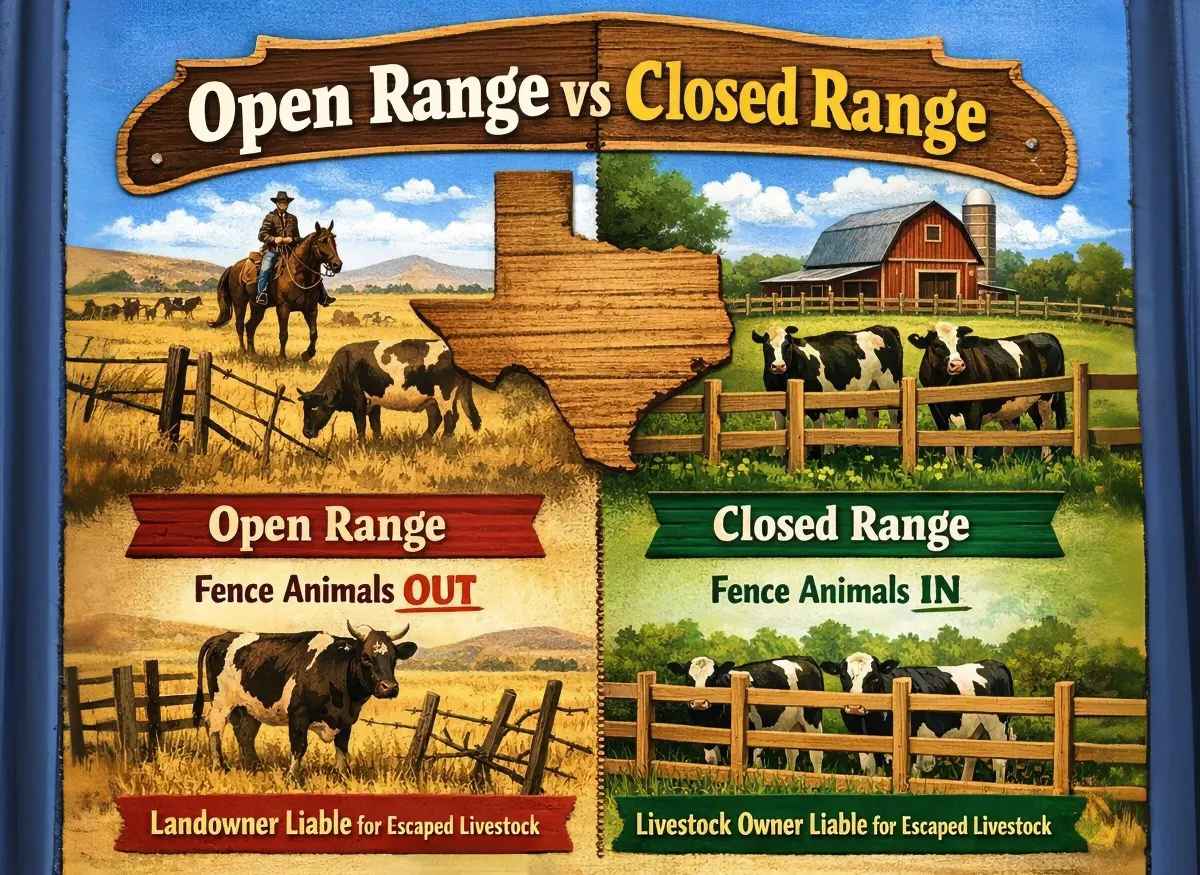
Open Range vs Closed Range
Texas has 254 counties, and one of the biggest mistakes landowners make is assuming they know whether their property is in an open range area or subject to a local stock law. In reality, many counties—and sometimes only specific precincts within a county—have adopted “closed range” stock laws that change who is legally responsible when livestock escapes.
If you don’t know which rule applies where your land is located, you are guessing—and guessing wrong in a fence dispute can cost real money.
To find out which rule applies contact the appropriate Texas County Clerk’s Office. Ask whether your county—or your specific precinct—has adopted a local stock law. Many of these elections occurred decades ago and are not obvious from a quick online search.
What Is a “Sufficient Fence” Under Texas Law?
If livestock is part of the dispute, courts often focus on whether the damaged property was protected by a legally “sufficient fence.”
Texas Agriculture Code § 143.028 outlines minimum standards for common fencing, including barbed wire fences. While not every fence must be identical, a fence generally must meet baseline construction and height requirements to qualify as legally sufficient.
Key concepts include:
- At least three strands of barbed wire
- Posts spaced no more than 30 feet apart
- A minimum height of approximately four feet
If you are relying on fence condition to support a claim, documentation matters. Photos, measurements, and maintenance records can become critical evidence.
The Fence of Convenience Problem
In the rugged terrain of Texas, fences are often built for ease, not accuracy. To avoid a creek, a dense thicket, or a rocky outcrop, neighbors frequently place fences where it’s practical—creating a “fence of convenience” rather than a surveyed boundary.
This creates a massive legal liability. If a fence sits inside your true property line and your neighbor uses that extra land openly and continuously, they may eventually claim ownership under Texas adverse possession statutes. In the eyes of the law, a fence that stays in the wrong place for too long can become evidence that the boundary has shifted.
Waiting quietly while a fence remains “off-line” is one of the most expensive mistakes a Texas landowner can make. Always verify your deed lines with a professional survey before a temporary fence becomes a permanent loss of land.
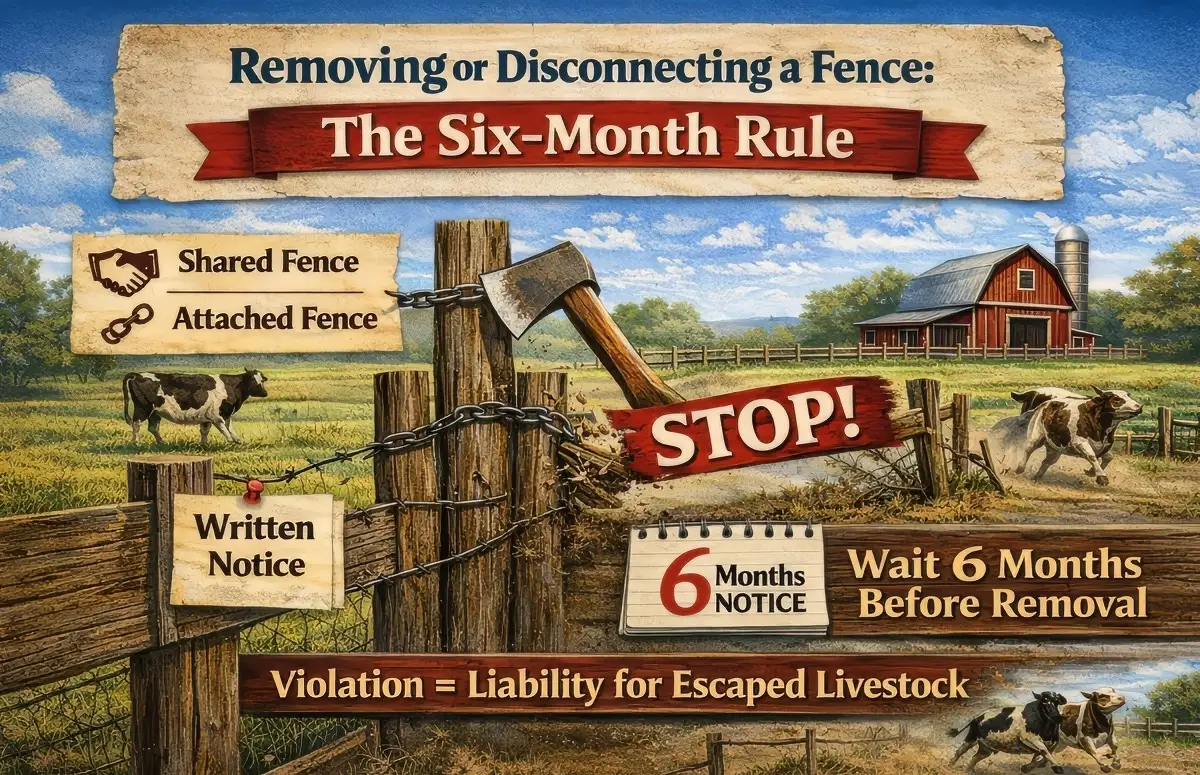
Removing or Disconnecting a Fence: The Six-Month Rule
Texas law restricts self-help when it comes to removing certain fences.
If a fence is:
- A separating or dividing fence jointly used, or
- Physically attached to another person’s fence
You cannot simply tear it down without notice. Texas Agriculture Code § 143.121 requires written notice and a waiting period before removal. Ignoring this process can shift liability onto you—especially if livestock escapes as a result.
The “Spite Fence” Law in Texas
Texas generally allows landowners to build fences on their own property, even if the fence blocks a view or annoys a neighbor. However, there is a narrow exception that catches some people off guard: a fence built solely to harass or punish a neighbor can sometimes be challenged as a nuisance.
Texas does not have a clean, standalone “spite fence statute.” Instead, these disputes are usually argued under nuisance law. To win, the complaining neighbor typically must prove the fence serves no legitimate purpose and was constructed primarily to cause harm or annoyance. This is a high bar and explains why spite fence claims are difficult—but not impossible.
Texas Fence Law for Ag-Exempt Land
In Texas, an Ag Exemption makes fencing a vital tax strategy. County Appraisal Districts (CADs) require a “sufficient fence”—defined by Texas Ag Code § 143.028 as at least three strands of barbed wire with posts spaced no more than 30 feet apart—to prove “primary agricultural use.” Without this perimeter, you risk failing the “degree of intensity” standards required to keep your tax valuation.
Fence disputes create immediate financial risk. A “Change of Use” determination by the CAD instantly removes your 20% annual appraisal cap, exposing the acreage to full market-value taxation. Landowners must recognize that a single removed boundary line can trigger a complete reclassification of the property, causing your annual tax bill to skyrocket overnight.
The ultimate penalty for a fence-related tax failure is the Rollback Tax. Under HB 3833, the recapture period is the previous three years of tax differences plus interest. Before altering any boundary, calculate the risk: a minor neighbor dispute can result in thousands of dollars in back-taxes, a bill that often far outweighs the cost of the fence itself.
What if a Neighbor’s Tree Falls on My Fence?
In Texas, tree disputes are a common source of neighborhood friction. If your neighbor’s tree falls and crushes your fence, the question of who pays comes down to the health of the tree and the “Act of God” principle.
The “Act of God” Rule
If a healthy tree falls due to a storm, wind, or lightning, Texas law generally treats this as an “Act of God.” In these cases, you are typically responsible for the cleanup and repairs to your own property (and your fence), even if the tree grew in your neighbor’s yard.
Liability for Negligence
The rules change if the tree was dead, diseased, or leaning dangerously before it fell. If you can prove the neighbor knew the tree was a hazard and failed to maintain it, they (or their insurance) may be held liable for the damages. Pro Tip: If you see a dangerous tree on a neighbor’s property, send them a polite written notice (certified mail). This creates a paper trail of their knowledge of the hazard.
Your Right to Trim
You don’t have to wait for the tree to fall. Under Texas law, you generally have the right to trim branches or roots that grow over the property line, provided you do not kill the tree or enter the neighbor’s property without permission.
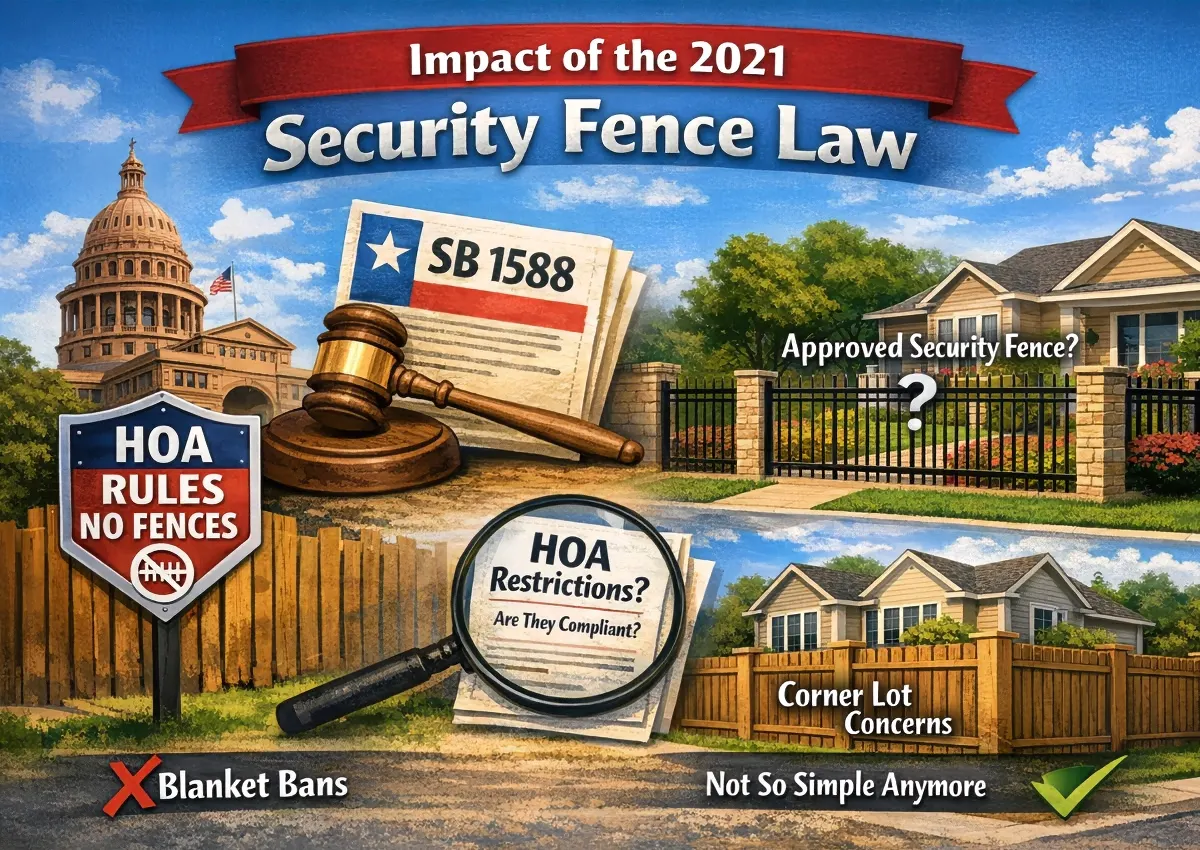
Impact of the 2021 Security Fence Law
In 2021, Texas passed Senate Bill 1588, which limited the ability of HOAs to completely prohibit certain security measures, including perimeter and security fencing in specific circumstances.
While HOAs can still regulate fence height, materials, and appearance, they can no longer rely on blanket bans to prevent homeowners from installing security fences. This change is especially relevant in disputes involving front-yard fencing, corner lots, and security-related concerns.
If your HOA claims “fences are not allowed” without citing specific, compliant restrictions, the HOA may be overstepping. That does not mean every fence is allowed—but it does mean the analysis is no longer as simple as “the HOA said no.”
The Texas Fence Law Checklist
Before building, replacing, or removing a fence in Texas, every landowner should walk through the following checklist. Skipping any one of these steps is how fence disputes spiral out of control.
- Confirm the property line. Do not rely on old fences, stakes, or assumptions—use a survey.
- Check county stock laws. Open range vs closed range can change liability completely.
- Review city ordinances. Height limits, corner visibility rules, and permits often apply.
- Check HOA or POA restrictions. Security fence protections exist, but design rules still matter.
- Document agreements in writing. Verbal understandings are the root of most fence lawsuits.
🛠️ Free Resource: The Professional Fence & Boundary Audit 🛠️
Don’t risk legal liability or neighbor disputes by guessing. We’ve developed this comprehensive 4-phase field guide to help you audit boundaries, verify compliance, and document communication like a pro.
📥 Download the Printable PDF Audit
Print this out to use as a worksheet while you walk your property line.
Texas Fence Law Case Studies: Real Court Decisions
Texas fence disputes are rarely decided by a single statewide rule. Instead, Texas courts focus on property boundaries, adverse possession elements, long-term fence placement, and the conduct of neighboring landowners over time. These cases show how Texas judges analyze fence disputes involving old fence lines, surveys, and claims that a fence became the legal boundary.
Tran v. Macha (2006)
In Tran v. Macha, neighboring landowners disputed whether a long-standing fence line had become the legal boundary between their properties. One party argued that because both owners had treated the fence as the boundary for years, it should override the surveyed deed line. The Texas Supreme Court rejected that argument, holding that Texas does not recognize boundary by acquiescence as a standalone doctrine.
- Legal Principle: Texas requires proof of adverse possession elements; mere acquiescence is not enough.
- Key Limitation: Long-term fence acceptance alone does not change a legal boundary.
- Key Takeaway: In Texas, a fence does not become the boundary without meeting strict adverse possession requirements.
Rhodes v. Cahill (1994)
In Rhodes v. Cahill, the court examined whether a fence that had been in place for decades supported a claim of adverse possession. The claimant argued that maintaining and relying on the fence line showed exclusive ownership of the disputed strip. The Texas Supreme Court emphasized that adverse possession requires clear proof of actual, visible, continuous, and hostile possession for the statutory period.
- Legal Standard: Adverse possession in Texas requires more than fence placement.
- Evidence Required: Use of the land must be open, notorious, and exclusive.
- Key Takeaway: A fence can support an adverse possession claim, but only when all statutory elements are proven.
Best v. Thornton (2018)
In Best v. Thornton, the dispute centered on whether a fence enclosing land supported an adverse possession claim under Texas law. The claimant relied on fencing, grazing, and maintenance activities to establish ownership beyond the deed description. The Texas Supreme Court reaffirmed that fencing is relevant evidence, but possession must clearly extend to the disputed area and meet the statutory time period.
- Case Context: Fence-enclosed land and grazing use.
- Legal Principle: Fences are evidence of possession, not automatic proof of ownership.
- Key Takeaway: Texas courts require precise, fact-specific proof when fences are used to claim land.
FAQs
Do I have to pay for half my neighbor’s fence in Texas?
No. Texas law does not impose automatic cost sharing. Without an agreement or covenant, your neighbor generally cannot force you to pay for a fence they chose to build.
Is Texas really an open range state?
Texas is often described as open range by default, but many counties and even specific precincts have adopted stock laws that require livestock owners to fence animals in. The rule depends on where the property is located.
Can a fence become the legal property line?
A fence does not automatically replace a deed or survey. However, if a fence remains off the true boundary for many years and both parties treat it as the dividing line, it can become evidence in an adverse possession or boundary dispute.
Can I remove a fence I don’t want?
Not always. If the fence is connected to another fence or functions as a dividing fence, Texas law requires notice and a waiting period before removal. Tearing it down without following the process can make you liable for damages.
Does fence height matter under Texas law?
Fence height is not controlled by a statewide statute. In most cases, height limits are set by city ordinances or HOA rules, especially for front yards and corner lots.
Conclusion
Texas fence laws are a blend of historic agricultural rules and modern land-use realities. Cost sharing is not automatic, open range rules are often misunderstood, and a fence does not magically become a property line just because it has been there for years. Most disputes come down to boundaries, local stock laws, and whether neighbors acted deliberately or just made assumptions.
If fence disputes, surveys, permits, and neighbor conflict are standing in the way of your plans, there is a simpler path. You can skip the uncertainty entirely by choosing to sell your Texas land fast to a buyer who handles the complications for you.