What Does an Acre Look Like?
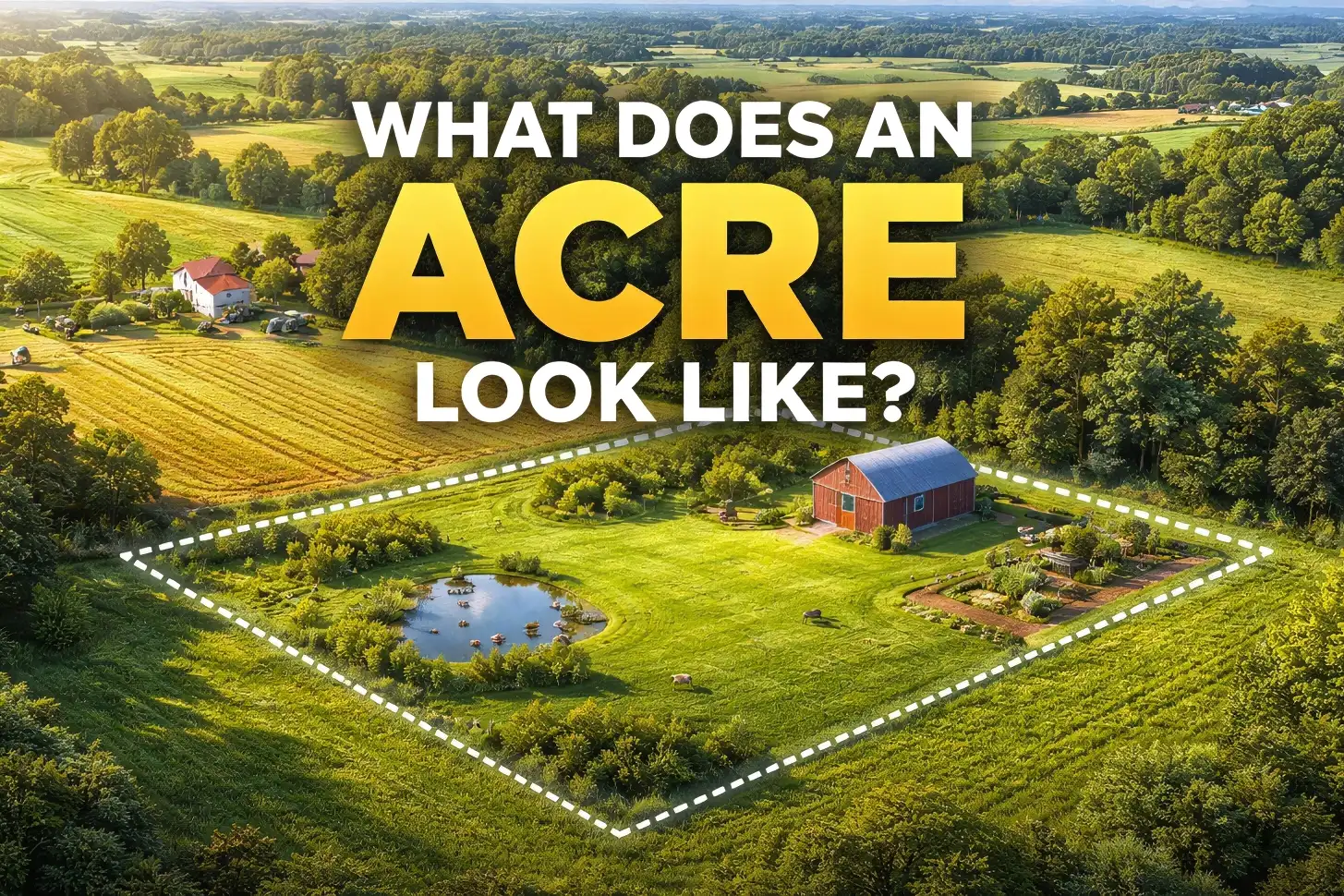
Overview: An acre is a standard unit of land measurement equaling exactly 43,560 square feet. Accurately visualizing this space is the critical first step in evaluating a property’s development potential and true market value.
Key Points:
- Exact Dimensions: One full acre mathematically equals 43,560 square feet, 4,840 square yards, or 4,047 square meters.
- Usable vs. Gross Acreage: Land valuation relies on usable acreage, which subtracts the mandatory space required for county setbacks, utility easements, and roads.
- Development Capacity: A standard one-acre residential tract comfortably supports three to four single-family homes with standard yards.
- Fractional Lots: Most modern suburban properties sit on a quarter-acre lot measuring exactly 10,890 square feet.
Visualizing an Acre Through Sports
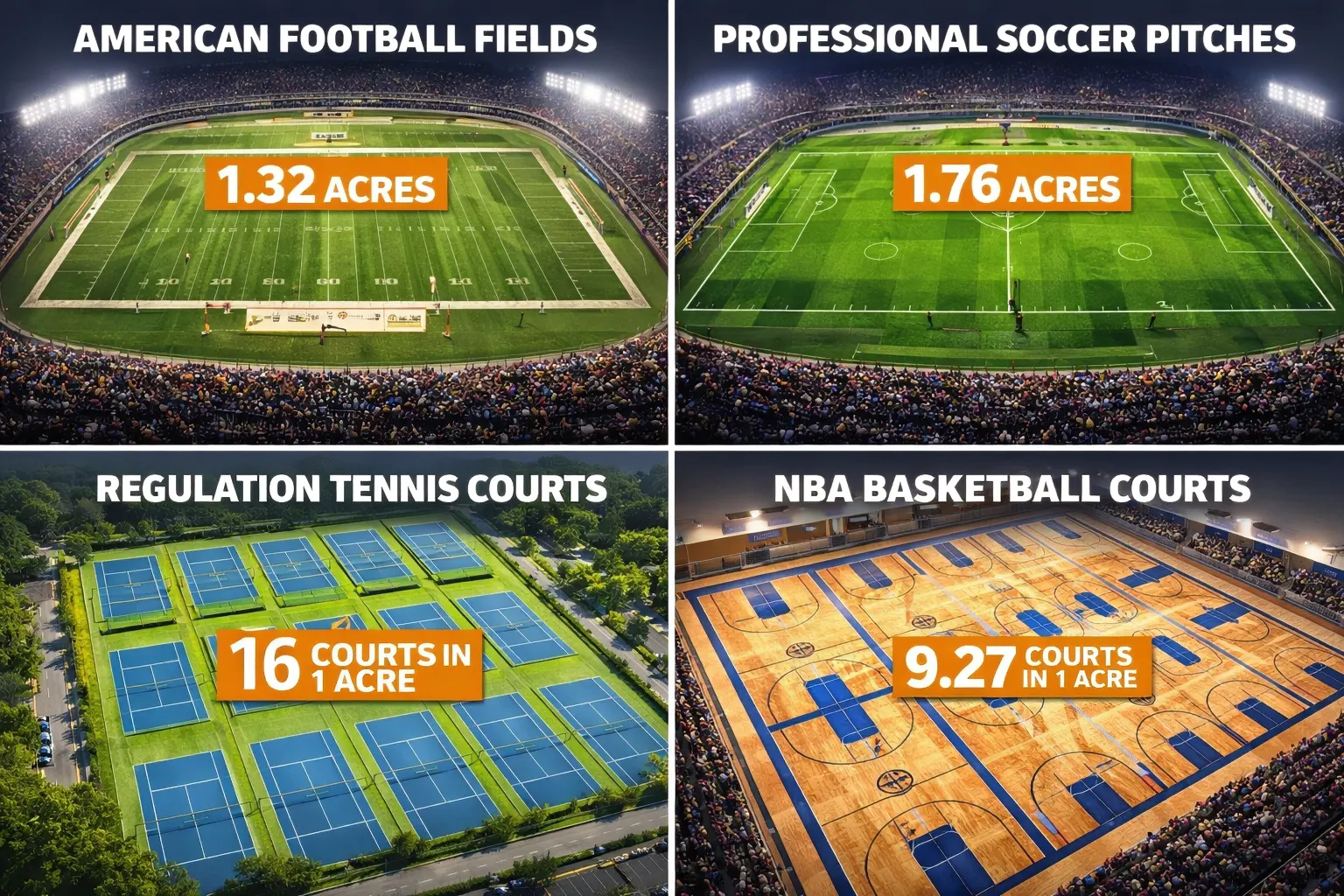
Overlaying the exact dimensions of an acre onto familiar athletic spaces provides the easiest way to understand its true size. Here is a detailed breakdown using common sports boundaries.
American Football Fields
Professional football fields cover 1.32 acres when you include both end zones. Standing on the goal line and looking toward the opposite side, a single acre stretches from your feet to roughly the 10-yard line on the other end of the field. This footprint covers about 75 percent of the entire playing surface.
Professional Soccer Pitches
Standard professional soccer pitches are much wider than football fields, covering roughly 1.76 acres in total. One acre of land takes up exactly 60 percent of the playable area. Picture slightly more than one complete half of the pitch to accurately visualize the footprint.
Regulation Tennis Courts
Racket sports offer another excellent mental map for visualizing property lines. Picture a large community tennis complex. You can fit exactly 16 regulation-sized tennis courts inside a perfect one-acre boundary. This measurement includes the standard playable areas surrounding the outer lines of each court.
NBA Basketball Courts
Standard NBA basketball courts measure 94 feet long by 50 feet wide. One single acre of land holds exactly 9.27 full-size basketball courts positioned side by side.
Comparing an Acre to Everyday Landmarks
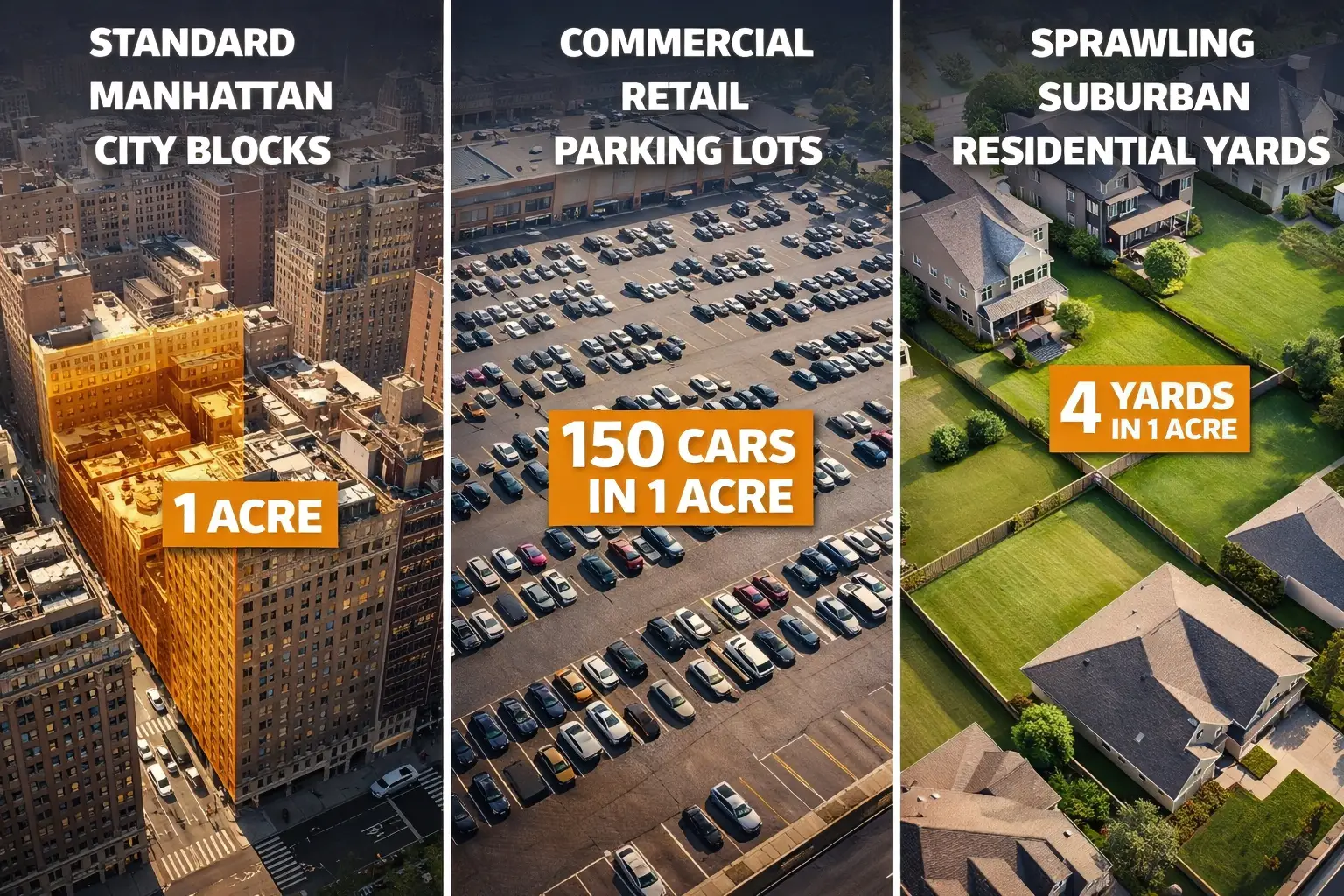
Shifting from athletic fields to local infrastructure helps put acreage into a community perspective. Here is how an acre translates to everyday residential and commercial environments.
Standard Manhattan City Blocks
City blocks vary widely depending on the municipality and local zoning laws. Rectangular city blocks in Manhattan cover approximately 2 to 2.5 acres. One acre represents roughly half of that classic city block. Walking down an avenue, an acre equals about the size of half the buildings occupying that single block face.
Commercial Retail Parking Lots
Picture the exterior of your local grocery store or retail strip center. Paved commercial parking lots accommodate approximately 150 parked vehicles within a one-acre space. This physical measurement actively accounts for the necessary driving lanes and turning radius space between the rows of parked cars.
Sprawling Suburban Residential Yards
Putting an acre into a residential perspective requires visualizing a sprawling suburban property. Most modern subdivision lots hover around a quarter of an acre. One full acre equals the exact equivalent of combining four of those standard suburban yards into a single continuous tract of land.
Fractional Acreage: Visualizing Smaller Lots
Most residential buyers and sellers deal with fractional acreage. Here is how smaller parcels break down in the real world.
- Half Acre (21,780 square feet): This provides ample room for a large single-family home, a spacious front yard, a long driveway, and a backyard large enough for a pool and detached garage.
- Quarter Acre (10,890 square feet): The classic American suburban lot. A quarter acre comfortably fits a standard 2,000-square-foot house with a modest front and backyard.
- Tenth of an Acre (4,356 square feet): Typical for dense urban environments or townhome developments. This footprint covers the structure itself with minimal exterior space.
The Housing Myth: How Many Homes Fit on an Acre?
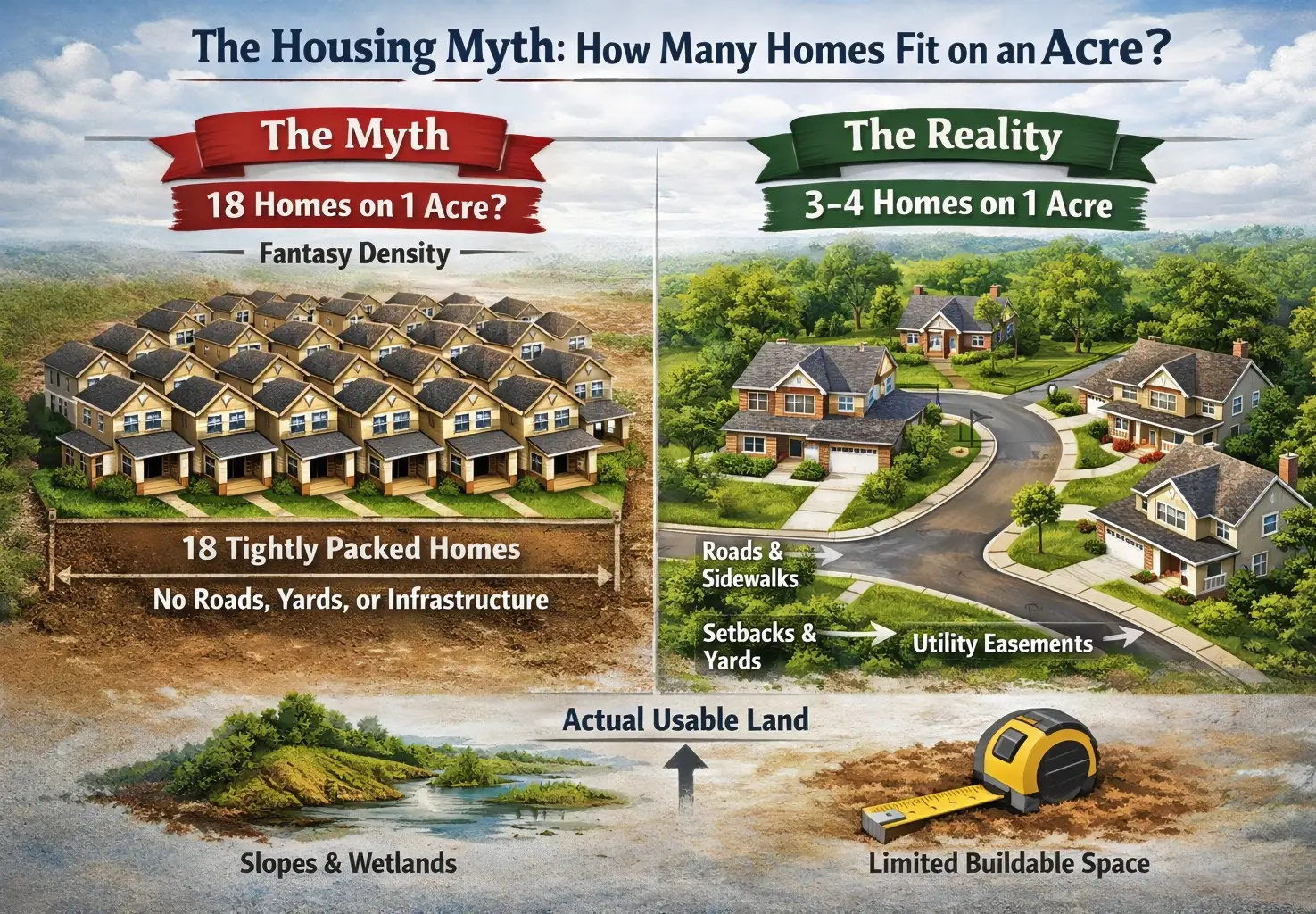
A widespread misconception online claims you can fit up to 18 average-sized homes on a single acre of land. This is a purely mathematical fantasy. It assumes you can tightly pack 2,400-square-foot boxes against each other without any infrastructure. Real estate development is dictated by usable acreage rather than gross acreage.
Usable acreage subtracts the land required for county setbacks, utility easements, sidewalks, driveways, and paved access roads. Topography issues like steep slopes or wetlands further reduce the buildable footprint. In the real world, a standard suburban residential development typically fits three to four single-family homes with standard yards onto a one-acre tract.
What Does an Acre Look Like in a Rural Environment?
The visual scale of an acre changes dramatically when evaluating raw land, timber, or agricultural space. Here is a detailed look at what a single acre yields in practical rural applications.
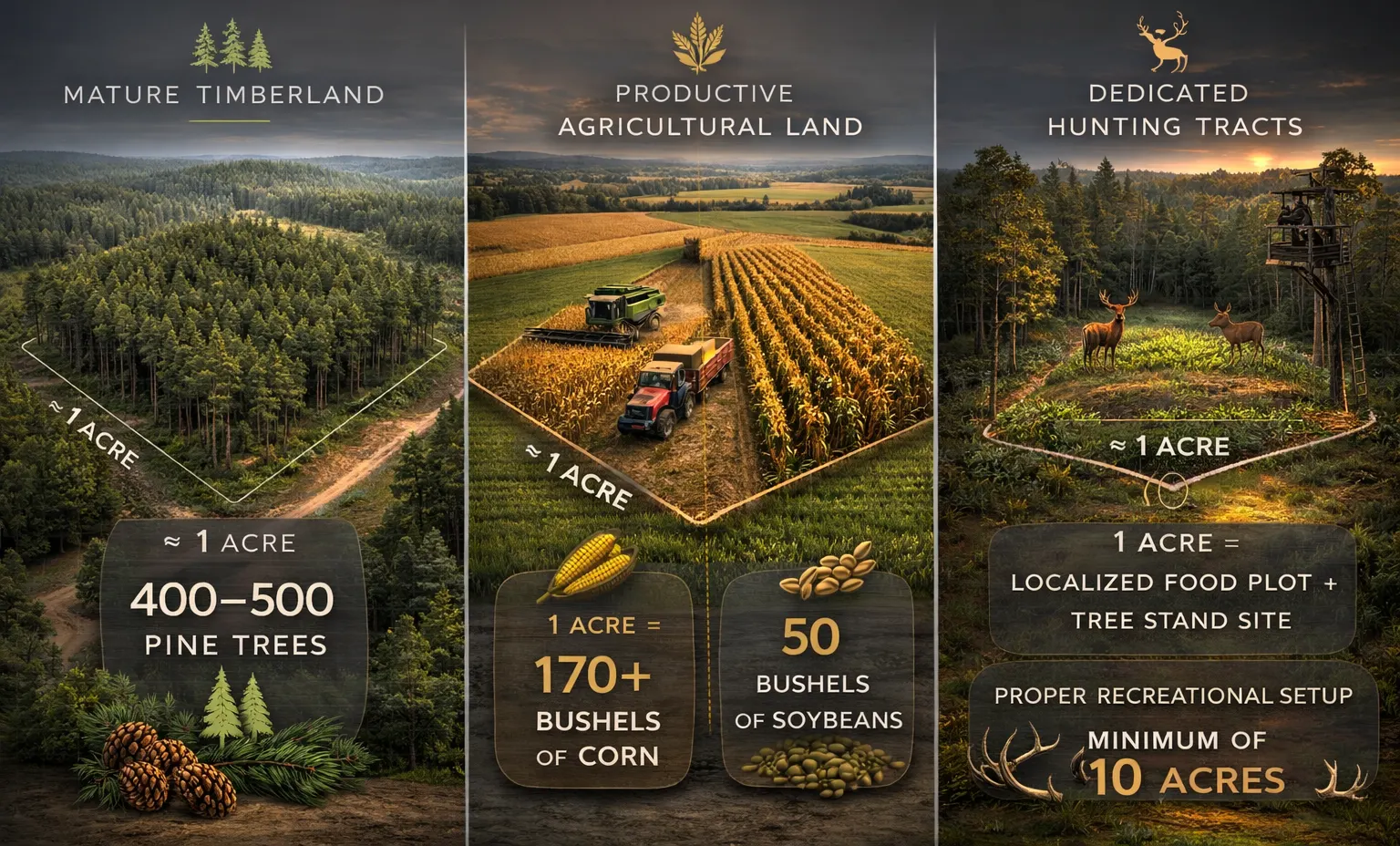
Mature Timberland
A well-managed acre of Southern timberland typically supports 400 to 500 mature pine trees. The exact density depends heavily on the specific thinning schedule and the timber species planted. This scale provides a solid physical benchmark for understanding the commercial timber value of your property.
Productive Agricultural Land
The visual output of an acre shifts significantly when applied to row crops. Soil quality and topography dictate your exact farming yields. A highly productive acre in states like Kentucky or Ohio can yield over 170 bushels of corn or roughly 50 bushels of soybeans per harvest.
Dedicated Hunting Tracts
A single acre provides limited utility for a standalone hunting property. One acre serves perfectly as a localized food plot or a strategic spot for a single tree stand. Serious hunters require much larger contiguous acreage to manage wildlife funnels, establish bedding areas, and maintain safe shooting lanes. Visualizing a proper recreational setup is a minimum of 10-acres where the terrain fully supports diverse wildlife movement.
The Exact Mathematical Dimensions of an Acre
An acre is strictly a measurement of area. It can take any physical shape, such as a rectangle, a circle, or an irregular polygon, as long as the total surface area equals 43,560 square feet. Here is the exact mathematical breakdown of a standard acre.
| Measurement Unit | Exact Size |
|---|---|
| Square Feet | 43,560 |
| Square Yards | 4,840 |
| Square Meters | 4,047 |
| Perfect Square Dimensions | 208.71 feet by 208.71 feet |
| Classic Survey Dimensions | 66 feet by 660 feet (1 chain by 1 furlong) |
The Historical Origin of the Measurement
The term “acre” originates from the Old English word “æcer,” which translates to “open field.” Historically, an acre was defined as the amount of land a single yoke of oxen could plow in one day. Surveyors eventually standardized this measurement using chains and furlongs. One chain equals 66 feet, and one furlong equals 660 feet. A rectangular strip of land one chain wide and one furlong deep equals exactly 43,560 square feet.
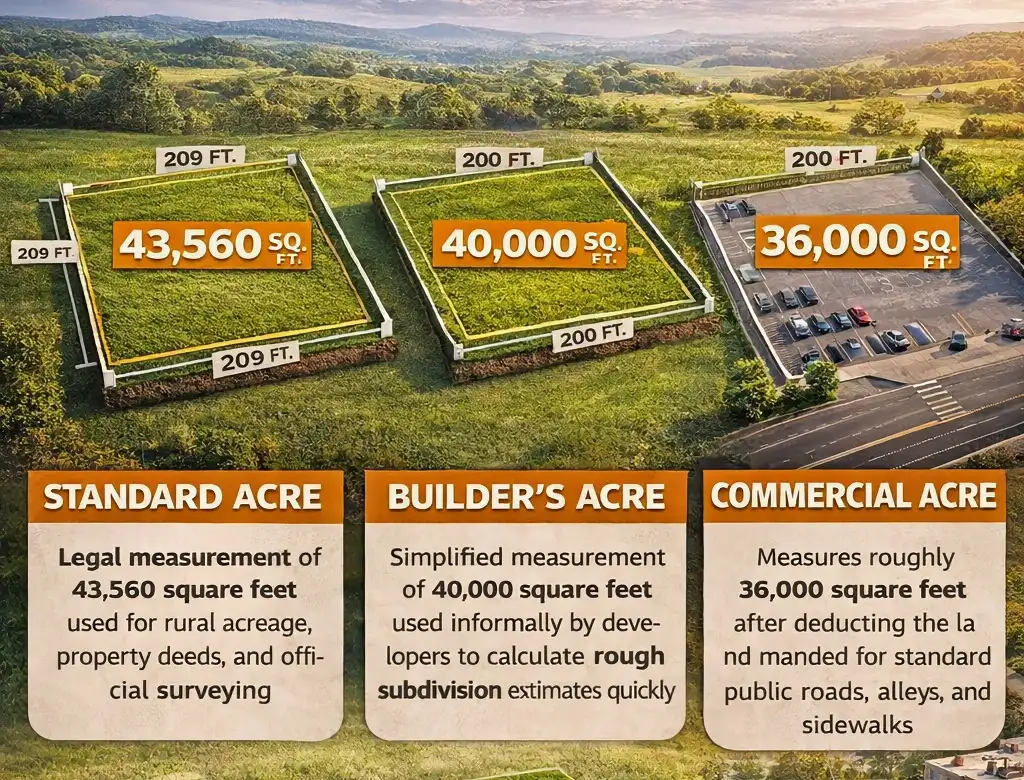
The Different Types of Acres in Real Estate
Developers, appraisers, and land buyers use variations of the acre depending on the specific application and zoning requirements.
Standard Acre
The legal measurement of 43,560 square feet used for rural acreage, property deeds, and official surveying.
Builder’s Acre
A simplified measurement of exactly 40,000 square feet used informally by developers to calculate rough subdivision estimates quickly.
Commercial Acre
A commercial acre measures roughly 36,000 square feet. This reflects the remaining usable commercial space after deducting the land mandated for standard public roads, alleys, and sidewalks.
How to Estimate an Acre on Foot
You can map out a rough acre while walking your property to gain an immediate visual understanding of your boundaries. The average adult stride measures roughly 2.5 to 3 feet long. Walk 80 normal paces in a straight line, turn 90 degrees, and walk another 80 paces. Repeating this process to complete a square will give you a highly accurate, on-the-ground approximation of one full acre.
How to Determine the Value of Your Acreage
Visualizing your acreage accurately allows you to assess its highest and best use. Whether you are managing timber, planning a subdivision lot, planting crops, or surveying inherited land, knowing the exact physical footprint is the foundation of smart real estate ownership and accurate valuation.
Once you understand the physical size of your property, the next step is determining its market value. If you own vacant rural acreage, hunting land, timberland, or inherited property and want to avoid the fees and long timelines of traditional real estate listings, we provide a hassle-free cash sale.