How to Subdivide Land in Oklahoma: Local Laws & Costs
The Basics: Subdividing land in Oklahoma is regulated primarily by Title 11 for city jurisdictions and Title 19 for rural counties. This means regulations change drastically depending on where your property is located.
Quick Takeaways:
- Jurisdiction Matters: City limits mean strict zoning and infrastructure demands. Rural county land offers more freedom but still requires road access and environmental compliance.
- The DEQ Soil Profile: Oklahoma relies heavily on the Department of Environmental Quality for wastewater management. Failing a soil profile test can prevent a subdivision entirely.
Keep in Mind: If navigating county boards, soil tests, and surveying costs sounds like a headache, many landowners opt to sell their Oklahoma land fast for cash and bypass the subdivision process completely.
Understanding Land Subdivision in Oklahoma
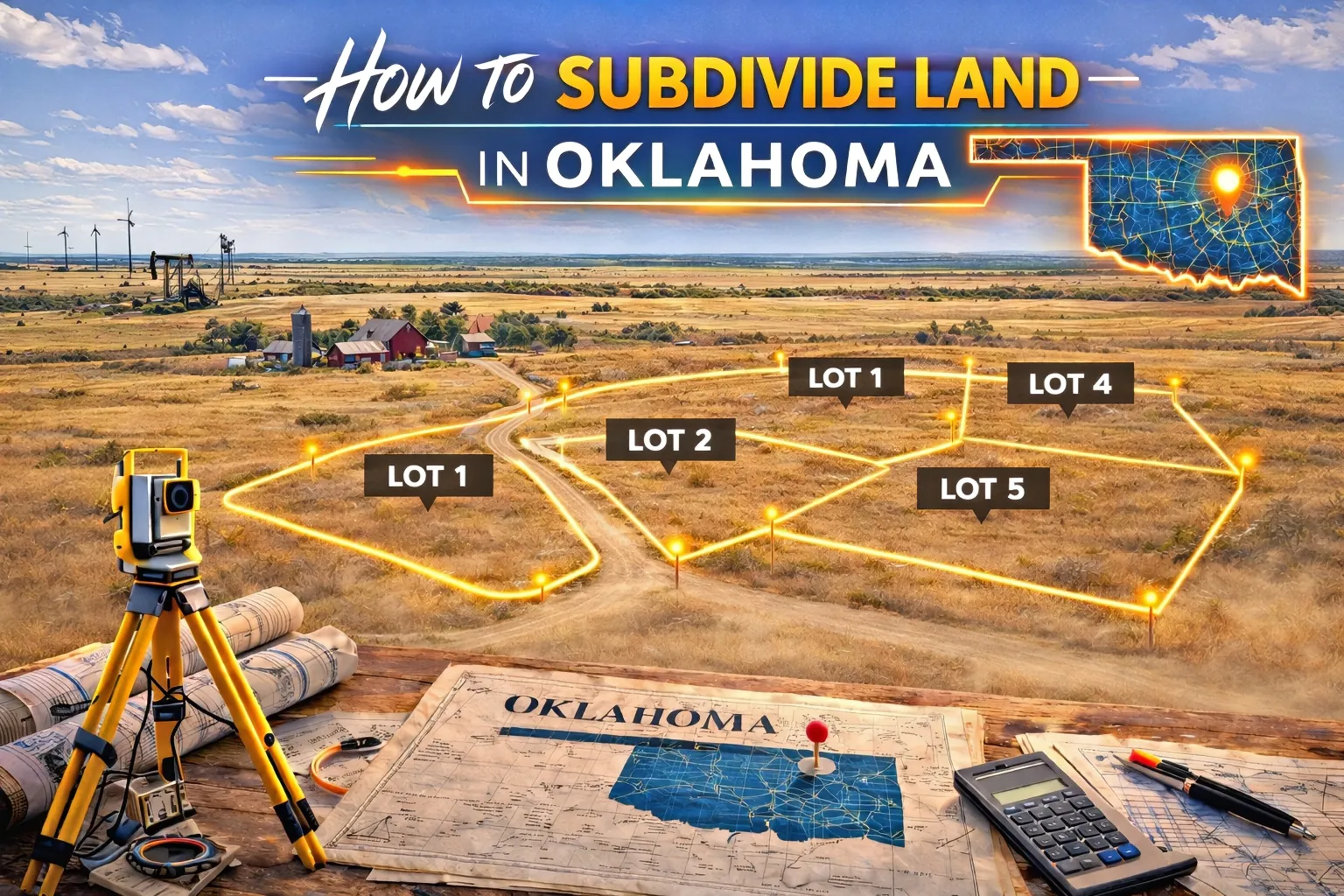
Subdividing land allows property owners to maximize parcel value, prepare acreage for residential development, or pass specific tracts down to family members. The process requires a strict understanding of local zoning laws, environmental regulations, and state statutes.
What Constitutes a Subdivision?
In Oklahoma, state law defines a subdivision based on the size and number of the newly created parcels. According to Oklahoma Statutes, dividing a tract of land into two or more lots where any single resulting lot is less than 10 acres typically triggers formal subdivision regulations.
Splitting a large agricultural parcel into 40-acre tracts is generally straightforward. Creating two-acre residential lots requires platting, engineering, and formal approval from local planning commissions.
Why Landowners Choose to Subdivide
Landowners pursue subdivision for several financial and practical reasons.
- Creating smaller, more affordable residential lots to attract homebuilders.
- Separating a homesite from a larger agricultural or hunting tract.
- Liquidating a portion of an inherited estate while keeping the remainder in the family.
- Increasing the overall gross value of the property prior to a sale.
The Legal Framework: City vs. County Jurisdiction
Your property’s location determines which government entity controls the subdivision approval process. You must identify your local jurisdiction before hiring surveyors or contractors.
Municipal Planning Commissions (City Limits)
Land within incorporated city limits falls under Title 11 of the Oklahoma Statutes and is governed by the local municipal planning commission and city council.
- Strict Zoning: Requires specific lot sizes and dedicated street access.
- Required Infrastructure: Often mandates expensive improvements like paved roads, curbs, and municipal sewer taps.
County Planning Commissions (Rural Land)
Land outside city limits falls under Title 19 of the Oklahoma Statutes and is overseen by the County Planning Commission and the Board of County Commissioners.
- More Flexibility: Unzoned rural counties generally have fewer restrictions than incorporated cities.
- Core Requirements: You must still provide public road access, utility easements, and adhere to state environmental guidelines for wastewater management.
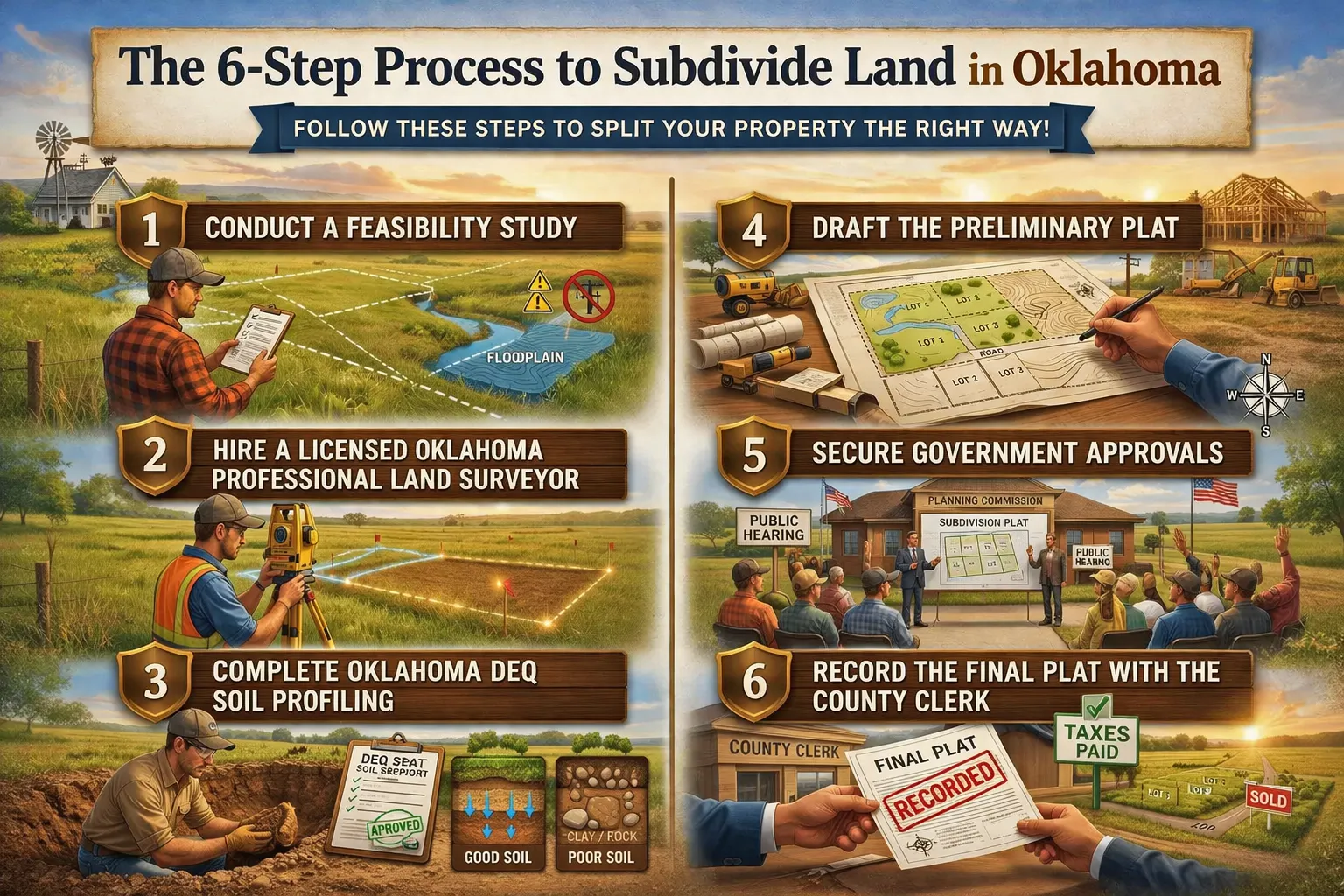
The 6-Step Process to Subdivide Land in Oklahoma
Successfully splitting a parcel requires coordinating with surveyors, soil scientists, and local government boards. Follow this step-by-step process to ensure your project meets all legal requirements.
Step 1: Conduct a Feasibility Study
Verify your local zoning district and county regulations immediately. You must confirm the minimum lot sizes required for your specific area. Attempting to create one-acre lots in a county that mandates five-acre minimums will result in an automatic denial.
Check the property for physical limitations. Look for floodplains, steep topographical changes, and existing utility easements that could restrict where property lines can be drawn.
Step 2: Hire a Licensed Oklahoma Professional Land Surveyor
You must hire a state-licensed professional land surveyor to legally establish your new property boundaries. The surveyor locates existing physical boundaries, identifies easements, and mathematically closes all lots.
The surveyor ensures your new parcels meet the Oklahoma Minimum Standards for the Practice of Land Surveying. They will place physical markers at the new property corners and draft the necessary documents for county review.
Step 3: Complete Oklahoma DEQ Soil Profiling
Rural land without access to municipal sewer lines requires on-site septic systems. The Oklahoma Department of Environmental Quality (DEQ) regulates all septic installations.
Conventional septic systems use lateral lines to disperse wastewater directly into the ground. If your soil has dense clay or shallow bedrock, the DEQ mandates an expensive aerobic treatment system. These systems cost significantly more to install and maintain, directly lowering the potential resale value of your subdivided lots.
A failed DEQ soil profile means the lot cannot legally support a septic system. Without a compliant system, the parcel cannot be developed or sold as a residential building site.
Step 4: Draft the Preliminary Plat
Your surveyor or civil engineer will draft a preliminary plat based on the boundary survey and soil test results. This document serves as the visual blueprint for your proposed subdivision.
A standard preliminary plat includes specific technical details.
- Accurate boundary lines and progressive lot numbers.
- Topographical contours and identified flood zones.
- Results from the DEQ soil profile tests.
- Proposed utility easements for power and water lines.
- Dedicated legal access to a county or state-maintained road.
Step 5: Secure Government Approvals
Submit your preliminary plat to the appropriate planning commission for official review. The commission will schedule a public hearing to discuss your subdivision. Adjacent property owners will receive notification of this hearing and have the right to voice their opinions.
The planning commission evaluates the plat for compliance with all local ordinances. They will vote to recommend approval, require modifications, or deny the request. The final approval vote comes from the City Council or the Board of County Commissioners.
Step 6: Record the Final Plat with the County Clerk
An approved subdivision is not legally valid until the final plat is filed of record. You must take the approved documents to the local County Clerk for official recording.
The county requires a Treasurer’s Certificate before recording the plat. This certificate proves that all current and past property taxes are paid in full. Once recorded, the new lots legally exist and can be sold or developed independently.
Costs Associated with Subdividing Oklahoma Land
Subdividing property requires upfront capital. You must pay for professional services, environmental testing, and government application fees long before you can sell the newly created lots.
Below is a breakdown of the typical costs associated with a minor rural land subdivision in Oklahoma. These figures represent a basic lot split without the need for new road construction or municipal utility extensions.
Large-scale developments requiring paved roads, fire hydrants, and commercial engineering will increase these costs exponentially. Always request detailed quotes from local professionals before beginning your project.
Common Roadblocks When Subdividing Land in OK
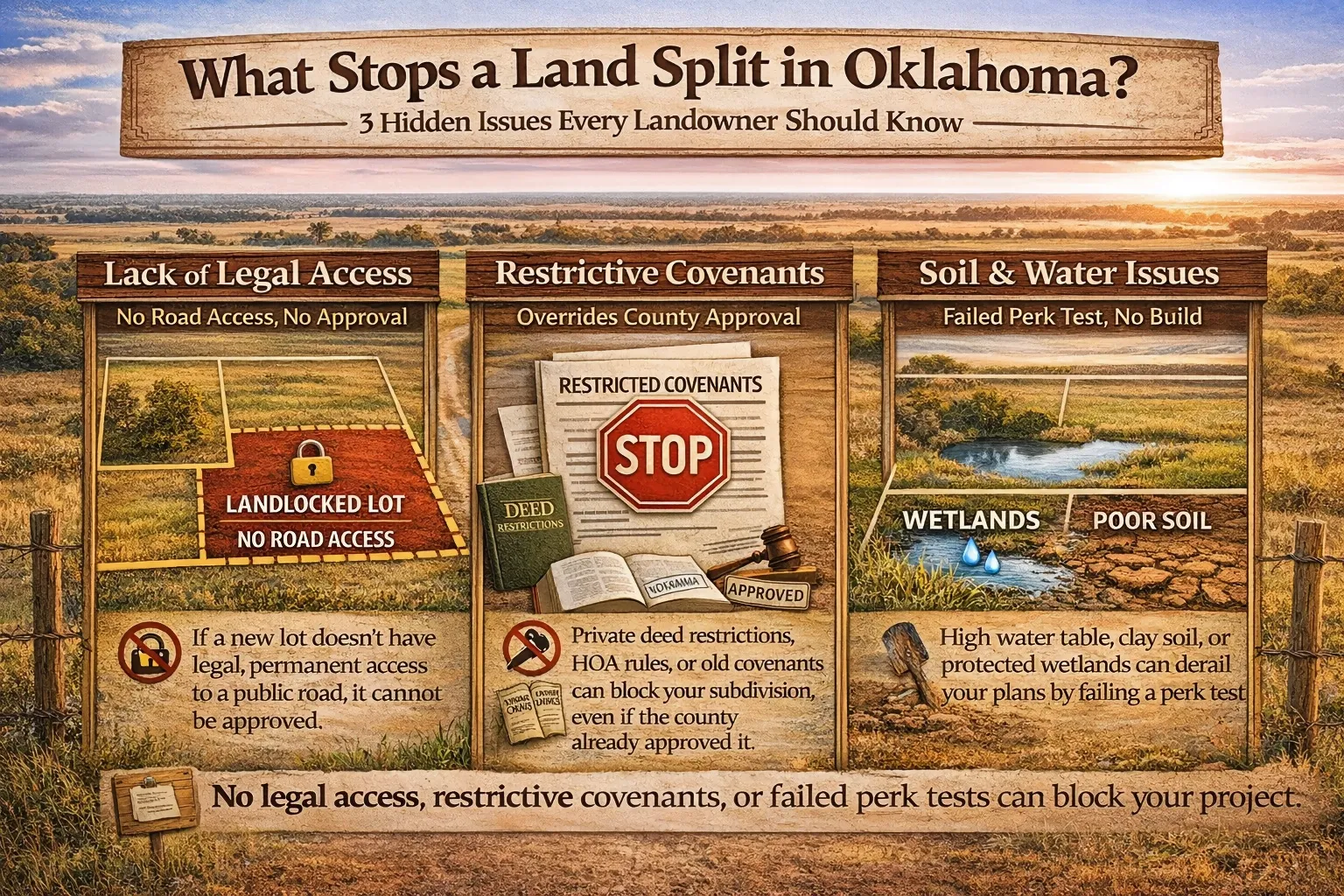
Landowners frequently encounter obstacles that delay their subdivision timeline or halt the project entirely. Understanding these roadblocks allows you to plan accordingly.
Lack of Legal Access
Every newly created lot must have dedicated legal access to a public road. You cannot create a landlocked parcel. If a lot lacks direct road frontage, you must secure and record a permanent access easement across an adjacent property.
Restrictive Covenants
Check your deed for existing restrictions. Neighborhood covenants or prior deed restrictions can legally block a subdivision. Read the Oklahoma statutory laws regarding real estate to understand how private covenants interact with county zoning. A county may approve your plat, but a private Homeowners Association can still sue to prevent the lot split.
Environmental Limitations
Protected wetlands, steep ravines, and poor soil conditions heavily restrict usable acreage. If the DEQ determines your soil contains too much clay or sits too close to a high water table, you will be forced to install expensive aerobic treatment systems or abandon the subdivision entirely.
A Direct Cash Solution for Your Oklahoma Acreage
Subdividing land routinely demands six to twelve months and thousands of dollars in surveyor, county, and DEQ fees. Bubba Land Company offers a streamlined solution by purchasing your rural acreage, hunting land, or timberland for cash in its current condition. You receive a fair offer and close on your chosen timeline. To secure your funds quickly, request your fair cash offer today.