How to Subdivide Land in Wyoming: The 35 Acre Loophole
Overview: Subdividing land in Wyoming is governed by the Wyoming Real Estate Subdivision Act, but actual zoning and permitting authority lies heavily with individual county commissioners.
Key Points:
- The 35 Acre Rule: Subdividing into parcels of 35 acres or larger usually bypasses lengthy permitting if legal access exists.
- County Control: State law sets the baseline, but local counties dictate minimum lot sizes, testing, and road requirements.
- Upfront Costs: Expect to pay thousands out of pocket for professional surveyors, soil tests, and county application fees.
Alternative Option: If you want to bypass the surveying fees, county meetings, and months of waiting, many property owners opt to sell their Wyoming land directly for a fast cash closing instead of dealing with the complex development process.
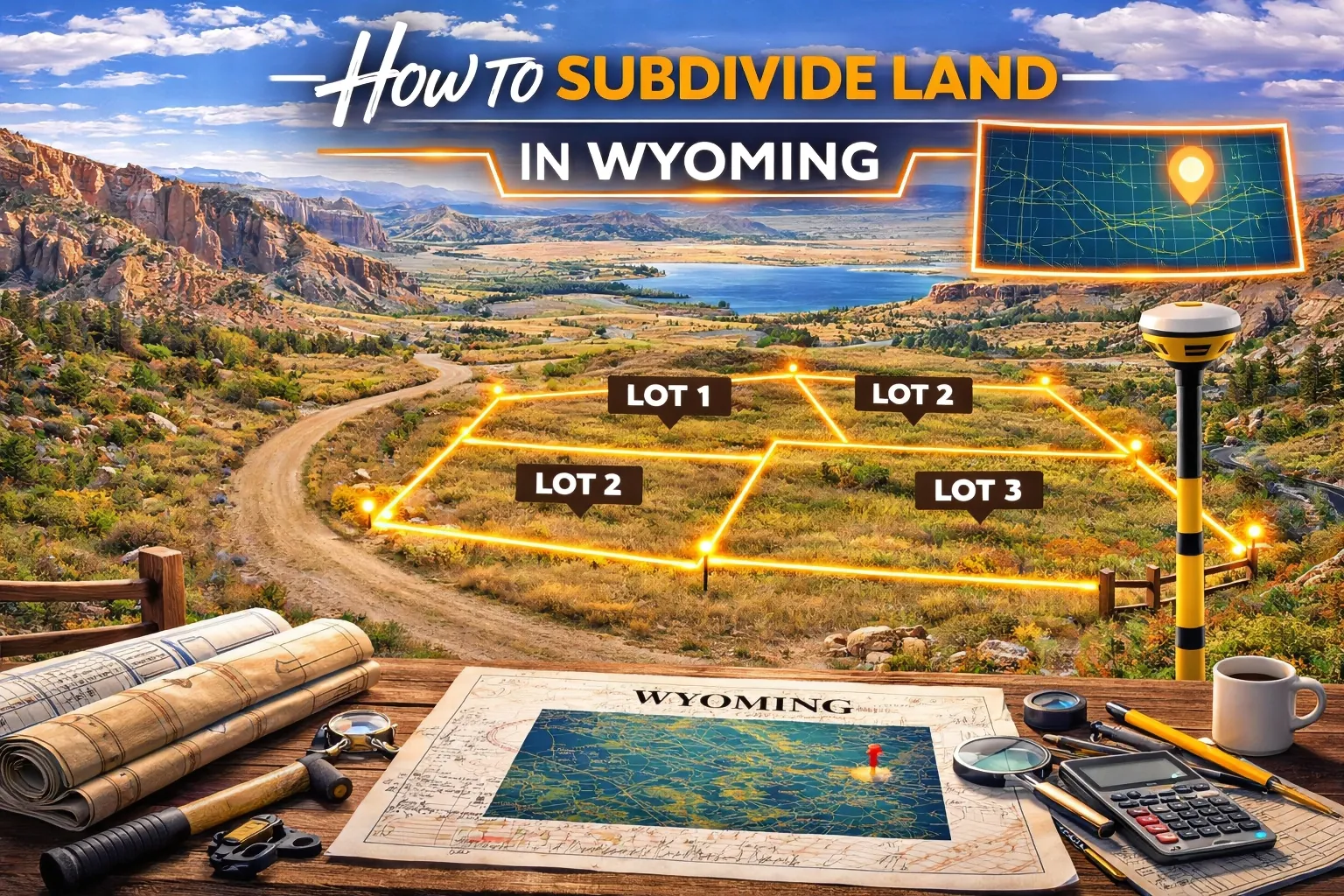
Subdividing land in Wyoming requires strict adherence to state statutes and specific county regulations. Whether you want to carve out a lot for a family member or maximize your property’s overall market value, understanding the Wyoming Real Estate Subdivision Act is your primary step. This guide details the laws, critical exemptions, the step by step permitting process, and the exact costs of splitting a parcel in the Cowboy State.
Understanding Wyoming Land Subdivision Laws
The Wyoming Real Estate Subdivision Act
Wyoming Statute (W.S.) 18-5-301 places the authority to regulate subdivisions squarely in the hands of the board of county commissioners for all unincorporated areas. This act establishes the foundational baseline rules for dividing land, ensuring that all new developments protect public health, safety, and orderly regional growth.
County Level Control vs. State Law
While the state sets the minimum legal standards, individual counties hold the authority to enforce much stricter zoning and subdivision regulations. Counties like Park County, Laramie County, or Fremont County have distinct requirements for minimum lot sizes, setbacks, and infrastructure that build upon state law. You must comply with both the broad Wyoming statutes and your local county’s specific subdivision resolution.
Defining a Subdivision in Wyoming
Under Wyoming law, a subdivision is legally defined as the creation or division of a lot, tract, parcel, or other unit of land for the immediate or future purpose of sale, building development, or redevelopment. This definition encompasses residential, recreational, industrial, commercial, and public uses. Creating even one new lot out of an existing parcel officially triggers the subdivision review process unless your project qualifies for a specific legal exemption.
Wyoming Subdivision Exemptions You Need to Know
The 35 Acre Exemption
The most widely utilized exemption in Wyoming is the 35 acre rule. Under W.S. 18-5-303, divisions of land where all resulting parcels are 35 acres or larger are generally exempt from the standard, lengthy subdivision permitting process. The strict requirement for this exemption is that each newly created parcel must have a formally recorded ingress, egress, and utility easement of at least 40 feet to guarantee legal access.
Large Acreage Regulations
Counties have the legislative option to regulate divisions of parcels between 35 and 140 acres under W.S. 18-5-316. If your county has adopted these specific large acreage provisions, you will need a subdivision permit for large acreage splits. These county reviews focus heavily on proving adequate groundwater supply, safe sewage disposal, and guaranteed legal access.
The Immediate Family Exemption
Wyoming allows landowners to divide land for a single gift or sale to an immediate family member without triggering major subdivision rules. Legislative updates passed in 2019 changed the title holding requirements. For land titled on or after February 27, 2019, the grantor must have held the property title for at least 10 years prior to the division. The family member receiving the land must then retain ownership for a minimum of 5 years. This division must directly provide for the housing, business, or agricultural needs of the grantee.
Agricultural Use Exemptions
Divisions of land executed strictly for agricultural purposes frequently bypass standard development regulations. This legal provision ensures that active ranching and farming operations can manage their land boundaries efficiently without facing the heavy regulatory burdens intended for residential housing developments.
Boundary Line Adjustments
Moving a property line between two existing adjacent parcels does not constitute a new subdivision. This adjustment process requires a professional survey and a newly recorded deed to merge the adjusted land into the existing parcel. A boundary line adjustment cannot create an additional new parcel of land.
The Step by Step Process to Subdivide Land in Wyoming
Step 1: Consult with the County Planning Department
Schedule a pre application meeting with your local county planning office before spending money on engineering. This initial discussion will clarify the current zoning of your property, verify minimum lot sizes, and identify the specific application requirements for your exact jurisdiction.
Step 2: Hire a Licensed Wyoming Surveyor
A professional, state licensed land surveyor is legally required to draft the new legal descriptions and preliminary plats. They will mark the physical boundaries on the ground and ensure the newly proposed lot lines meet all county setback and access requirements.
Step 3: Conduct Soil and Groundwater Testing
Counties mandate proof that the new lots can safely support modern development. You must secure percolation tests for septic system suitability and a groundwater study to verify the availability and quality of well water. The Wyoming Department of Environmental Quality (DEQ) frequently reviews these studies, especially for subdivisions creating more than five parcels.
Step 4: Submit the Preliminary Plat
Compile your comprehensive application package for county review. A standard minor subdivision submission includes the following items:
- The completed county application form and all associated fees.
- A certified title report proving clear ownership.
- The preliminary plat map drafted by your surveyor.
- Written proof of utility availability from local service providers.
- Certified soil and groundwater test results.
Step 5: Complete Public Notice and Hearings
Wyoming law demands transparency in land development. You are required to publish a Notice of Intent to Subdivide in the legal notice section of a local newspaper once a week for two consecutive weeks within 30 days prior to filing your application. Following the formal submission, you will present your development plan at public hearings before the planning commission and the board of county commissioners.
Step 6: Record the Final Plat
Once the board of county commissioners officially approves your subdivision application, you will finalize the legal documents. Recording the approved final plat and the new property deeds with the county clerk officially and legally creates the new parcels.
Crucial Requirements for a Successful Subdivision
Legal Access and Easements
Every new parcel must have guaranteed, permanent access. You must provide legally recorded ingress and egress easements connecting each new lot directly to a maintained public road system. Landlocked parcels are prohibited by state statute.
Water Rights and Well Permits
Water usage is highly regulated in the West. You must coordinate with the State Engineer’s Office to secure proper well permits for the newly created lots. Your subdivision application must clearly prove that drawing groundwater for the new parcels will not negatively impact existing, neighboring wells in the area.
Utilities and Infrastructure Planning
You bear the responsibility of demonstrating exactly how the new lots will receive essential daily services. This involves securing formal letters from local utility providers confirming the availability and future extension of electricity, gas, garbage disposal, and emergency fire protection services.
Minor Subdivisions vs. Major Subdivisions
Minor Subdivisions (Simple Subdivisions)
Most Wyoming counties classify a minor or simple subdivision as a division resulting in five or fewer lots, with each lot being smaller than 35 acres. The application process for a minor subdivision is streamlined, requires less environmental documentation, and typically takes fewer months to complete.
Major Subdivisions (Regular Subdivisions)
Creating six or more lots constitutes a major subdivision. This classification triggers a rigorous, comprehensive review process. You will face heavy scrutiny regarding localized traffic impacts, broad environmental concerns, and large scale infrastructure planning. Major subdivisions require extensive civil engineering studies, DEQ water quality reviews, and significant upfront capital to execute.
How Much Does It Cost to Subdivide Land in Wyoming?
The total financial expense of subdividing land varies significantly based on total acreage, terrain complexity, and individual county fee structures. Review the breakdown of the typical costs you can expect when subdividing a standard parcel into a simple minor subdivision.
Surveying Fees
Professional land surveyors in Wyoming generally charge between $1,500 and $5,500 for a boundary and topographic survey. Heavily wooded or mountainous terrain will push the surveying costs to the higher end of that spectrum.
Engineering and Testing Costs
Percolation tests for septic systems and complex groundwater studies require specialized environmental professionals. These mandatory viability tests typically range from $1,000 to $3,500 depending on the soil composition.
County Application Fees
Application fees are set individually by each board of county commissioners. A simple minor subdivision application may cost $150 to $800, plus additional recording fees per lot.
| Expense Category | Estimated Cost Range |
|---|---|
| Professional Boundary & Plat Survey | $2,000 to $5,500 |
| Soil (Perc) & Groundwater Testing | $1,000 to $3,500 |
| County Application & Review Fees | $250 to $800 |
| Public Notice Publishing & Recording | $150 to $400 |
| Total Estimated Cost | $3,400 to $10,200 |
Weighing Your Wyoming Land Options
Subdividing land in Wyoming is a complex process that demands significant time, capital, and patience to navigate local government bureaucracy. For landowners who prefer to avoid upfront engineering fees and months of public hearings, selling the property as is offers a straightforward exit strategy. Bubba Land Company buys rural acreage, hunting land, and inherited properties directly for cash. If you want to bypass the stress of development and secure a hassle free sale, get your fair cash offer today.
Beyond The Cowboy State: Regional Parcel Splitting Guides
Expanding your rural real estate portfolio outside of Wyoming means navigating a new set of county zoning laws and environmental protections. Splitting acreage across the High Plains and Northern Rockies requires a firm grasp of specific municipal codes and agricultural exemptions. Whether you are partitioning mountain recreational tracts or vast tillable farmland, mastering these regional lot division rules is essential for maximizing your property’s overall value. Use our comprehensive resources below to confidently execute parcel divisions across adjoining states.
- Colorado Parcel Splitting: Navigate the Centennial State’s specific county regulations and land use policies to successfully separate your plains or mountain property.
- Montana Lot Division: Understand the Treasure State’s subdivision laws and local planning board requirements to efficiently carve up your big sky acreage.
- Nebraska Land Separation: Master the Cornhusker State’s local planning requirements to smoothly divide your agricultural tracts and ranchland.
- South Dakota Lot Division: Conquer the Mount Rushmore State’s platting rules to successfully separate your rural investment tracts.