North Dakota Fence Laws: Neighbor Disputes & Your Rights
Overview: North Dakota fence laws are primarily governed by Chapter 47-26 of the North Dakota Century Code, which defines what qualifies as a lawful fence, how partition fences are shared between neighbors, and how disputes are resolved through township fence viewers. These rules matter most in rural and agricultural areas, where fences are often legally required rather than optional.
Key Points:
- Legal Fence: North Dakota law specifies several lawful fence types, including barbed wire, smooth wire, electric, and equivalent fencing capable of restraining livestock.
- Partition Fence Duty: Adjoining landowners are generally equally responsible for maintaining a boundary fence unless one elects to let land lie open.
- Fence Viewers: In organized townships, fence disputes follow a formal statutory process overseen by township supervisors.
Side Note: If fence disputes are stalling your plans, you can sell your North Dakota land directly to Bubba Land Company for a simple exit.

What Is a “Legal Fence” Under North Dakota Law
North Dakota law is unusually specific about what qualifies as a lawful fence, because fence status directly affects cost-sharing, enforcement, and livestock liability. Chapter 47-26 recognizes several fence types as lawful if they are built and maintained to restrain livestock effectively. These include wood or board fences, wire fences, electric fences, and any structure fence viewers deem equivalent in strength and function.
For wire fencing, the statute outlines minimum strand counts and spacing. A typical lawful barbed-wire fence consists of multiple tightly stretched strands securely fastened to posts set at reasonable intervals. Electric fences are also lawful when properly installed and maintained. The key issue in most disputes is not the fence style itself, but whether the fence is in usable condition at the time a dispute arises.
Partition Fences and Shared Responsibility
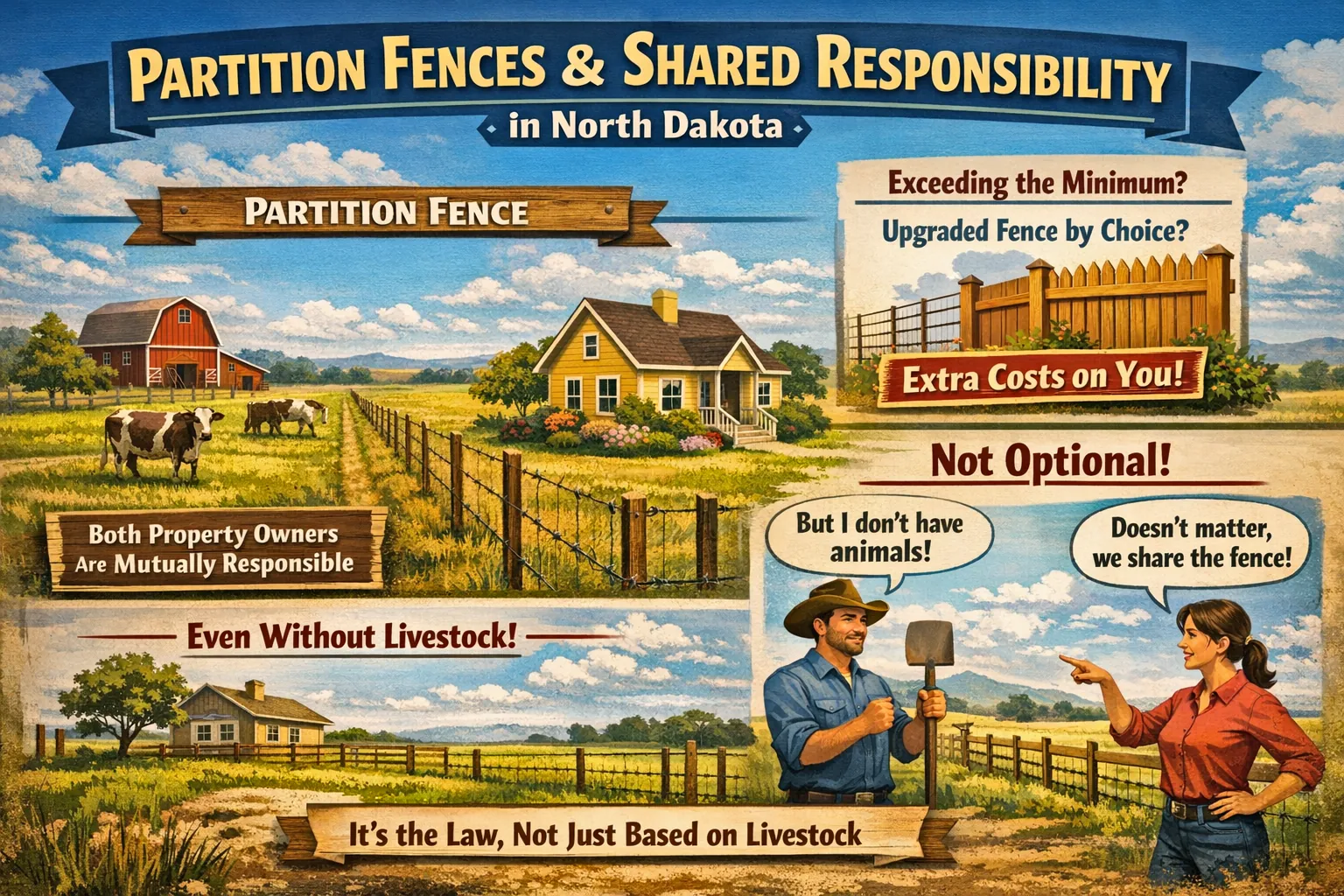
Under North Dakota law, adjoining landowners share an equal duty to build and maintain a partition fence separating their enclosed properties. This mutual obligation applies to both owners regardless of who actually owns livestock. If a neighbor requests a fence that exceeds legal minimums for height or aesthetics, they must pay for those upgrades themselves. Cost-sharing depends entirely on the fence’s legal status and land use context.
Fence Viewers and the Dispute Resolution Process
In organized townships, fence disputes are handled through a formal process involving township supervisors acting as fence viewers. If you believe your neighbor is failing to maintain their share of a partition fence, the statute provides a step-by-step remedy rather than self-help.
The process generally works as follows: a complaint is made to the fence viewers, notice is given to the other landowner, the fence is inspected, and a written determination is issued with a deadline for repairs. If the responsible party fails to act, the complaining owner may complete the work and seek reimbursement after the fence viewers certify sufficiency. Costs can be recovered through demand and, if necessary, court action, with statutory interest applied.
Organized vs. Unorganized Townships
Not all areas of North Dakota have functioning fence viewers. In unorganized townships, the statutory fence-viewer mechanism does not exist. In these areas, landowners must rely on private agreements, mediation, or district court to resolve fence disputes. This distinction is critical and often overlooked, as it determines whether the statutory enforcement pathway is available at all.
A practical next step is to confirm township status through local records such as county or township offices. Knowing whether the fence-viewer route is available can change your strategy immediately, and it helps you avoid wasting time pursuing a process that does not apply where you live.
Agricultural vs. Residential Fence Rules
The big takeaway is that state partition-fence rules typically matter most outside cities, while city lots are usually governed by local code, permits, and sometimes HOA rules. If you’re in town, always check your municipality first.
Fence Lines vs. Property Lines
One of the most misunderstood aspects of North Dakota fence law is that a fence does not automatically become the legal boundary. Courts consistently hold that deeds and surveys control property lines. A fence may become evidence in a boundary dispute, but only under narrow doctrines such as boundary by acquiescence or adverse possession, both of which require clear proof over long periods.
If your dispute is really about location (not condition), the smartest move is usually to obtain a survey before escalating. A fence that “has always been there” can still be inside the true boundary line. In many cases, moving or removing a fence without clarity creates more legal exposure than it solves.
Checklist: Before You Challenge a Neighbor’s Fence
- Lawful Fence: Does the fence meet one of the lawful fence definitions under NDCC Chapter 47-26?
- Partition Fence: Is the fence on a shared boundary between enclosed properties?
- Township Status: Is your land in an organized township with fence viewers?
- Condition Issues: Is the problem maintenance, placement, or both?
- Documentation: Do you have photos, surveys, and written notices ready?
🛠️ Free Resource: The Professional Fence & Boundary Audit 🛠️
Don’t risk legal liability or neighbor disputes by guessing. We’ve developed this comprehensive 4-phase field guide to help you audit boundaries, verify compliance, and document communication like a pro.
📥 Download the Printable PDF Audit
Print this out to use as a worksheet while you walk your property line.
North Dakota Fence Law Case Studies: Real Court Decisions
These North Dakota Supreme Court decisions show how fence disputes are resolved in real cases. The consistent theme is that a fence can be important evidence, but it does not automatically control ownership or boundaries. Courts focus on mutual recognition over time, the required legal period, and whether a survey or deed line ultimately controls.
Kubik v. Hauck (2022)
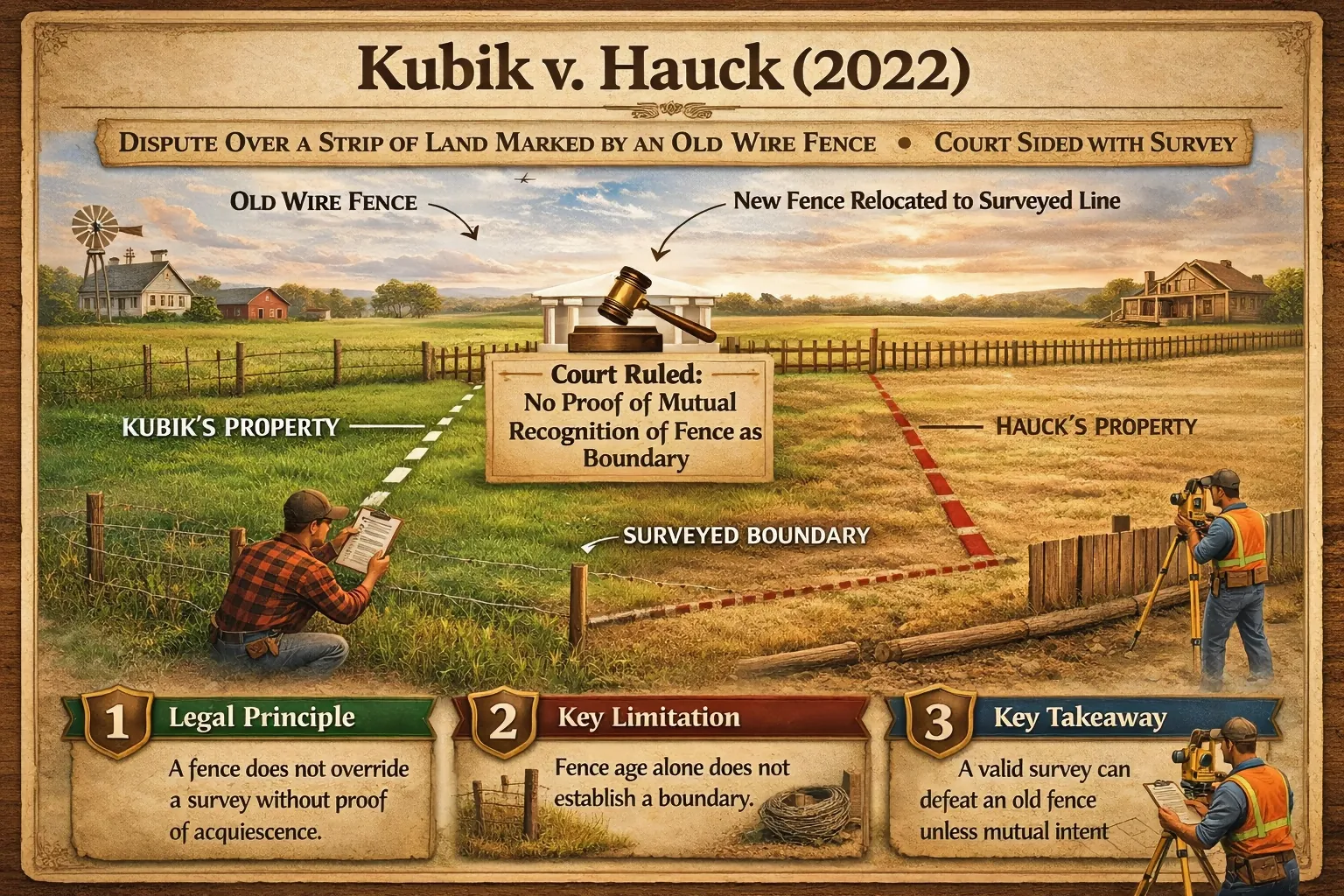
In Kubik v. Hauck, neighbors disputed a strip of land where an old wire fence sat several feet inside one owner’s surveyed property. After purchasing the land, Hauck obtained a survey, removed the fence, and rebuilt it on the surveyed line. Kubik argued the old fence had become the boundary through acquiescence, but the court rejected that claim, holding there was no clear and convincing evidence of mutual recognition of the fence as the boundary.
Sauter v. Miller (2018)
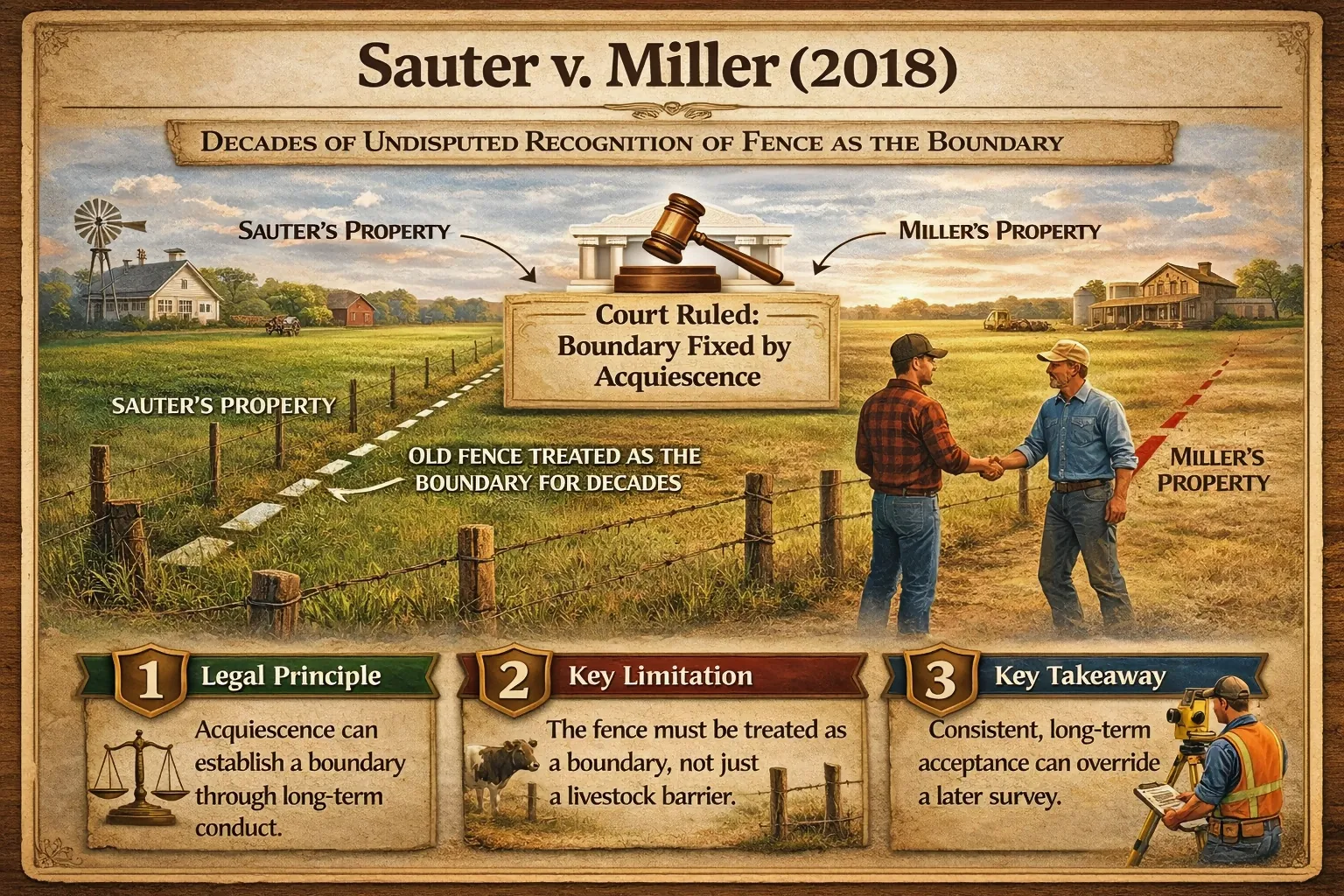
In Sauter v. Miller, an original fence had existed for decades and was consistently treated by both properties as the boundary line. After the fence was removed, Sauter claimed the boundary had been fixed by acquiescence. The court agreed, emphasizing the long-term conduct of both sides and finding decades of undisputed recognition that the fence marked the boundary.
James v. Griffin (2001)
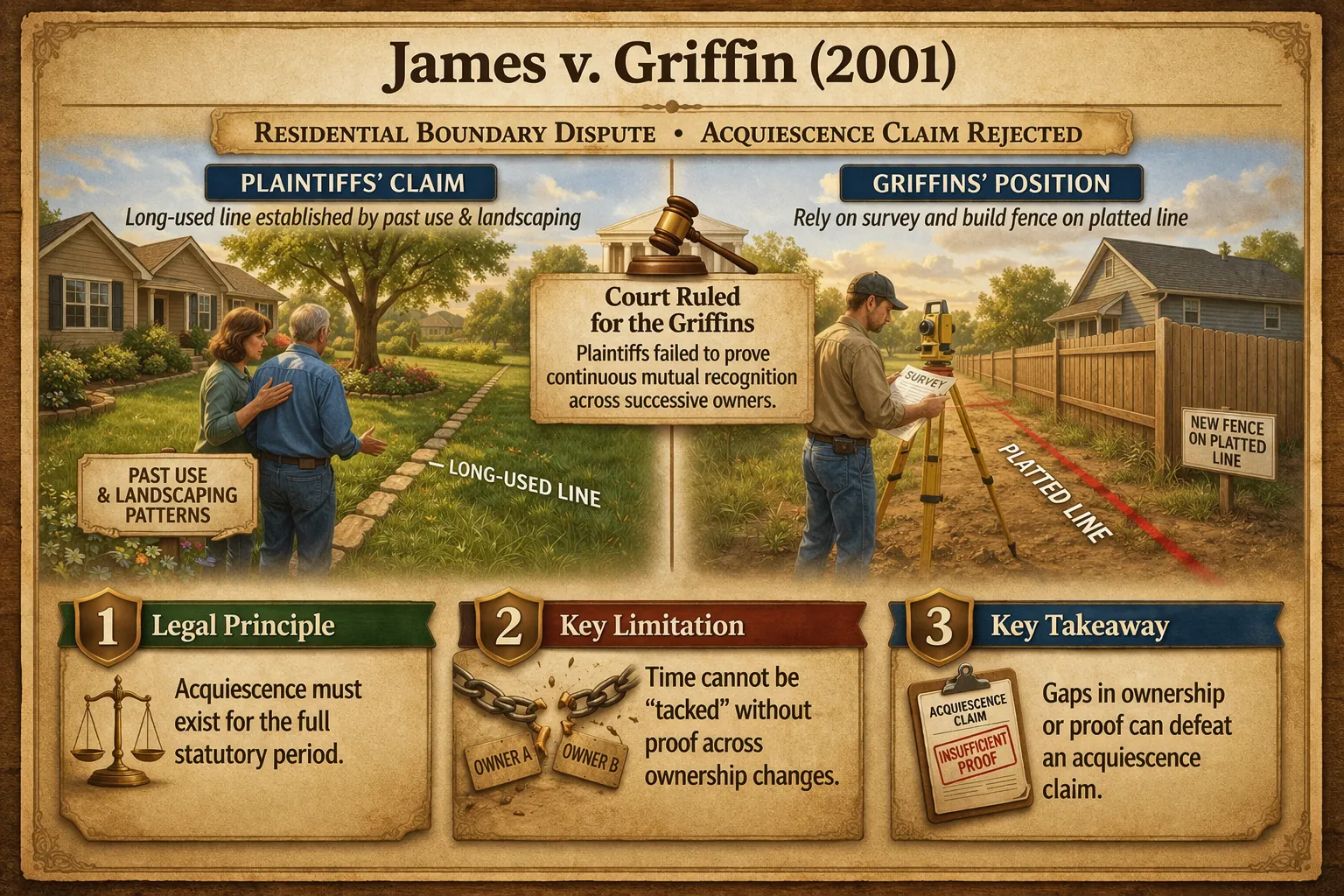
In James v. Griffin, a residential dispute focused on whether a long-used line became the boundary through acquiescence. The plaintiffs relied on past use and landscaping patterns, while the Griffins relied on a survey and built a fence on the platted line. The court ruled for the Griffins because the plaintiffs failed to prove continuous mutual recognition across successive owners.
FAQs: North Dakota Fence Laws
Do I have to pay for half my neighbor’s fence in North Dakota?
If the fence is a lawful partition fence between enclosed properties, adjoining owners generally share responsibility equally unless one has elected to let their land lie open.
What is a fence viewer?
Fence viewers are township supervisors who inspect disputed fences, issue written decisions, and certify repairs in organized townships. Their findings are often central to cost recovery when one owner repairs a fence the other refused to maintain.
Can I tear down a fence I believe is on my property?
Be careful. Removing a fence without confirming the boundary through a survey can expose you to liability if the fence is treated as a boundary marker or if the removal escalates a dispute. When in doubt, treat the fence as contested and gather documentation first.
Does a fence establish the property line?
No. Surveys and deeds control. A fence only becomes relevant if strict legal doctrines are proven, and those doctrines require strong facts over time—not assumptions.
Do city fence rules override state law?
Yes, in most situations. Within city limits, municipal ordinances typically control height, materials, setbacks, and permits. Even if the fence would be “lawful” under state standards, local code can still restrict it.
Ready to Skip the Boundary Disputes?
North Dakota fence laws blend state statutes and local township rules that require careful navigation. Always verify your township’s status and confirm your boundary lines with a professional survey before taking action. Relying on proper documentation is the best way to protect your property rights and avoid costly legal disputes.
If neighbor conflicts make your property a burden, you can sell your North Dakota land directly to Bubba Land Company. We provide a hassle-free cash sale so you can bypass traditional real estate fees and long timelines. Reach out today for a fair valuation and exit your situation cleanly.