Wisconsin Fence Laws: A Practical Guide (2026)
At a Glance: Wisconsin fence laws are primarily governed by Chapter 90 of the Wisconsin Statutes and Section 844.10, which prohibits spite fences. When either adjoining property is used for farming or grazing, both neighbors share equal responsibility for building and maintaining the boundary fence—regardless of who owns livestock.
Fast Facts:
- Right-Hand Rule: When facing your neighbor’s property, you maintain the right half of the fence line (Section 90.07).
- Partition Fence Costs: Split equally 50/50 between neighbors when either property is used for farming or grazing.
- Spite Fences: Structures over 6 feet erected maliciously to annoy neighbors are prohibited statewide.
Worth Noting: If fence obligations and unclear boundaries feel overwhelming, you can sell your Wisconsin land directly to Bubba Land Company and avoid the legal complexities entirely.

Understanding Wisconsin’s Partition Fence Requirements
Wisconsin fence law is simple but often unexpected: if either neighboring property is used for farming or grazing, both owners must share responsibility for a partition fence under Section 90.03—even if only one owns livestock.
This means a neighbor can begin grazing animals and, by law, you become responsible for maintaining half of the boundary fence whether you wanted one or not. Chapter 90 treats partition fences as a shared obligation because they protect livestock and define property boundaries. Because these 50/50 cost-sharing rules can be an unexpected financial burden for sellers, many owners choose to sell their land as-is rather than investing in a boundary fence right before a sale.
What Is a Lawful Fence in Wisconsin?
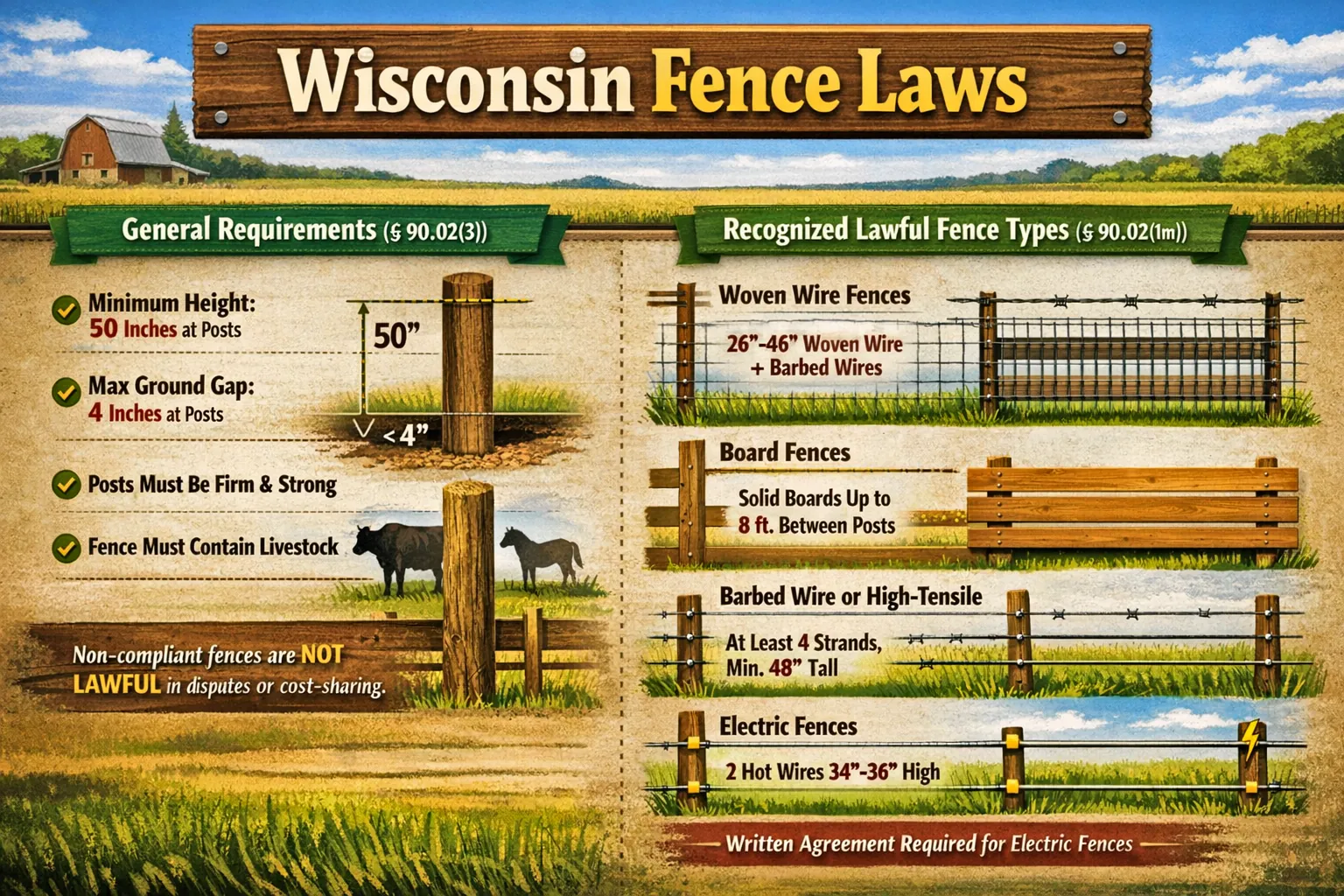
Under Wisconsin Statute § 90.02, a lawful fence (also called a legal or sufficient fence) must meet specific standards to effectively restrain common livestock such as horses, cattle, sheep, and hogs. These requirements apply statewide to boundary and partition fences unless adjoining owners agree otherwise in writing.
General Requirements
- Minimum height: 50 inches (measured at the posts)
- Maximum ground gap: 4 inches (measured at the posts)
- Posts must be firmly set and of sufficient strength
- The fence must reliably contain livestock
If any of these standards are not met, the fence is not lawful in boundary disputes, liability issues, or cost-sharing matters.
Recognized Lawful Fence Types
Woven Wire Fences
Strong woven wire (strands ≥ No. 12, cross wires ≥ No. 16; strands ≤ 8 inches apart, cross wires ≤ 12 inches apart; tightly stretched; posts ≤ 16 feet apart or 20 feet for high-tensile wire):
- 26-inch woven + 3 barbed/high-tensile wires above
- 30-inch woven + 2 barbed/high-tensile wires above
- 46-inch woven + 1 barbed/high-tensile wire above
- 50-inch woven (no additional wires needed)
Board Fences
Boards firmly fastened to posts ≤ 8 feet apart:
- Spacing ≤ 6 inches up to 30 inches high
- Spacing ≤ 10 inches above 30 inches
Barbed Wire or High-Tensile Wire Fences
At least 4 evenly spaced wires on steel posts (any diameter) or wood posts ≥ 3 inches diameter:
- Minimum height: 48 inches
- (The general 50-inch height rule typically applies in practice)
Electric Fences
2 tightly stretched strands charged by an approved electric or battery fencer; posts firmly set with insulators ≤ 2 rods (~66 feet) apart:
- Top wire height: 34–36 inches from ground (measured at post)
- Key restriction: Only qualifies as a lawful boundary/partition fence with written agreement from both adjoining owners—without it, the fence does not qualify
Agricultural vs. Residential Fence Regulations
Wisconsin fence law operates on two distinct tracks depending on property use.
Key Distinction: Chapter 90 only applies when property is used for farming or grazing. Once land converts to purely residential use, Chapter 90 obligations end, and municipal ordinances take over.
Residential Fence Rules
Chapter 90 covers farm and partition fences statewide in Wisconsin. Residential fences follow local city, village, or town zoning rules—no uniform statewide height limit. Always check with your local building or zoning office first before installing or replacing a fence.
Typical Height Limits
- Madison: Back/side yards: max 6 ft • Front yards: max 4 ft for solid fences • Corner lots: max 30 in within 25 ft of intersections for visibility.
- Milwaukee: Back/side yards: up to 6 ft • Front yards: up to 4 ft • Commercial/industrial zones: up to 8 ft.
General Patterns Across Wisconsin
- Front yards: usually 3–4 ft max for solid fences
- Side/rear yards: often 6–8 ft max for privacy
- Pool enclosures: minimum 4 ft high with self-closing, self-latching gates required for safety
- Corner lots: reduced heights in visibility triangles near intersections to prevent accidents
Permit Requirements in Wisconsin
Most Wisconsin municipalities require a permit for new, replacement, or major fence work—even small changes can trigger one. Permits ensure compliance with height, setback, material, and safety rules. Common requirements include submitting a site plan (showing location, height, material), property survey or plat, and paying a fee. Work often needs inspection after installation.
Real examples from Wisconsin cities (based on current municipal codes):
- Green Bay: Residential fence permit required ($75 fee); site plan needed showing location, height, material; “good side” must face neighbor; valid for 1 year, start work within 6 months.
- Kenosha: Permit required for all fence-type structures (including arbors/trellises); work must be completed within time limits set by the permit.
- Marinette: Zoning permit required ($40 fee); fences in alleys need 4 ft setback from property line; corner lots may require vision triangle setbacks.
- Glendale: Residential fence permit $105; no permit if ≤3 ft high; rear/side up to 6 ft, front 3 ft.
- Wisconsin Rapids: Residential fence permit $40; detailed site plan required; inspection needed after installation.
Consequences of no permit: Fines (often $50–$500+ depending on city), stop-work orders, or forced removal/reconstruction at your expense. Some cities double fees for unpermitted work. Always verify locally—rules can change and vary by zoning district.
Spite Fences
Wisconsin law (Section 844.10) declares any fence, hedge, or similar structure that is unnecessarily over 6 feet high and maliciously erected or maintained to annoy neighbors a private nuisance.
Even fences shorter than 6 feet can be ruled spite fences if clear malice is proven (see Schultz v. Trascher, 2002 WI App 4).
Real Court Cases
- Apple Hill Farms v. Price (2012 WI App 69): A 12-foot-high, 32-foot-long bare concrete wall was declared a spite fence. The owner admitted wanting it “ugly” to devalue the neighbor’s property and sprayed weed killer to spell an insult on their lawn. Court awarded $15,000 compensatory + $100,000 punitive damages.
- Schultz v. Trascher (2002 WI App 4): A 4-foot fence was found to be a private nuisance due to malicious intent. Court ordered partial removal and payment of costs.
- Metzger v. Hochrein (1900, Wisconsin Supreme Court): A 16-foot-high spite fence of rough tamarack posts was initially upheld as legal under the old common-law rule (no prohibition on spiteful structures). This case directly led to the enactment of Wisconsin’s spite fence statute in 1903 to ban such malicious barriers.
What Courts Consider
- Was the fence built right after a neighbor dispute?
- Does it serve any legitimate purpose (like privacy or security)?
- Is it intentionally ugly, oversized, or obstructive?
- Does it maliciously block light, views, or access?
- Did the owner make statements showing spiteful intent?
If you suspect a spite fence, gather evidence (photos, timing relative to disputes, neighbor statements) and consider filing a civil lawsuit for removal, damages, and court costs.
Fence Viewer System in Wisconsin
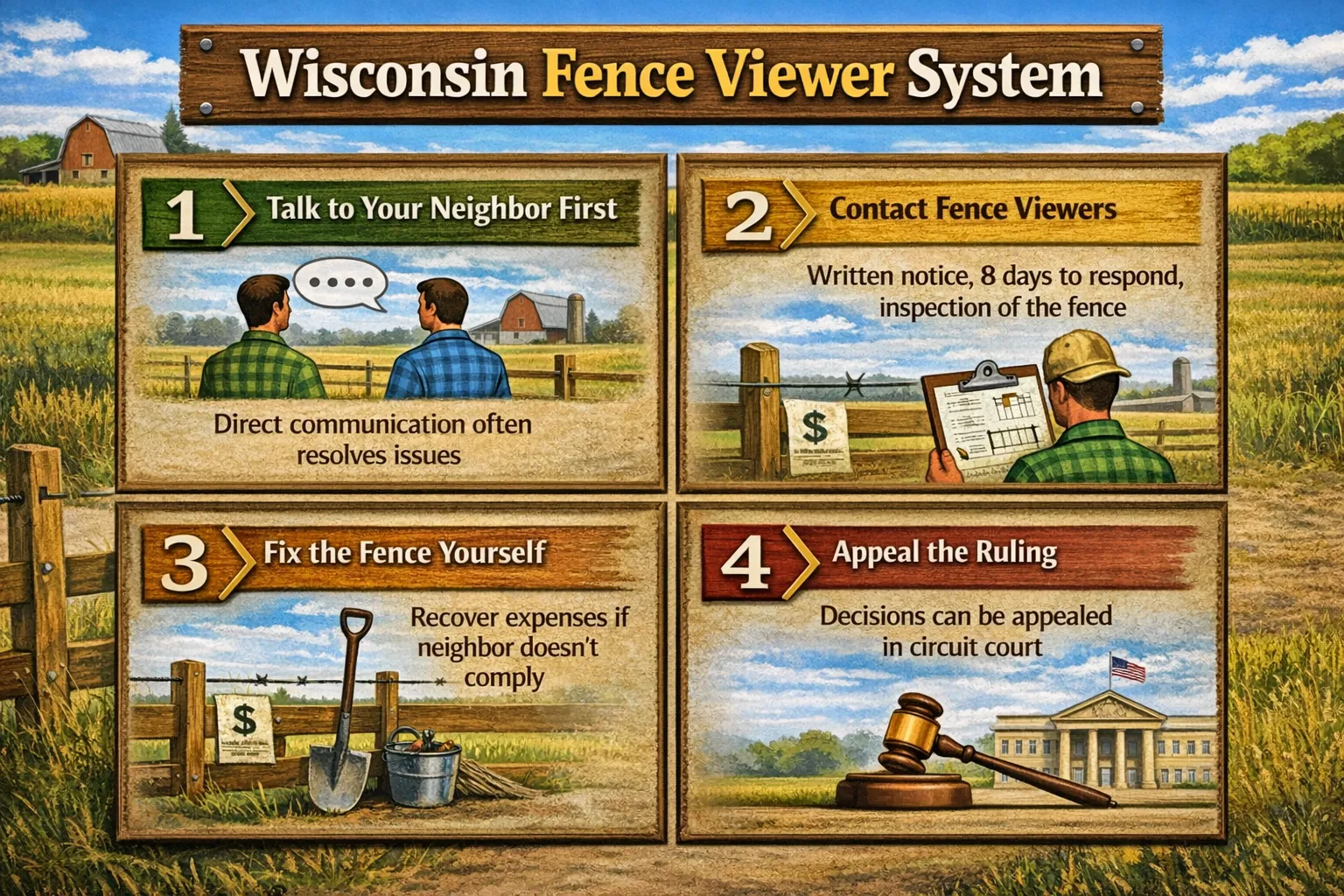
While state law (Chapter 90) sets the baseline, specific rural towns within counties like Dane, Marathon, and Waukesha often have their own local nuances for how Fence Viewers settle disputes. We’ve seen cases in Brown County where the ‘Right-Hand Rule’ was contested because of a change in land use, which is why having a clear agreement is so vital. Under Section 90.07, these local officials (typically town supervisors, village trustees, or alderpersons) act as a fast, low-cost alternative to court. If you find yourself in a disagreement, here is the process:
Process
- Talk to your neighbor first — many issues resolve with direct communication.
- Contact fence viewers — they give 8 days’ written notice to both parties, inspect the fence or proposed fence, decide responsibilities (who builds/repairs what portion), set reasonable deadlines, and file their decision with the town clerk.
- If the neighbor fails to comply — you can complete the work yourself and recover your costs (often as a lien on their property if unpaid).
- Appeal option — decisions can be appealed to circuit court within the time specified in the viewers’ ruling.
Important limit: Fence viewers only handle fence construction, repair, and cost-sharing disputes — they have no authority to determine property lines. For boundary questions, hire a licensed surveyor.
Property Lines & Encroachment
Building a fence over the property line can lead to serious legal issues, including adverse possession claims where the neighbor may gain ownership of the disputed land after 20 years of continuous, open use under certain conditions.
Under Section 90.06, if a fence is discovered to be on the neighbor’s land:
- The original builder remains the owner of the fence materials.
- They must relocate it within 30 days of receiving written notice.
- If they don’t, the landowner can relocate it and recover reasonable expenses.
- Exception: Relocation is not required during times when it would damage growing annual crops (unless the neighbors agree otherwise).
Quick Reference: Wisconsin Fence Law Summary
Checklist: What to Do Before You Build a Fence in Wisconsin
Follow these steps to ensure your fence remains legally compliant and dispute-free:
- Determine Property Use: Verify whether your property or your neighbor’s is used for farming or grazing (triggers Chapter 90 requirements).
- Hire a Surveyor: Never build based on assumptions or visible markers; get a professional boundary survey.
- Check Municipal Ordinances: Contact your local building/zoning department to verify height limits, setback requirements, and permit needs.
- Communicate with Neighbors: Discuss fence plans, materials, and cost-sharing before construction begins.
- Written Agreements: If negotiating non-standard arrangements, put them in writing, have them witnessed, and file with the town clerk.
- Call 811: Always have underground utility lines marked before digging post holes.
- Verify HOA Rules: If your property is subject to homeowners’ association covenants, ensure compliance with their fence restrictions.
- Obtain Permits: If your municipality requires fence permits, obtain them before construction to avoid fines or removal orders.
🛠️ Free Resource: The Professional Fence & Boundary Audit 🛠️
Don’t risk legal liability or neighbor disputes by guessing. We’ve developed this comprehensive 4-phase field guide to help you audit boundaries, verify compliance, and document communication like a pro.
📥 Download the Printable PDF Audit
Print this out to use as a worksheet while you walk your property line.
FAQs for Wisconsin Fence Law
Do I have to pay for half of my neighbor’s fence in Wisconsin?
Yes, if either property is used for farming or grazing. Wisconsin Statute 90.03 requires a 50/50 cost split for both owners, regardless of livestock ownership. Purely residential properties only share costs if required by local ordinances or HOA rules.
What is the “Right-Hand Rule” in Wisconsin fence law?
Wisconsin Statute 90.07 uses this rule to divide partition fence maintenance. When facing your neighbor’s land, you maintain the right half of the fence line. Your neighbor maintains the left. You can modify this arrangement with a written agreement filed with the town clerk.
Can I build a fence directly on the property line in Wisconsin?
Yes, Chapter 90 partition fences are usually built right on the boundary line. Always get an accurate survey first to avoid encroachment. Check local municipal ordinances, as some require specific setbacks for residential fences.
What happens if my neighbor refuses to pay for a shared fence?
Under Wisconsin Statute 90.07, you can contact local “fence viewers” (town supervisors, alderpersons, or village trustees) to intervene. They will inspect the property, make a binding cost-division decision, and set payment deadlines. If your neighbor still refuses, Section 90.11 allows you to complete the work yourself and place a lien on their property to recover your costs.
Are “spite fences” illegal in Wisconsin?
Yes. Wisconsin Statute 844.10 prohibits maliciously erected fences exceeding 6 feet tall designed to annoy neighbors. Courts also classify shorter fences as illegal spite fences if built with malicious intent. The defining factor is whether the fence serves a legitimate purpose or was built solely for harassment.
The Simple Alternative to Wisconsin Boundary Disputes
Wisconsin fence laws blend complex agricultural statutes with modern zoning regulations, often requiring significant time and effort to navigate Chapter 90 rules, local setbacks, and boundary surveys. You can bypass these obligations entirely by selling your Wisconsin land directly to Bubba Land Company. We purchase your property for cash in its current condition and manage all the legal details on your behalf.